The door of his bedroom was unlocked.
He noticed it on the way back from the bathroom. He had reached for the handle expecting the bolt and the bolt had not been there. He let the door swing all the way open. He stood in the doorway. He listened.
The corridor was empty.
A test, then. A small one. He stepped into the corridor in his stocking feet and his shirtsleeves and walked as far as the spiral stair at the end of it. There were security cameras at the second sconce and at the fourth sconce and at the head of the stair. He had mapped them yesterday. He looked into none of them. He went down the stair.
A movie was playing on the television in the lounge below his floor, a phony-looking war movie with men in helmets that were not the right helmets for the country the men were saying they were in, and Nick paused at the doorway out of habit and registered the picture and went on. The torch sconces in the corridor were modern. The flicker was modern. The cold under his stocking feet was the original stone of the original castle and was, it turned out, reliably cold, no matter what century you stood on it in.
He stepped out onto the parapet.
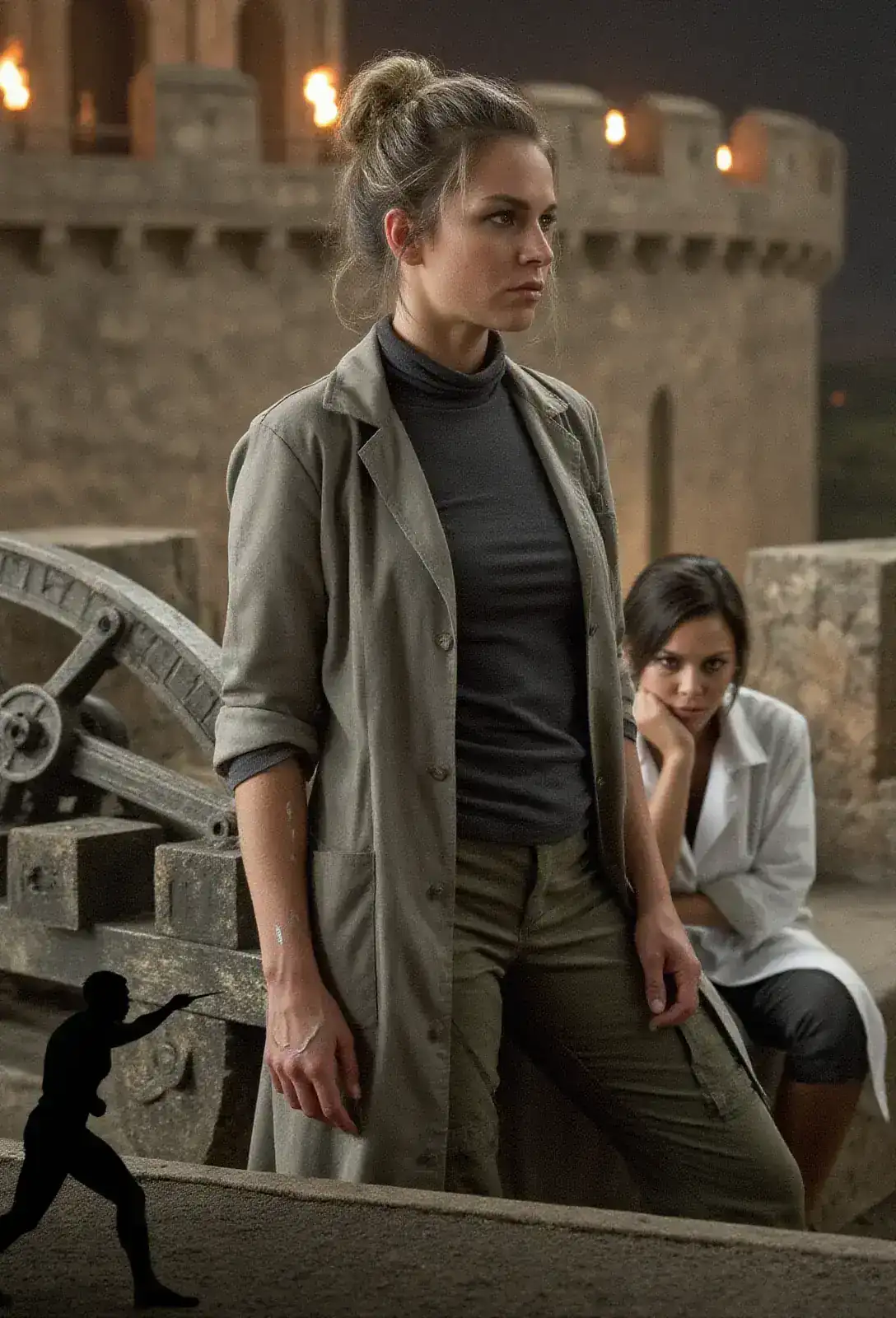
Maya was at the catapult.
She was sitting at the base of it with her chin on her wrist and her wrist on her knee and her eyes on the lights of the small mountain town two thousand feet below the wall. She had not changed out of the lab coat. Her hair was down. Her hair was longer than he had thought and the wind off the gorge was working at the side of it.
He came up beside the catapult and tapped the worn oak arm of it.
“I could send you over the moat with this if you’d like.”
She looked up. The smile came.
“I may take you up on that.”
“That’s not the Grendel International spirit I’m hearing.”
She glanced down into the courtyard. Kroner was leaning against the wall under a torch with a cigarette he was, this time as last time, not smoking. He was reading the parapet by ear. Nick met her eyes and nodded once. They both understood. The conversation they had on the parapet was for two audiences.
“Had a few setbacks today,” she said again, although they had said it last night.
“What kind.”
“The kind where you put a harness on an animal and then somebody jolts the harness.”
“Zeiss.”
“Zeiss.”
“Joyce will not cut him.”
“Joyce will not cut him.”
She stood. She moved past the catapult and they walked, slow, the parapet end to end. The walk was a walk they had practiced. The walk had its own language. They walked in the language.
“How does one get to be a dinosaur trainer?” he said, the same question he had asked her the night before, and she gave him the same answer because the second audience had not heard it yet. Wolves in Saskatchewan. The doctorate. The big cats. The trapeze artist she had needed to leave. Nick made the listening sounds he had not made the night before because he had been listening for real. Tonight he was making them for Kroner.
“In the cage this morning,” he said. “How did you know that thing wasn’t going to go for you.”
She stopped at the wall. She put her hand on the merlon. She looked out.
“When a wolf pack works a herd of elk,” she said, “they single out the weakest. There is a conversation of death that goes on between them. Hunter and prey. Something like an understanding.” She smiled, sad. “I have seen the rest of the herd continue to graze peacefully, twenty yards from where it is happening. Because they know it is not their turn.”
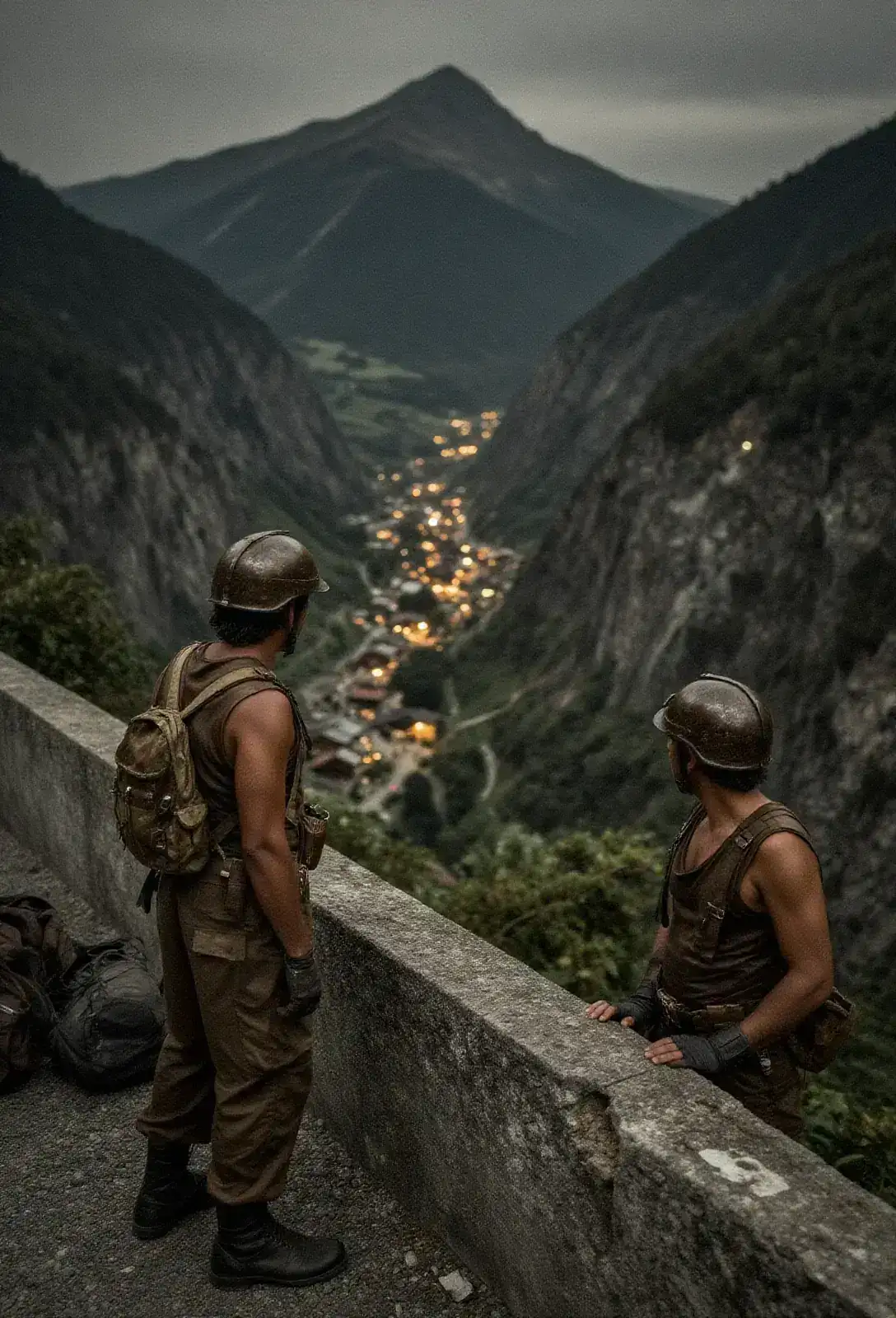
“So you just looked it in the eye and you could tell.”
“Something like that.”
A footstep came up behind them. Nick had heard it three steps off and was not surprised when the voice was Joyce’s.
“She’s a bit of a hypnotist,” Joyce said. “Our Maya.”
He stepped out from the base of a small turret, which he had been in for some time. He had a glass in his hand. The glass had whisky in it that the candles caught.
“But she doesn’t really approve of our goals here.”
“Wild animals should not—”
“First of all,” Joyce said, “they are not wild. They are bio-engineered. We created them. And like any other weaponized organism, their effectiveness depends on the skill of those who deploy them.”
He turned to Nick. The half-smile.
“Like any good soldier. Eh, Nick.”
“Good soldiers care what side they’re on.”
Joyce made a small dismissive movement with the glass.
“Oh, we’re on the side of the angels here.”
He pulled a photograph from his coat and handed it to Nick. The print was a high-glare four-by-six, the kind a printer makes for an embassy passport. Nick angled it under the torch.
A little girl. Maybe ten. She sat on a small bay pony in a riding-school yard with a green ribbon in her hair and a smile with the gap of a front tooth where the grown-up tooth had not yet come in. Her hands were small and pale on the reins.
“Who is this.”
“She’s the little girl whose life you’re going to save.”
The wind on the parapet had a small new sound in it Nick had not heard a moment before. The sound was the sound of a thing tipping over inside the chest and not finding the floor. He held the photograph at the edge of the torchlight. He held it longer than he meant to.
“Her name.”
“Isabel Chartiers. Her father is Bertrand Chartiers, chairman of the Duhamel Group, which maintains substantial financial holdings in many of France’s former colonies. The North African Liberation Front is holding her in a quarter of the Tangier waterfront.” Joyce sipped his whisky. “They have, in a previous transaction, killed two of his employees. They are holding her for two million euros and a week.”
“And she is alive.”
“As of yesterday, yes.”
Joyce moved Nick toward the door at the inner end of the parapet. The door led down to a strategy room Nick had not been in. It was small, paneled, dim, the kind of room a man with a great deal of money built when he wanted to plan things.
A wall screen showed an aerial photograph of the Tangier waterfront, blown up to twelve feet across. A model of the same waterfront was laid out on a table. Joyce clicked to a ground-level photograph of the sort of decaying brick and plaster and corrugated tin that a thousand quarters in a hundred countries had in common.
“This section of the docks has mostly been abandoned. Our sources inform us that Isabel is being held somewhere in the quarter.”
Joyce clicked. A businessman in a charcoal suit appeared on the screen, the kind of charcoal suit that cost more than the Tangier neighborhood the photograph had been taken in.
“Bertrand Chartiers. Two of his employees have already been kidnapped. The first, a minor functionary, was killed during protracted negotiations. With the second, a junior vice president, the company paid the ransom immediately. With the same result.”
A still of French police carrying a body bag out of a tenement.
“And the kidnappers.”
“They seem to be motivated by a personal grudge against Monsieur Chartiers as much as by the lure of ransom money. They call themselves the North African Liberation Front. The little we know of them suggests their motives are more criminal than political. The cell that took Isabel is small. Six men, possibly seven. Two of them, by the police photographs, are not Moroccan at all. The accents on the ransom calls are Algerian. The rifles in the room with her are Russian. The composition of this cell is, in short, very convenient.”
“And you’re sure she’s alive.”
Joyce clicked. A shaky video appeared. Several black-hooded kidnappers moved in the foreground and background of a small windowless room. The wallpaper behind the chair was a faded green damask that had peeled at the seam in the upper corner. A single bare bulb hung from a wire. The floor was old tile, broken in two places. At a central table, on a wooden chair too big for her, sat little Isabel.
Papa, Maman, je suis en bonne santé mais vous me manquez beaucoup. Ces gens ici m’épouvantent et il faut que vous payez à eux tout ce qu’ils demandent.
“She says she’s scared and wants to go home,” Joyce said.
“I speak French.”
“Of course you do.”
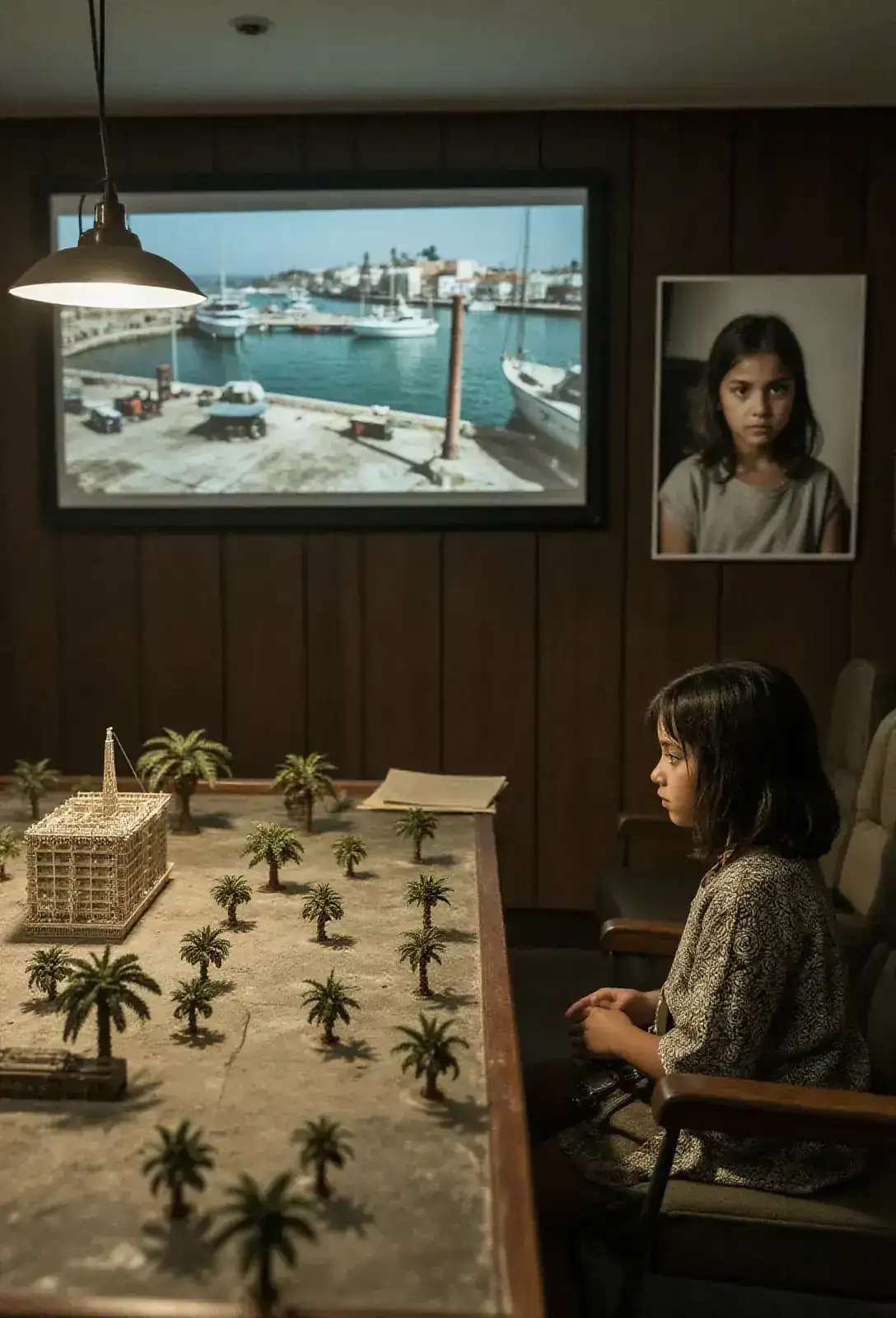
They crossed to the model. The model had been built by someone who knew how to build models. The waterfront was to scale. The roofs of the warehouses lifted off in the way miniature roofs lift, on small iron pegs.
“That arrived yesterday. Chartiers has been given a week to deliver two million euros.”
“A week is—”
“—is all we have. We can only hope they will keep her alive at least until the ransom exchange.”
“I could take a half-dozen good men and—”
“And what. Knock on doors. The quarter is a half-mile square. Our deinonychus, given a few personal articles, will sniff the girl out in minutes.”
“So let one of them find her and we’ll—”
“Come in with guns blazing.” Joyce shook his head. “You notice in the videos they always have her in the center. To shoot at them, you put her in the middle of a fire-fight. But if the only shooting, should there be any, comes from them—”
“And what if your dinosaurs bust in and one of the kidnappers keeps his head long enough to turn a gun on her.”
Joyce shrugged.
“Then she will be spared the very graphic sight of what happens next.”
The room went quiet around the small clean buzz of the projector. Maya, behind Nick at the doorway, was looking at the floor. Nick looked at the photograph. He put his thumb on the corner of it. The pony in the photograph had a soft black mouth and was leaning into the girl’s small hand.
“All right,” he said.
“All right.”
“On one condition.”
“Name it.”
“I run the training. I run it from here to the door of the building in Tangier. You don’t second-guess me. You don’t crowd me. You don’t have Zeiss within fifty yards of any animal I am working.”
Joyce took a long thoughtful pull of his whisky. Then he smiled.
“I had hoped you would say something along those lines.”
“And the implants.”
“What about them.”
“You don’t dose them on the day of the run. Not until I tell you to. They go in clear-headed.”
Joyce looked at Maya. Maya looked at Joyce. Joyce looked back at Nick.
“On that I will need a discussion with the Baron.”
“Then have it.”
“I shall.”
He set the empty glass on the model city. He clicked the projector off. He left.
Maya stood at the door with her arms folded. She looked at Nick the way a circus trainer looks at a man who has just walked between the bars without being asked.
“What did you just do,” she said.
“I just bought us five days.”
“To do what.”
He looked at her a long moment.
“To get her home,” he said. “And then to find out which side of the angels we’re on.”
She kept her arms folded. The lab coat had a small pen-streak at the right pocket. Someone else’s coat. He filed it.
“Five days isn’t long,” she said.
“It’s longer than four.”
“You know what they’ll do to you if you cross them.”
“I know what they’ll do to me if I don’t.”
She nodded. She looked at the door Joyce had gone out of. Then she walked past him without saying anything else and the lab coat went out the door after her.
Nick put the photograph in his shirt pocket. The pony’s nose was warm against the girl’s palm in the print. He clicked the projector off. The Tangier waterfront on the table held its small careful shadows. He had five days to teach two raptors how to find a child without eating one.