The Baron Herman von Drax took his soup with the spoon held the way the spoon had been held in his family for four hundred years.
He drew it sideways, away from himself, and sipped from the side of the bowl of the spoon, and he did it without a sound. The Baron was a heavy man with a high florid color in his cheeks and stark white hair slicked back over a wide skull. He wore a burgundy three-piece bespoke at a house in Vienna in 1989 and refitted twice. The cravat was silk. There was a heavy gold ring on the third finger of each hand. The rings, by the small differences of wear, were the rings of two men, his father and his grandfather, the men he had inherited the company from in the order that had ended with him.
“Courage. Intelligence. The so-called killer instinct.” The Baron set the spoon down without sound. “These are qualities I have always sought in my employees. But it is the rare thing to find them all in the same individual.” He spread his palms a small fastidious distance above the tablecloth. “And so I am thinking. Why not give Nature a helping hand?”
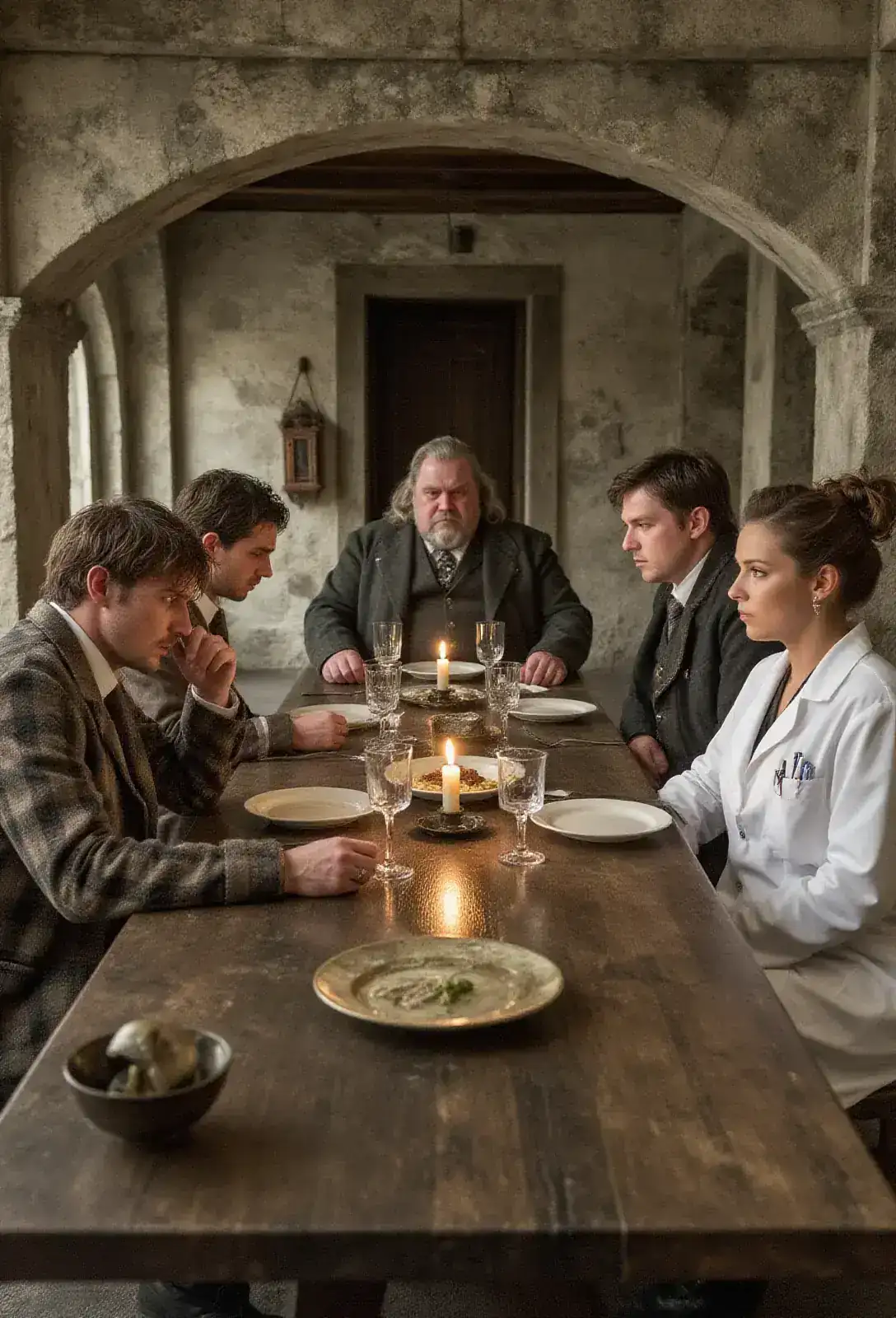
Sherman, on the Baron’s left, was eating his soup the way a man eats soup who is uncertain whether he has been told to eat it.
“The human DNA we used in the deinonychus,” he said, “came from Baron von Drax.”
He said it with the careful pride of a man delivering a line he had been instructed to deliver.
Nick set his glass down. He looked the Baron over with the kind of slow lookover one gives a horse one has been asked to buy.
“Now that you mention it, I can see the resemblance.”
Maya put her hand to her mouth, briefly, but the Baron was not, as a rule, distracted. The Baron addressed his soup and then, when the soup was done, his next sentence.
“We created our warriors,” the Baron said, “from only the finest of ingredients.”
“The Drax line,” the Baron said, almost as an aside to his soup, “has fought in seven major European wars. We have fielded mercenaries on every side of every conflict that has shaped this continent since Charles the Bold. We have bred for war the way other houses have bred for horses. The bloodline is. How shall I put this. The bloodline is curated.” He smiled the small unsmile of a man pleased to have arrived at a precise word. “It was a logical step that, having created an organism in our laboratories, we should have looked, for the human contribution, into the cabinet of our own house.”
“Your house is in the cabinet,” Nick said.
“Half the chromosomes.” The Baron raised his glass to himself. “The other half are from a creature which terrorized the Cretaceous. I do find that I sleep, since the splice was made, with a small additional satisfaction. This is anecdotal, of course.”
“You can combine behavioral attributes,” Nick said, “the way you make a cake.”
“At the moment,” Sherman said, “we can narrow them down to a certain section of the chain. It is possible that other, less desirable traits might. Hitchhike. So to speak. And end up as part of the organism.”
“This mix,” the Baron said, ignoring Sherman, “is giving you something which is greater than its parts. They are full of the hybrid vigor. Like the Swiss.”
“The Swiss aren’t sterile,” Nick said.
The Baron’s eyes went up. They went up slowly, with the deliberate motion of a man who was deciding whether to be insulted or amused, and he chose amused, the way a man chooses a wine. He laughed. The laugh was a single big bark that filled the hall.
“I am the twenty-third Baron von Drax, Mr. Harris. I assure you that we are not.”
Joyce, at the foot of the table, smiled into his glass.
The kitchen door opened and a young man in a starched white jacket came through with a covered silver dish on his shoulder, and went past the table without seeing them, the way servants in this castle had learned to go past tables. He set the dish on the sideboard. He uncovered it. There was a roast bird the size of a small turkey under the cover, with a sprig of rosemary and a circle of small browned potatoes. The bird had been broken at the joint by the kitchen for ease of carving. The smell of it filled the room. The young man went out.
Nick reached for his wine.
“In the second world war,” he said, “there was a program to train sea lions to place magnetic mines on enemy ships. Tireless swimmers. Able to stay under without oxygen tanks.”
“Did they blow anything up?” Sherman said.
“Mostly fishing boats. They couldn’t pass up a meal.”
“We are training our animals,” Maya said, “not to eat what they kill. That has been the most difficult instinct to modify so far.”
The Baron set his glass down. He looked toward Joyce.
“So.” His voice had not been loud and had not been soft and was, suddenly, a voice that demanded a small silence around it. “The embryos are on their way, ja?”
Joyce hesitated half a beat.
“Mr. Harris is still considering our offer.”
The Baron’s face did the smallest thing it knew how to do. The corner of the mouth came down. A line tightened at the side of the nose. The flush in the cheeks became, by a degree, redder. The voice held its level.
“Consider it,” the Baron said, “as quickly as you can manage, Mr. Harris. The patience is not part of my genetic heritage.”
Nick met the eyes. The eyes were a flat blue and very small and were, beyond the small they were, the least amused things in the room.
“Understood.”
“Excellent. Then we eat.”
The carver came back. He was an older man with a high white toque and the sleeves of his jacket rolled to the elbow. He turned the bird with two long forks and made the first cut at the breast, and laid the slices on a warmed plate, and took the plate to the Baron first. The Baron lifted his fork and the small heavy gold ring caught the candlelight.
The Baron began the meal again.
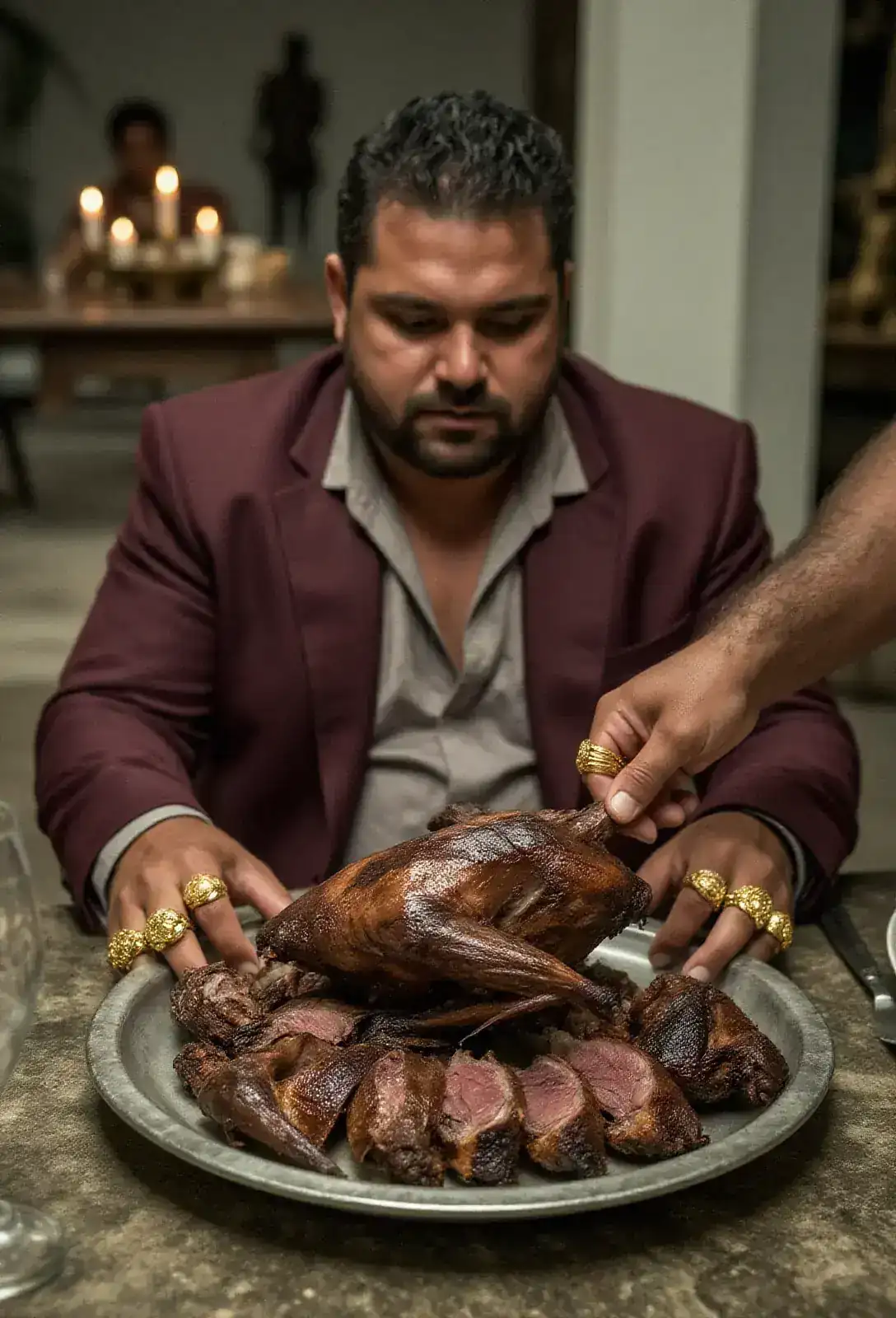
Nick ate. He ate slowly, with the discipline of a man who has been hungry in places that did not have plates. He noted, as he ate, the placement of the four men in dark suits standing at the four corners of the hall, two of whom wore earpieces and two of whom did not, and which of them wore shoulder rigs visible under the jacket and which carried in the small of the back. The Baron’s security was old security. They were old men. They had been with the family for a long time. They were standing, all four of them, at the same posture they had been standing at when the meal had begun.
He ate the bird.
He thought about the can in the cooler in Rodrigo’s, six hundred miles south, and he thought about Hammond, and he thought about the note in his pocket. He thought about the daddy drug and the deinonychus draxi and the small grim joke of a sub-species named, by Sherman or by the Baron, after the man who paid the bills.
He thought about the Baron’s patience, the word the Baron had said. The Baron had used the definite article. The patience. It was the article of a man whose first language had run on definite articles and who had never been allowed, by a tutor or a parent, to drop them. It was a small thing. It was, in another language, his only soft place. Nick stored it.
The Baron lifted his glass.
“To my new lieutenant.”
Joyce lifted his. Sherman, half a beat behind, lifted his. Maya took longer to raise hers, and her glass came up to a smaller height.
Nick lifted his.
He drank.
After dinner, the Baron stood and, with the small ceremony a man uses for his own kind of evening, took Nick by the elbow and led him to a side gallery off the great hall. The gallery had been the muniments room of the original Baron and had been converted, in the present Baron’s father’s time, into a private armory. There were swords on the walls. There were pikes. There were half a dozen wheel-lock pistols in a glass case that had been disarmed but were, by their ornament, dangerous. The Baron stopped before a tall iron stand on which a medieval crossbow was hung at chest height.
He took the crossbow off the stand.
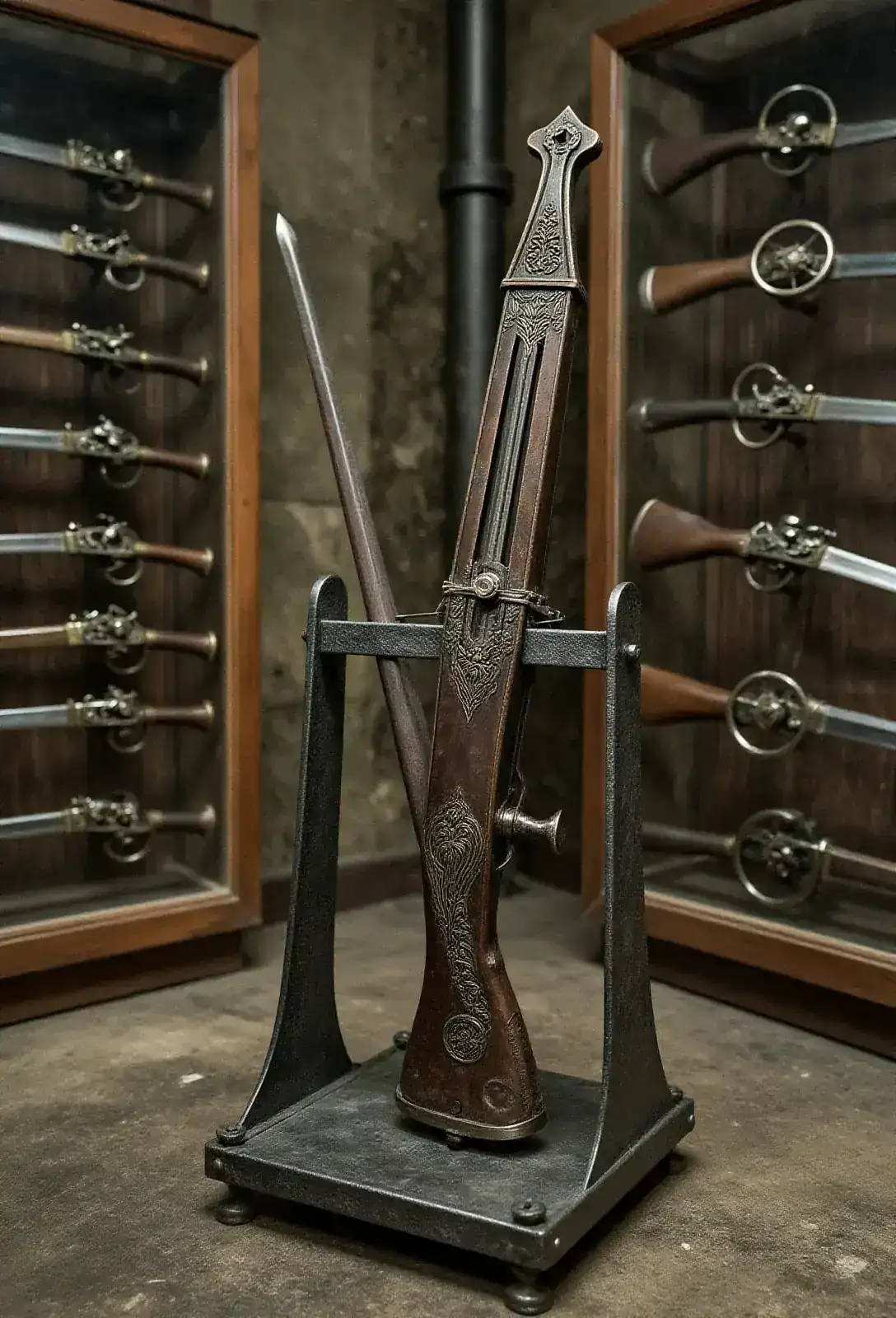
“This was made for my forebear,” he said, “by a smith in Schaffhausen in the year fourteen hundred and seventy-one. One must not, of course, dry-fire it. The string is original. The mechanism has been repaired, twice.” He held it out, weighed it on his palm. “It is heavier than a man would expect. Do you find it heavier than you would expect, Mr. Harris.”
“Yes.”
“Yes.” The Baron nodded. “It is heavier because it is meant to do a thing. The thing it is meant to do is to put a quarrel through plate armor at sixty paces. The mechanism is geared. A child can cock it.” He set the crossbow back on the stand. He patted the stock of it. “I would not like to cock it again, however. Not on a man I am asking to work for me.”
He turned. He smiled. The smile did not reach the eyes.
“You have understood me?”
“Yes.”
“Excellent. Then I will wish you a good evening, Mr. Harris. We shall speak again in the morning.”
The Baron’s hand on Nick’s elbow released. The Baron walked out of the armory the way the Baron walked, which was without hurry, without doubt, without ever looking back.
Nick stood a long moment in the armory alone.
He looked at the crossbow on its stand. He looked at the rings of the wheel-lock pistols. He looked, last, at himself in the dim glass of the case.
He turned out the light. He went to bed.
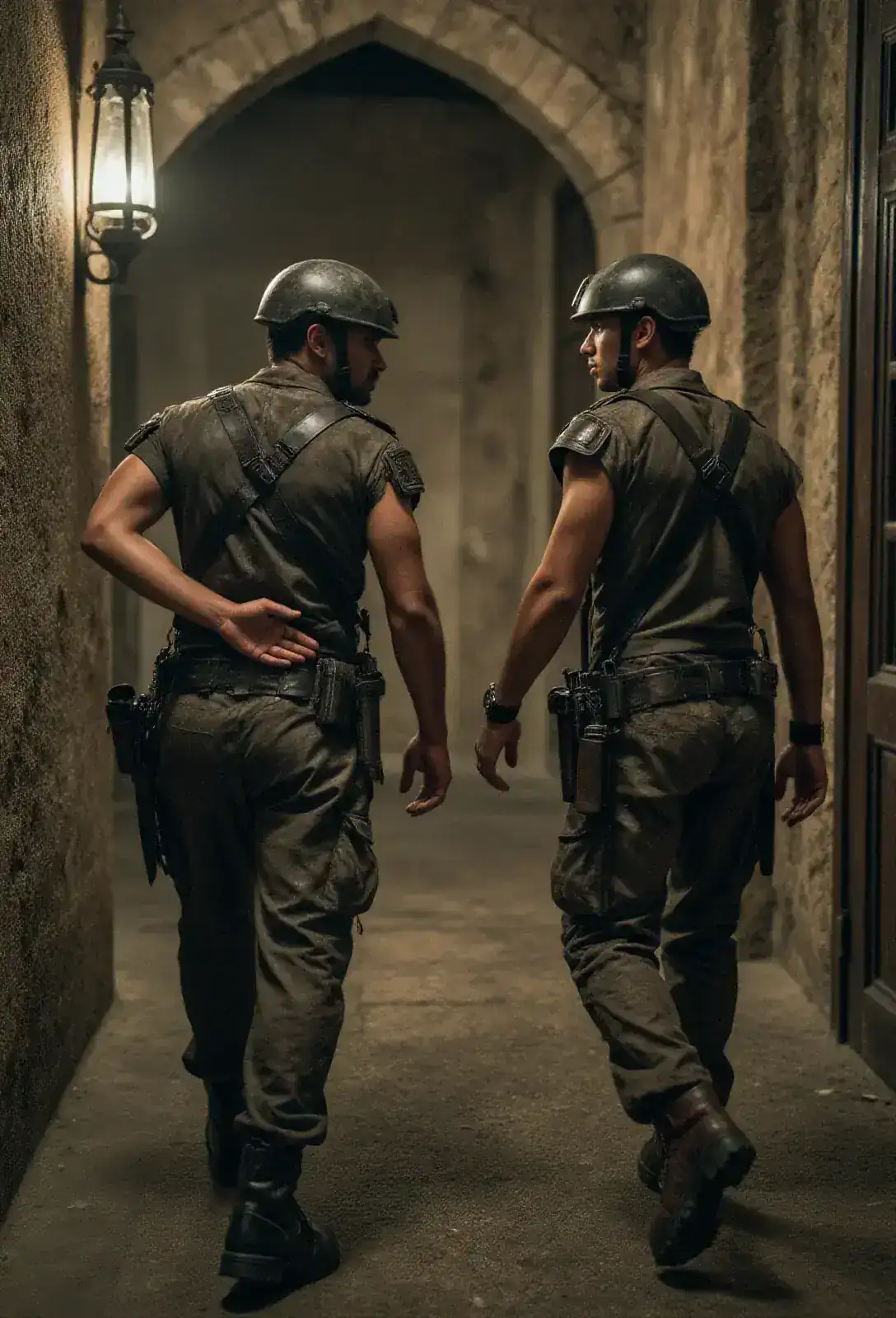
He did not sleep. He lay on the cool linen with his hands folded under the small of his back the way he had folded them in a barracks in Bahrain in 2005, and he did the small useful exercise of going over the floor plan of the castle as he had pieced it together. The great hall to the cavern lab. Cavern lab to the south corridor. South corridor to the courtyard, the courtyard to the parapet, the parapet to the cable car platform that ran the long wire across the gorge to a service hut on the far slope. He had counted four cameras between the parapet and the cable car. He had counted six men in three shifts of two on the cable platform. He had counted two doors between the parapet and the cable car that locked from one side only.
He thought about the two-million-euro ransom in the photograph Joyce had shown him at the strategy table after dinner. He thought about the little girl in the video, Papa, Maman. He thought about a phrase that had not occurred to him in a long time, the phrase a man’s old colonel had used in a barracks once: the rest of the herd kept chewing grass. He had not known what it meant in 2005. He had it in front of him in 2026.
He turned over.
The wind worked at the slit window high above the bed. Somewhere out beyond the moat the night birds were making the small noises night birds made. The moon was off the wall, gone behind the eastern peak. The room was as dark as a room got in a castle that ran electric ghost-tours through its halls four nights a week.
He slept, eventually. He slept badly. He woke once before dawn with a clean sense of having been watched, and the sense was not, that he could prove, wrong.
In the corridor he passed Maya. Her hands were in the pockets of her lab coat. As she went past she brushed the back of his hand once with hers. A folded scrap of paper went between two of his fingers and stayed there.
She kept walking. So did he.