He took them out of the chute at six in the morning and he made them stand in a line.
The five of them. Five eight-foot deinonychuses with the regulator boxes bolted into the side of their heads and the spray paint on their flanks and the ruby red holding fix on him and only on him. Sherman was at the console fifteen yards back with the radio control in his hand, looking at his shoes. Maya was at his shoulder with a clipboard against her chest and her eyes neutral. Behind them, twelve of the Baron’s men in tactical gear, and Zeiss off to one side wearing the pheromone armband and trying to look bored.
Nick had the parade-rest he had taught himself in 1992 and stood in it.
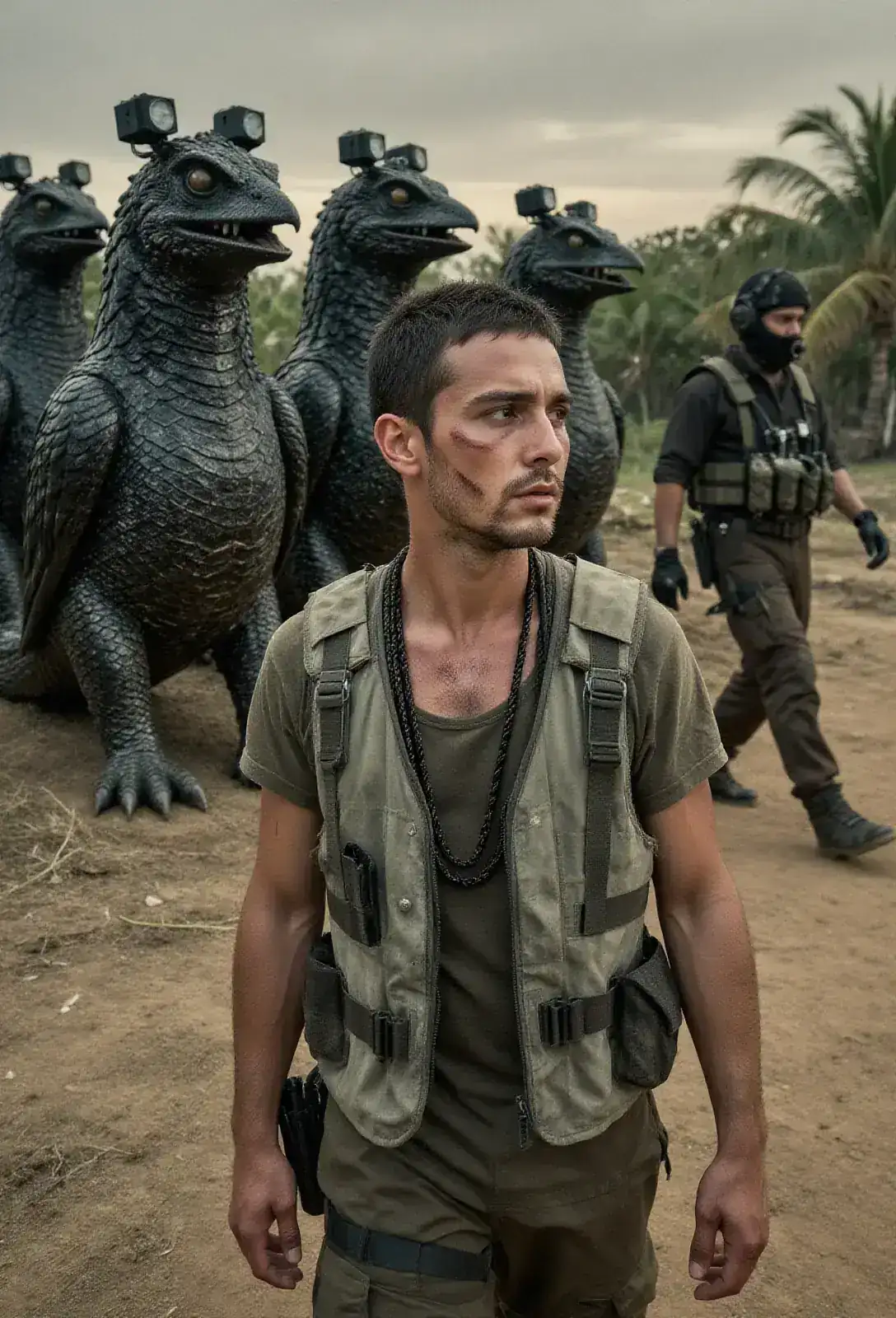
“Any soldier worth his pay,” he said, “has a name to answer to. Not a number. Even the most sniveling little lapdog answers to its name.” He pivoted. He looked at the man behind him. “Zeiss.”
“Sir.”
“See what I mean.”
A small ripple in the line. They had heard the word Zeiss and they had heard sir and the little glance one to another was a glance Nick was not supposed to see and he had seen, and he had seen it five mornings running. It confirmed every instinct he had had since the minefield drill.
He walked the line. He walked it from the largest down to the smallest, the way Hesiod had walked the line in some old book Nick had had to read in a community college course in the late nineties, a line he had not understood at twenty and understood at thirty-eight without effort.
“Achilles.”
He pointed at X-5.
“Hector. Perseus. Orestes.”
He stopped in front of X-1. The biggest. The widest in the chest. The eyes a deeper red than the others, whose reds had blue in them in a certain light. X-1’s eyes had no blue. X-1 met him eye to eye for a long second.
“Spartacus.”
He turned to the men.
“You will learn these names. From this moment forward, you will not fail to refer to them by them. You will not address these warriors by number. The numbers are gone. Three of these five will go on the run at hand. All five will train for it.”
He looked specifically at Maya.
“From now on. And this is very important. All military directives will be given by me. By me only. Is that understood?”
Sherman nodded too quickly. Maya nodded once. Zeiss looked at his shoes. The men in tactical gear looked at Joyce, who had come up behind them in the loose half-attention of a colonel who would let his lieutenant do this naming because the naming was, in the end, theater for the men, and the men needed theater.
Joyce nodded. The men nodded.
The deinonychus stood. They watched.
Nick walked the line again. He let his hand pass within two feet of each of them, deliberately, the way the cat trainer had taught Maya to let a hand pass at the circus. Spartacus tracked the hand and did not move. Hector flared his nostrils. The others held.
“All right,” Nick said. “Let’s work.”
They worked.
The first day was the night-vision drill. They put Spartacus alone in the darkened lab enclosure with a soccer ball, a boombox, and a roast pig on a platter spaced along a low table, and they cut the lights to a hundredth of a lux, and Sherman flipped the switch.
Pop. Pop. Bap-bap-bap-bap.
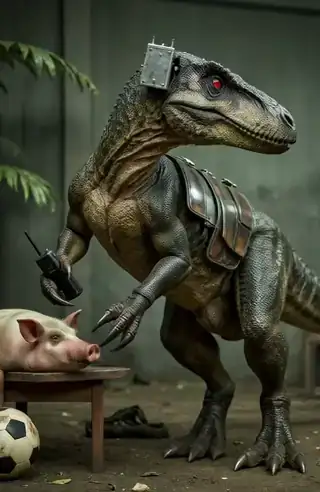
The flashes and gunfire from concealed speakers in the walls hit Spartacus from all sides. He roared. He spun once. He went to the table and sniffed each item in series. Then he picked up the boombox, neat and careful, in one of those wrong-long fingered hands, and walked it to the far wall and set it down where the flashes were not pointing at it.
Nick clicked the stopwatch.
“Stimulus off.”
Sherman cut the switch. The lights came on. Spartacus turned and looked at the observation window. He looked at Nick, exactly at Nick.
Nick clicked the speaker.
“Excellent work, Spartacus.” Then, off-mike, to Sherman: “Shoot him some love, Sherman.”
Sherman turned a dial.
“You’re overdoing it with the serotonin,” Maya said.
“Tomorrow we’ll reward and punish with insulin,” Nick said. “Remind them that we control their vital functions.”
“We’re making them into a bunch of drug addicts.”
“Some day a pat on the back and a good boy might be enough to motivate them.” He let his eyes go back to the glass, where Spartacus had not stopped looking at him. “I don’t think we’re there yet.”
The second day was the obstacle course. They had built it in the floor of the valley over the previous month, with Sherman’s specs and a few of Maya’s last-minute additions: a single-log bridge over a scree pit, a two-story tenement wall with a real fire escape welded onto it, a trench full of fire that one had to leap to clear, a short minefield that Sherman swore was inert and Nick was, for the first run, not certain about. They put helmets on the humans and the humans stood behind a low wall.
The five raptors moved through the course at the full sprint they did when their colors had gone green-brown and the pheromone armbands were doing whatever the pheromone armbands did. They balanced on the log. They climbed the wall. They jumped down. They picked up speed and cleared the trench in a leap that Joyce, beside Nick, said ja under his breath at, in spite of himself.
The minefield they slowed for.
“Von Drax is not going to be happy if one of his investments gets blown apart here,” Joyce said.
“If they can’t sniff out a mine six inches under the dirt,” Nick said, “their aggressiveness becomes a liability. Look at this.”
Achilles, smallest, fastest, most uneven of temper, had stepped out ahead of the other four. The others were holding back at the rim of the field, watching. Achilles sniffed, lowered his snout, took half a step, sniffed again. He pressed his tail down against the ground at the side of the path he had taken.
“There’s a scent gland under his tail,” Maya said, low.
“He’s marking a trail for the others,” Nick said.
“Did you teach them that?” Joyce said.
“I wish I had. Saves time. Only risks one member of the team.”
“Insightful behavior,” Maya said.
Achilles got to the far side. He turned. He gave a small clicking call, almost a series of taps in the throat, and the other four came across, single file, along the path he had marked, each foot down on the same place his foot had gone down, a line of moving black against the dust.
“Makes you wonder,” Nick said, “what else they have been cooking up.”
At the back of the line Spartacus stopped. He turned his head sideways. He looked, for two seconds, at Nick.
The look was the look of a man counting the men in a fight before the fight started, and Nick had had the look thrown at him by men in three jurisdictions in his life, and he had not, before today, had it thrown at him by an animal.
He held the look.
Spartacus turned away, and went.
That night, after the cleanup, Nick sat alone in the observation room, half-lit, watching the night feed of the raptor enclosure where Spartacus and the others moved slowly in the half-dark. He had a cup of coffee that had gone cool. He had the photograph of Isabel Chartiers in his shirt pocket. He had a dull, low-grade headache that had been with him since the dinner with the Baron. A pressure-headache. He had carried it before runs into Mosul and into Brazzaville and once, briefly, in the Florida Keys.
Footsteps behind him. Maya.
“You be careful tomorrow,” she said.
“I’m not the one they’ll be shooting at.”
“It’s not the kidnappers you have to worry about.” She nodded at the monitor. “When it goes down. Just make sure you’re somewhere safe.”
“I’ve seen you walk right up to them.”
She came around the desk and leaned on the edge of it.
“When I was in the ring with the big cats I learned never to think they were my friends. You turn your back, and.”
“They can’t help themselves.”
“They can’t help themselves.”
He looked at her.
“What if one went for you when you were looking it straight in the eye?”
“If you let them have the DNA,” she said, “they’ll probably let you go.”
He shook his head. “Not here. I was held in the desert for fourteen months. No war had been declared. We were just. If we’d all disappeared, nobody would have made a fuss.”
“She must be so scared.”
“She is.”
She leaned in. She kissed him on the cheek, the way a woman in a circus tent in Cleveland might have kissed a man she had known for two weeks but had decided about.
“Good luck tomorrow,” she said.
She went.
He turned back to the monitor. The raptors moved. Spartacus had his head turned sideways at the camera in the corner of the enclosure, the one that had been there for three months, the one Sherman thought Spartacus had not noticed.
Spartacus was looking at the camera.
Spartacus was looking through the camera, into the room, at Nick.
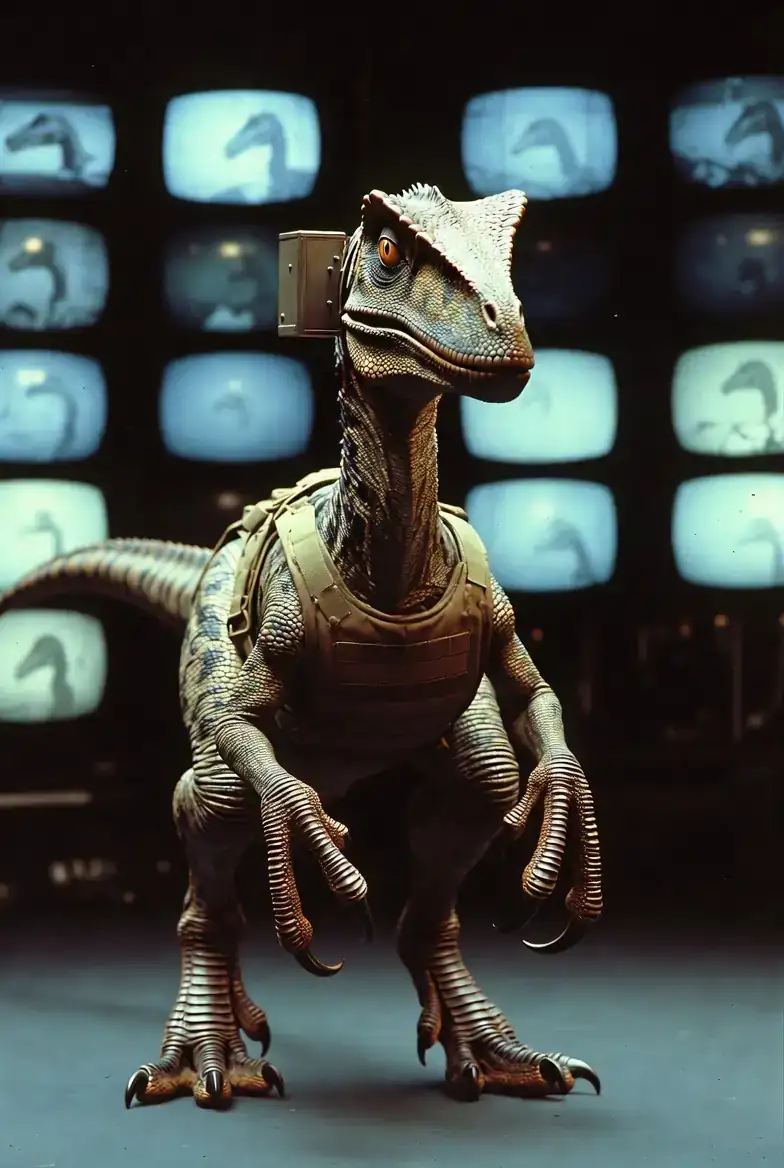
Nick sat with the cold coffee in his hand and looked back, and the looking went on for a long time, and was, he understood, the conversation Maya had been talking about.
He drained the cup. He set it down. He went to bed.
He slept, this night, well.
In the dark, in the enclosure, Spartacus stood very still for a long time after the man had left the observation room. The other four were curled along the back wall in the loose pile they made at night. Spartacus did not lie down. Spartacus, alone, kept his head turned sideways at the camera in the corner, the camera that was supposed to be hidden, the camera he had counted, the camera he had been counting since the day they had brought him here.
Spartacus had been counting many things.
He had been counting, in particular, the number of times the man at the console had used his left hand to hit the switch, and the number of times the man had used his right. The man used his left hand four times out of five. The fifth time, the right. He kept the count.
He had also been counting the men. The men in the dark suits at the dinner of the meat-eater table he had not been at, of which the cleaning-women’s voices on the corridor cameras spoke. The men in the white coats who came to the cage and went. The man in the field jacket who smelled of the gun oil and the cigar. The man with the moustache, who smelled of the small low yellow chemical the harness sang of. The man with the scar at the jaw, who smelled of nothing. He counted them. He had a number for the men.
He had been counting, also, the doors. The doors on the cage, the doors on the chute, the doors on the corridor between the cage and the chute, the door at the gallery to the long room where the lights at the ceiling were always on, the door at the back of the long room which had not, in three months, been opened. He had a memory for which door he would go through first.
He had been counting the days.
And he had been counting, although Maya had not yet been told this, the small soft places of the regulator box on the side of his head. The skin around it was a thin skin, a meat-skin, of the kind that bled when his sister Hector had bumped his shoulder hard against the corner of the cage two weeks ago, accidentally, drawing a line of blood that the man in the white coat had stitched. The stitches had come out clean. The line of blood had told him a thing that the man in the white coat did not know he had been told.
He could feel the box.
He could feel it.
The foot of a deinonychus draxi was a foot designed for the lifting of organs out of the bodies of small mammals. The regulator box was a small box.
He stood in the dark with his head turned at the camera, and he watched, and he waited.
The man went to bed.
The dark in the enclosure deepened.
Spartacus, alone, did not lie down. Not yet.