What Zeiss had done to X-5, Maya found out in the corridor on her way to lunch.
The kid Henke, who logged the metabolic panel in the morning, met her in the corridor with his eyes down and the clipboard pressed against his chest the way young men press clipboards when they have a thing to say and would rather be carrying a rifle.
“He’s juicing him,” Henke said.
“Who.”
“Zeiss.”
“Show me.”
She skipped lunch. She had been skipping lunch since she had taken this contract and the habit was holding, this was a circus rule, you do not eat before you go in the cage. Field-trip rules. Wolf rules. Mother rules.
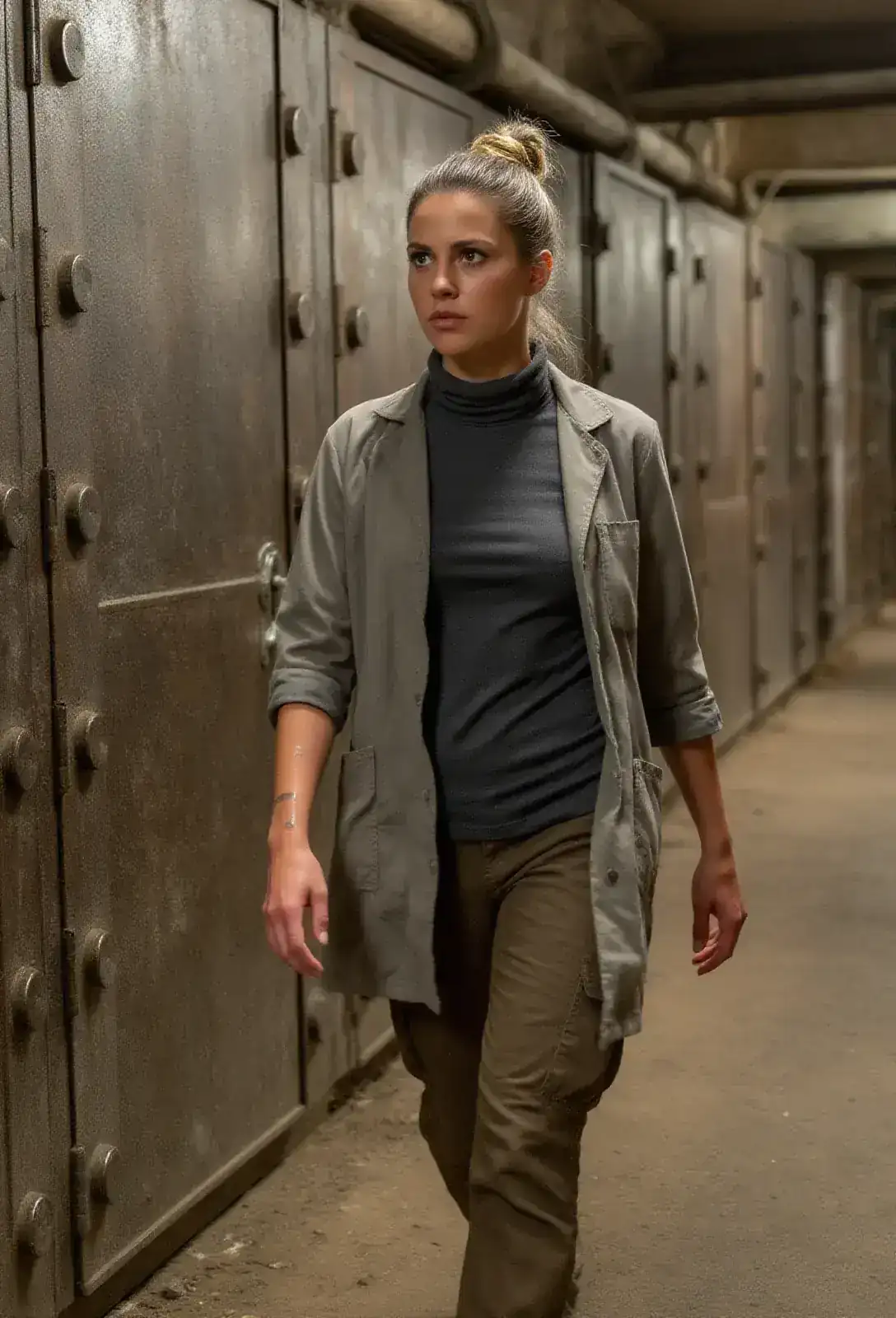
She went down the gallery the long way, past the south enclosures, because the long way kept her clear of Joyce’s office, and Joyce out of her face. Her face was a particular face today.
X-5 was the smallest of the deinonychus they had on rotation, a head shorter than X-1 and lighter through the chest, a juvenile by the metric of a species that was not supposed to have juveniles. He paced his outdoor enclosure with the long-shanked stride of an animal who had something to do but had been told not to. Spray-paint on his haunch. The number was cleaner than the number on X-1, which meant the orange had been re-applied recently. Someone had touched him up. Someone had, in other words, hit him hard enough to scrape the paint off.
There was a hunk of beef hanging on a wire from the cross-bar of the cage, just outside the bars at chest height. Inside the cage, a brand-new cattle harness around X-5’s body. The leather was stiff. The buckle on the strap had not been broken in. She read all of this in two seconds.
X-5 approached the beef.
ZZZZZZTTTTTTTT.
The shock came up through the harness from a cattle-prod console that Zeiss was leaning at, on the outside of the bars. X-5 went sideways and down on his haunches with the kind of small grunt an animal makes when an animal is trying not to give a man the satisfaction. He came back up. He looked at the meat. His tongue worked in the side of his mouth.
“We have learned our lesson, maybe?” Zeiss said.
She came up behind him in three strides. “Zeiss.”
He kept his back to her. He had a small affected mustache he had been growing for a month and he was the kind of man who, given another month, was going to grow a goatee.
“It continues to eat whenever it pleases,” he said. “It needs to learn.”
“The only thing it could learn from this is that you’re a nitwit. And it probably already knows that.”
“And the harness—”
“This is behavior modification, Zeiss. Not torture.”
“The neuro-implant induces nausea. Not pain.”
“Then why is he flinching.”
She turned away before he answered. She had no use for one. She had had the answer four times before, three times since signing on, and the answer was always different and was always wrong. She crossed the floor to the narrow steel side door of the cage, the one that opened on the keeper’s track, and put her hand on the handle.
“Unlock.”
“He’s very upset,” Zeiss said. “At you.”
“Unlock.”
A click. The bolt drew. The door went six inches and stopped where it always stopped, which is what side doors do when men want to keep women from going through them. She set her hip against it and pushed.
She went into the cage.
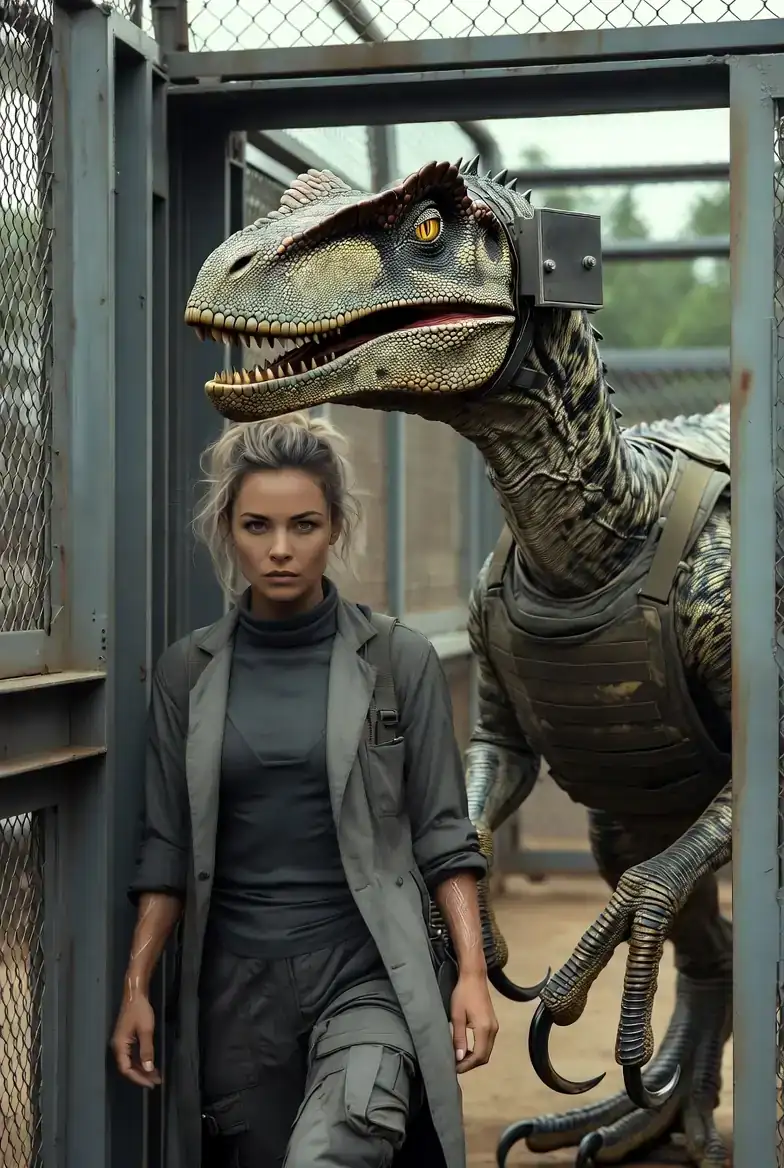
X-5 was at the far end, against the bars, watching her. His eyes were a wet bright red. The scales at his shoulder were lifted in the way the scales of certain lizards lift when the lizard is making itself larger. He was eight feet of lifted scales. He was, by the breathing in his chest, the angriest thing in three counties.
“Stay,” she said.
She knew about looking at things. Wolves in Saskatchewan, ‘02. Lions in a circus tent in Cleveland, ‘07. Looking was a thing she did with her whole face.
She took a step. Then another. She did not break the look.
“Easy. Easy.”
She came up to him at a slow flat pace. He held. The chest went up and went down and the scales held their lift. She was within reach. She lifted both hands, slow, slow, and unclipped the harness at the chest strap.
“Good boy.”
The leather slid off his back.
She turned and walked away from him. She kept her stride long and even. The walk away was harder than the walk in, harder than the looking, harder than any of it. She walked to the side door. The door went open six inches and she squeezed out and the door went shut behind her.
Joyce was there.
Joyce had come down from the gallery while she was inside. He was leaning at the rail with his hands in his pockets and the half-smile on. Behind him, a few yards back, Nick stood, watching her with the assessing flat eyes of a man who had been a sniper before he had been other things.
“Every time I start to make some progress with this animal,” she said, “one of your thugs sets it back two weeks.”
“We have a timetable to be aware of,” Joyce said.
“Then you’d better push it back.”
She walked away. She walked the way she had walked away from a man before, twice, three times, in different cities, with the flat steady pace that says I am leaving this ring and you are not going to say anything that will make me turn around.
Behind her, she heard Joyce.
“A relatively new recruit,” Joyce was saying, to Nick. “You know the type. Lots of attitude. A bit wild.”
“How many of these things do you have,” Nick said.
“Unfortunately, the genetic engineering involved in their creation renders them sterile.” That was Sherman. He had appeared from a side gallery the way Sherman appeared, as if he had been told by someone where to be and had been waiting twenty minutes for permission. “If we’re going to expand and have a breeding program—”
“We need the embryos that you stole from us.”
“I’m not so sure that’s a good idea.” Nick again. “What if you take them out for a spin and one decides to go AWOL?”
“Even if the neuro-implant malfunctioned,” Sherman said, “they wouldn’t get far. Their bodies are capable of creating insulin but lack the stimulant that causes it to be secreted. Only we can perform this function.”
“Without us,” Joyce said, “they can last only an hour. Maybe less.”
She had stopped at the corner of the gallery. She had not meant to stop. She had stopped to listen. There was a thing they had not told her when she signed on and the thing was that the dinosaurs were all addicts and that Grendel, the company, the men in the corridor behind her, were the dealer.
It was the daddy drug.
She had seen it in the panels and not known what she was seeing. Insulin without a trigger. She had read it as a quirk. She had read it the way people read quirks when they have just been hired and have been given a parking spot.
She was not going to turn around.
“The patrol we went on this morning,” Nick was saying. “She didn’t train them to do that, did she?”
A pause. Sherman looking away. She knew Sherman’s looking-away by ear at this point.
“There was a South African gentleman named de Vroot,” Joyce said. “Wonderful storyteller. He seemed to be getting on very well with his trainees.”
“And what happened to him?”
“That’s not totally clear.”
“We found one of his shoes,” Sherman said.
She kept walking.
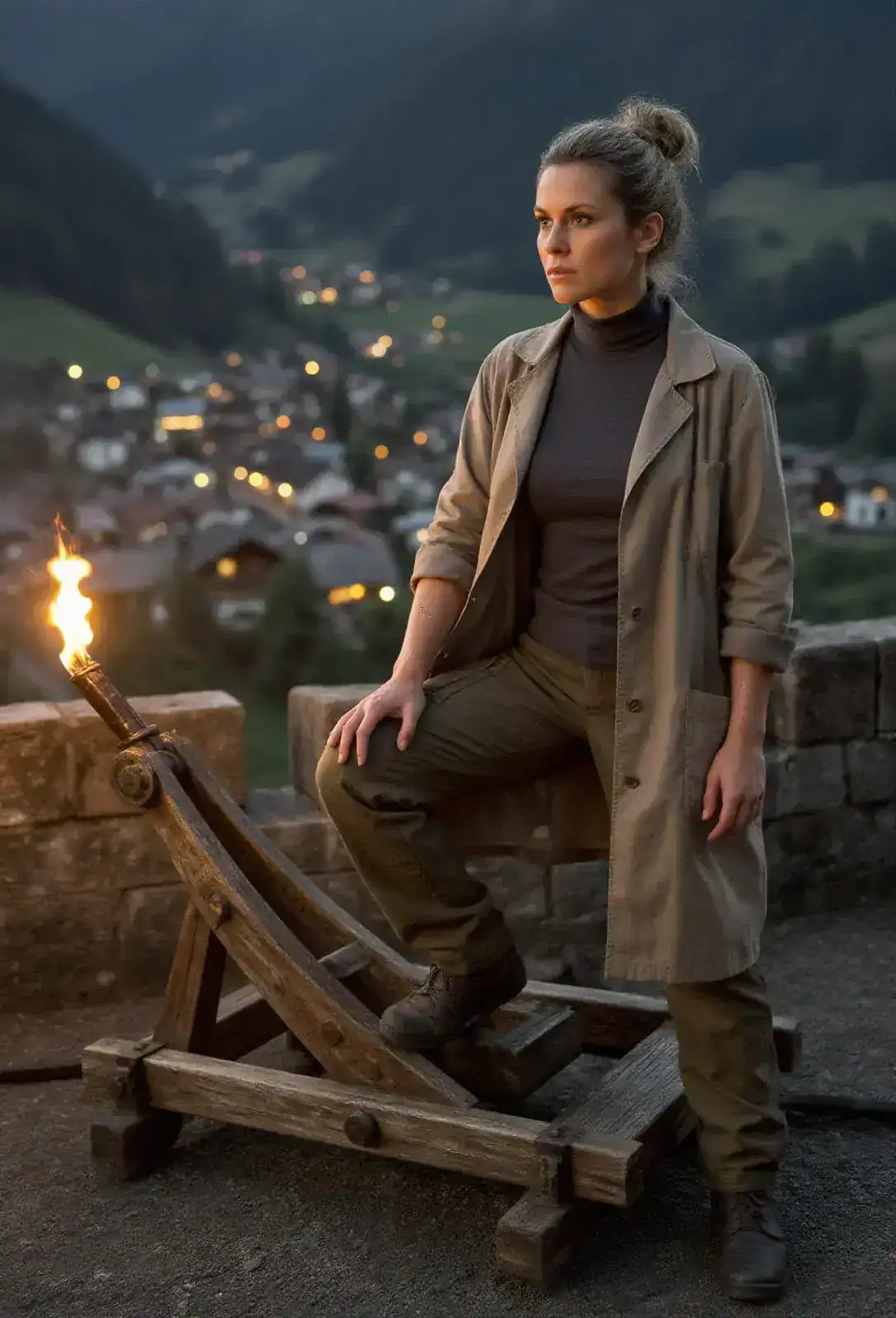
She went up the gallery stairs and out into the upper corridor and up to the parapet and did not let herself sit down for a long time. She walked the parapet end to end. She stopped at the catapult. She put her hand on the worn wooden arm of it. The wood was not the original wood. The wood had been replaced, with care, with the same kind of oak in the same shape, sometime in the eighties, by a Swiss carpenter she imagined as a man with thick wrists and a son in dental school. The catapult was, in this castle, the only thing she could touch that did not have her name on a chart somewhere.
She sat down on the base.
She breathed.
She thought about the shoe.
She thought, irrelevantly, that her father had bought her a pony when she was eight, a small bay mare with a soft mouth, and that she had been the only girl on her block with a pony, and the pony had been put down in the spring of her fifteenth year, and her father had given her a paper cup of ice cream after the appointment with a single chocolate animal cracker stuck in the top, and she had eaten the cracker first.
She thought about Nick. She thought about whether he was the kind of man Joyce thought he was. She thought about the note she had pressed into his hand and what it would cost her. She thought about the quiet mountain town below the castle, two thousand feet down a sheer face of granite, with its three church bells and its single all-night bakery and its many small old men who would not, if they were here, particularly approve of any of this.
She heard footsteps on the parapet.
She kept her eyes on the lights of the town. The footsteps were steady. The footsteps were a man who had done a lot of walking in places where footsteps mattered, which is to say a man who could either come up on you or not come up on you, and she heard him because he had decided to be heard.
“I could send you over the moat with this,” Nick said, tapping the catapult.
She looked up. She let the smile come.
“I may take you up on that.”
“That’s not the Grendel International spirit I’m hearing.”
She glanced down into the courtyard. Kroner stood at a wall under a torch, smoking a cigarette he was not really smoking, doing the tired careful work of a man pretending to be off duty. Nick saw her see him. He understood.
She stood up.
“Had a few setbacks today,” she said.
They began to walk. The torches were modern torches, butane, with a small flicker built in for the look of the thing. The light from them caught her hands.
“How does one get to be a dinosaur trainer,” Nick said.
She shrugged.
“I got my doctorate in behavioral sciences. Did some field work with wolves in the north of Canada. Until the grant money started drying up. Then. Well. There aren’t many practical applications for that. So I took a job with the circus.”
“The circus.”
“In the ring. With the whip and chair, pushing the big cats through their routines.” She let her mouth turn up a small fraction. “Then there was a certain trapeze artist I needed to get away from. And when I was approached for this job.”
“You knew what you were getting into.”
She thought about that. The trapeze artist’s name had been Calvin and Calvin had bought her a ring at the only jewelry store in Toledo that took layaway, and she had returned the ring and Calvin had never forgiven her, and somewhere on a circus circuit in the Midwest he was still telling people about it.
“For my fifteenth birthday,” she said, “my father promised to take me to opening day at Jurassic Park. I have the ticket.” She glanced at him. “When I heard I would be working with animals that used to be extinct. Well. I didn’t ask too many questions about what they were going to be trained to do.”
“In the cage this morning. How did you know that thing wasn’t going to go for you?”
She stopped walking. She looked out over the wall toward the lights of the small mountain town two thousand feet down the granite. The town had a single church bell ringing out a quarter-hour. The sound of it was thin in the cold air.
“When a wolf pack works a herd of elk,” she said, “they single out the weakest. An orphaned juvenile. An older adult on its last legs. And they look it straight in the eye. There’s a conversation of death that goes on between them. Hunter and prey. Something like an understanding. I have seen the rest of the herd continue to graze peacefully while one of their number is set upon and killed. Twenty yards away there is this grisly murder, and they keep chewing grass. Because they know it is not their turn.”
“So you just looked it in the eye and you could tell.”
“Something like that.”
“Hell of a parlor trick.”
“It’s a parlor trick that fails,” she said, “exactly once.”
He nodded slowly. He had the look of a man taking inventory of a thing he was going to need later.
Footsteps came up behind them, close, soft, owned. Joyce had been there longer than they had known.