
“I’m a prisoner in a theme park,” Nick said, to the empty stone room.
The bed was clean. His clothes were not his clothes. The door was oak. The door was locked. The window was a slot too narrow for shoulders.
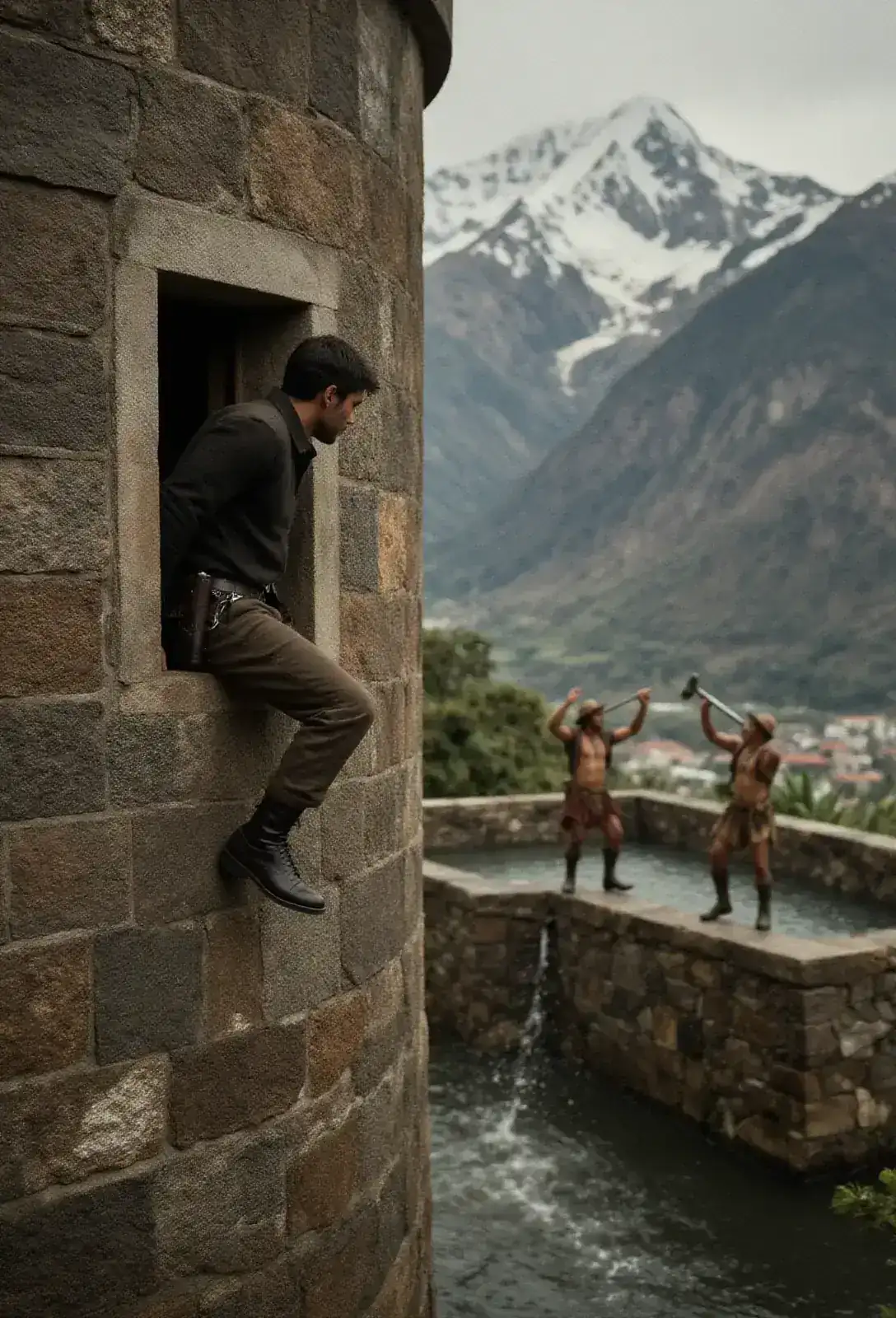
He was in a medieval castle on a mountainside. The mountainside was stitched with switchbacks and small green pastures and one cable-car wire that crossed a gulf to the north. On the opposite parapet, two men in lederhosen and feathered hats were yodeling for the entertainment of a small crowd of tourists who stood across a moat with their phones up. The yodel went up and came down. The tourists clapped. The yodelers bowed. Coins fell into a hat. A second yodel began.
Nick pulled his head back in.
His suitcase, which had been in a Florida storage unit yesterday, was open on a stand. His jacket was hanging in an armoire of black wood with brass corners. There were heraldic banners on the walls that were too clean to be old and too old to be new. There was a flat-screen television on a stand in the corner that had not been there in any century the castle had been built in. He picked up the remote and clicked through the channels for the small data of geography. French. German. Italian. A Spanish channel running an infomercial about a knife.
He stopped on a nature documentary, a plummy British narrator over footage of three compys driving a raccoon up a tree.
“Compsognathus,” the narrator said, “rarely exceed a full-grown pheasant in size.”
“No kidding,” Nick said.
“But, though diminutive, are extremely aggressive.”
He clicked the television off.
A booming knock at the door.
“It’s locked,” he called.
Keys fumbled. The bolt slid. The door opened on a butler in livery that had a small gold thread at the collar and the cuff and a face that did not want a tip.
“They are ready for you downstairs, Mr. Harris.”
The butler stepped back from the door without closing it. Nick took a long look at the open frame and at the stone hallway beyond it. He considered a great many things. He considered the thirty-three feet of vertical drop on the outside of the slit window in the bedroom and the rope of bedsheets he had not made. He considered the hallway that he could see, and the men he could not.
He went downstairs.
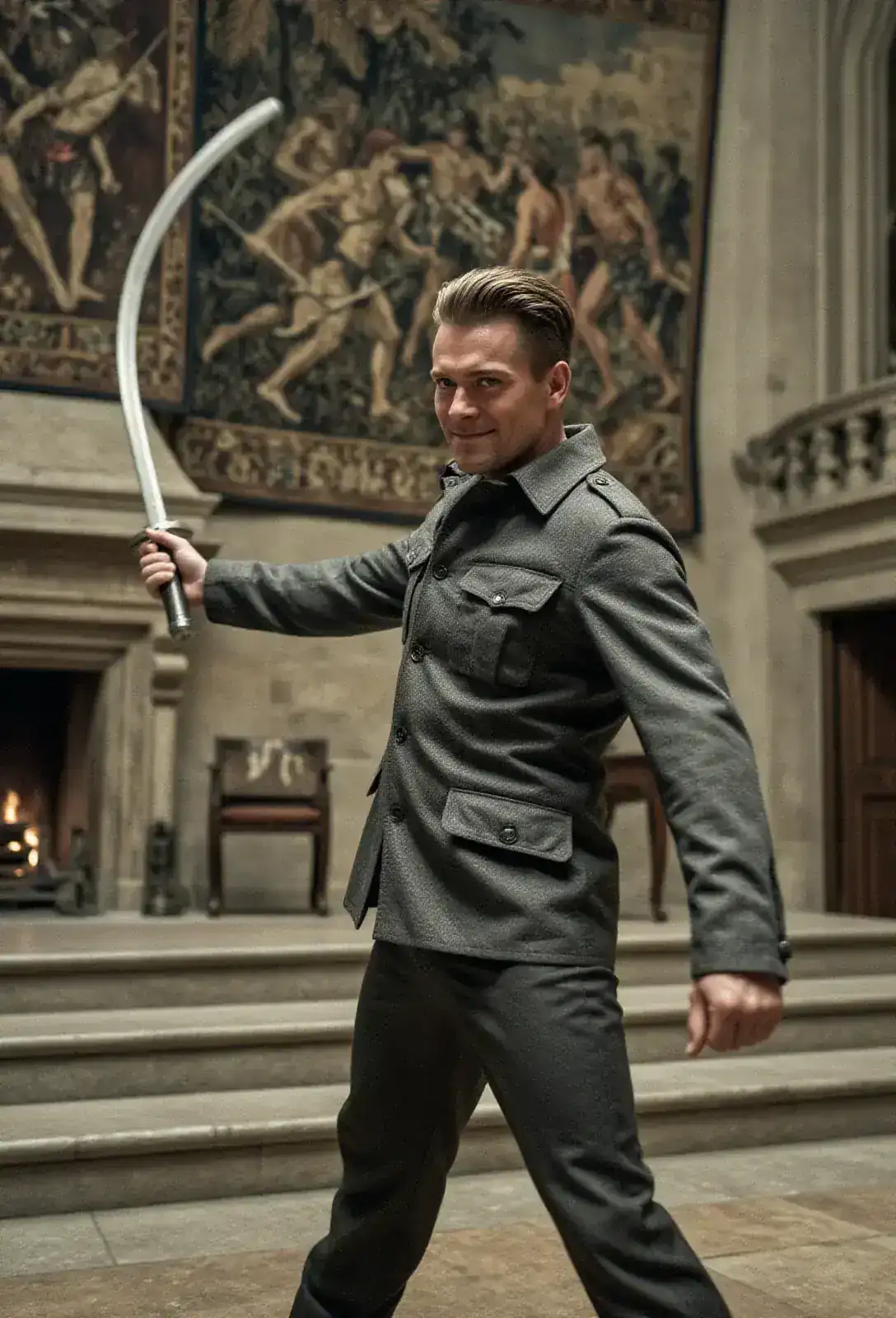
Adrien Joyce was in the great hall swinging a halberd.
He had the halberd in a long forward arc and was working it with the grip and the footwork of a man who had been to a fencing master with the kind of money it took to learn this particular weapon. He chopped, parried, thrust, came down on guard, looked very pleased. He froze in a backswing when he saw Nick on the stairs and let the smile come.
“It’s not only for ceremony, you know. The halberd. The Swiss Guards who protect the Pope at the Vatican could do a good deal of damage with these. Of course, they’ve also got an automatic pistol somewhere under those crazy uniforms.”
“Maybe you should apply for a job.”
Joyce laughed, the laugh of a man who liked the idea. He turned and hung the halberd on iron hooks above an enormous fireplace. The fireplace was cold and clean and large enough to walk into. A coat of arms above it had been recently re-painted.
“I haven’t seen you since,” Joyce said. “What.”
“Tegucigalpa. I helped get you kicked out of the country.”
“To be deported from Honduras.” Joyce shook his head with the slow amusement of a man whose past has begun to belong to someone else. “What horror must I have perpetrated.”
“Selling guns to the wrong people, as I recall.”
“But they were the right people when I began the transaction. The political sands are ever-shifting.” Joyce gestured at the great hall around them, the long table that could have seated forty, the high small windows of leaded glass, the suits of armor at the bases of three of the columns. “Something the Swiss understand better than anyone. This castle was built in the late fifteenth century by a local warlord and self-styled baron seeking to isolate himself from the endless armed conflicts of Europe. And, if possible, to profit from them.”
He moved to a tapestry on the long wall. The tapestry was a battle scene, horses and pikes and dead foot soldiers in a wash of brown and red. He spoke to the tapestry, half-turned, as if the tapestry were the point and Nick was a guest on the tour.
“He hired men. He trained them to fight. He sold — I should say, he rented — their services to whomever put cash on the barrelhead. Security forces, invasions, sieges. The Swiss mercenary was a force to be reckoned with. My employer, the current Baron von Drax, is principal stockholder and CEO of the Grendel International Corporation.”
“You make a hell of a tour guide, Joyce. What do you want with me?”
“You have something that belongs to us.”
“I lost it in the ocean.”
“We’ll match Hammond’s offer.”
“I made my deal with him.”
“But you haven’t delivered it. Have you.”
Nick put his hands in his pockets and made a quick assessment. The hall had two exits he could see and two more he could not. There was no weapon within ten feet of him that was not on the wall. The butler had gone, and one of the suits of armor had not been there a minute ago. Joyce was within striking distance and Joyce was a fencer, and a fencer in a fight is not a fencer if the fight is short and inside.
“It’s. It’s somewhere safe.”
“I’m happy to hear that, Nick.”
Joyce crossed to him. He had a way of crossing that was very fluid and very unhurried. Nick could see, this close, the small scar at the corner of Joyce’s mouth that gave the half-smile its lift. It had been a knife, badly stitched, in another country.
“I do apologize for the abrupt nature of your transportation here. The sensitive nature of the material in question.”
“Like that it’s illegal.”
The smile cooled. “There was some consideration given to torturing the whereabouts out of you. I suggested that, given your history, this would be counterproductive.” The smile came back. “Besides, we want you to work for us.”
He waved Nick toward the far end of the hall.
“Come. Let me show you the place.”
The corridor under the great hall was old work and bad light. Electric lanterns had been mounted in the original torch sconces. The walls were ten degrees colder than the hall and the floor went down in worn stairs. Joyce talked as they walked. He had the voice of a man who liked to talk while he walked and could keep his breathing under it.
“Grendel plans to use the material from Jurassic Park,” Joyce said, “in much the same way as that envisioned by your Mr. Hammond.”
“The United Nations.”
“When the infestation of creatures begins to seriously inconvenience the First World, the United Nations will snap to attention. Previously rejected solutions, drastic as they may seem, will be reconsidered. Solutions we would be able to offer.”
“For a price.”
“Naturally. And then there is a related project. The one we hope you’ll become involved in.”
A pounding began ahead of them. It was a deep, slow, rhythmic pounding, the kind of pounding a piledriver makes on a parking lot it is destroying for sport. The stones under Nick’s boots gave the pounding back through his soles.
“Remodeling?”
“That’s what we tell the tourists.”
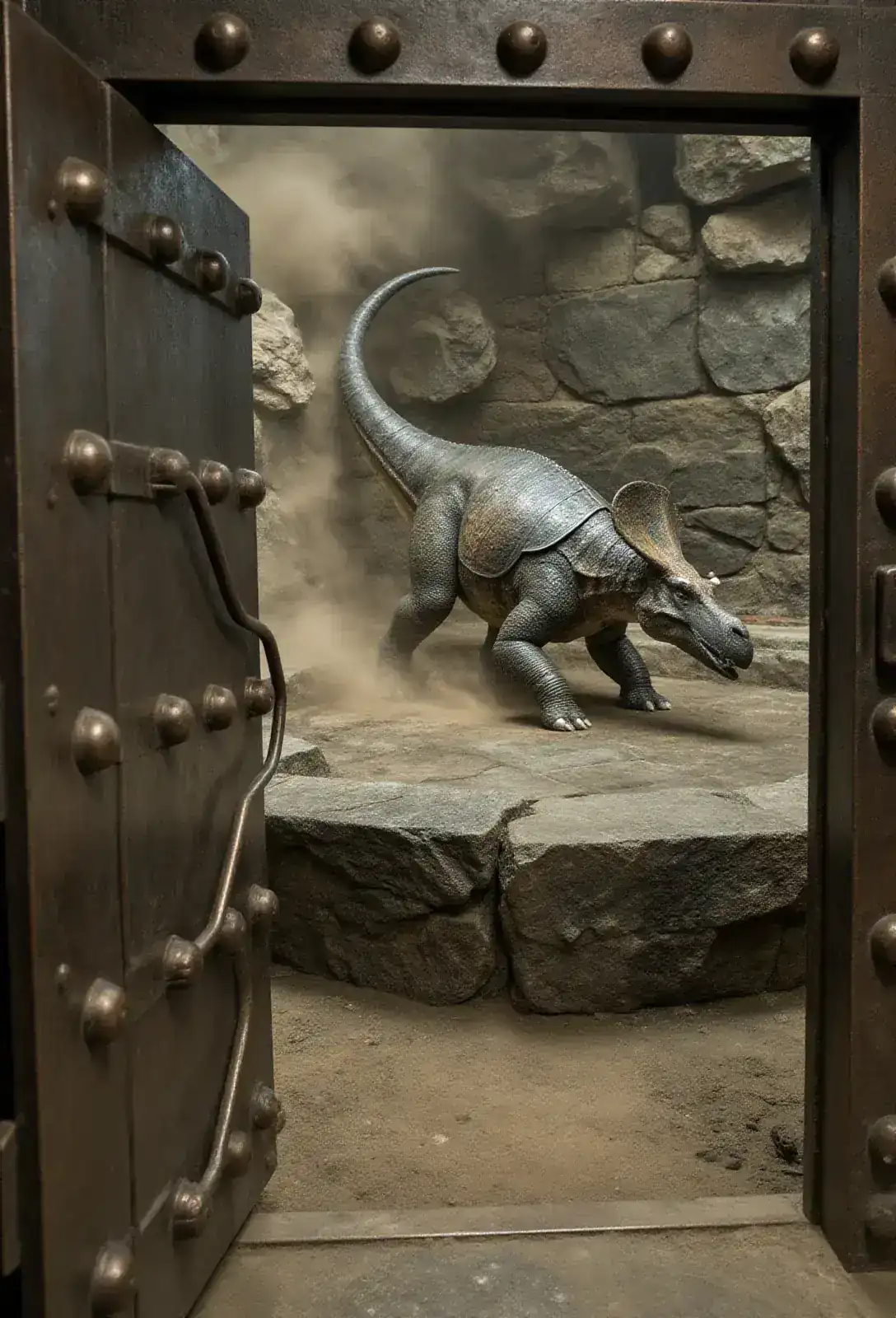
Joyce unlatched the door. He pushed it open. They stepped onto a railed platform above a pit.
The pit was fifty feet across, old stone, well lit by halogen banks set into the high arches. At the bottom, almost filling the floor, was an ankylosaurus the size of a small car. It was hammering its tail-club into the south wall in a slow regular pattern that had bowed the stones back two feet. Rock dust hung in the air in slow grey sheets. The animal did not look up. It was working.
Joyce had to fit his words between the strokes.
“A souvenir,” he said, “from our cleanup effort on Isla Nublar. We raised it from an egg —”
“From an embryo,” a voice behind them said. “To — to be precise. Embryo, not egg. Important distinction. Eggs are. Eggs come later.”
A young man had come through the door behind them. He was soft and slightly hunched, with thick-rimmed glasses he had to push back up his nose every fifth blink, and a rumpled lab coat over a graphic T-shirt that had a cartoon of a DNA helix wearing sunglasses. He talked with the unsorted quickness of a man who had been corrected too many times and had decided to say the correction first.
“Like the embryos you stole from us,” he added, looking at Nick, then at the ankylosaurus, then back. “Maybe we should put him down with her for awhile, to. To see what.”
“Be polite, Sherman,” Joyce said. “We haven’t even had dinner yet. Nick, this is our chief of Applied Genetics, Sherman Fosdick.”
Sherman half-extended a hand, then withdrew it. He pushed his glasses up the bridge of his nose. The handshake never happened.
The ankylosaurus hammered the wall.
Joyce led Nick away from the platform and back into the corridor, with Sherman trailing behind them in a hunched walk and a long unfinished sentence about acetylcholine. Joyce leaned in toward Nick’s ear as they walked.
“Too much Dungeons and Dragons. Not enough socializing with the other children.”
“Why bother having the thing if you’re going to keep it shut up in a dungeon.”
“Oh.” Joyce shrugged. “One never knows when an ankylosaurus might come in handy.”
They came to another door, this one steel-cored under a wooden veneer, and Joyce swiped a card.
“Come see the new wing.”
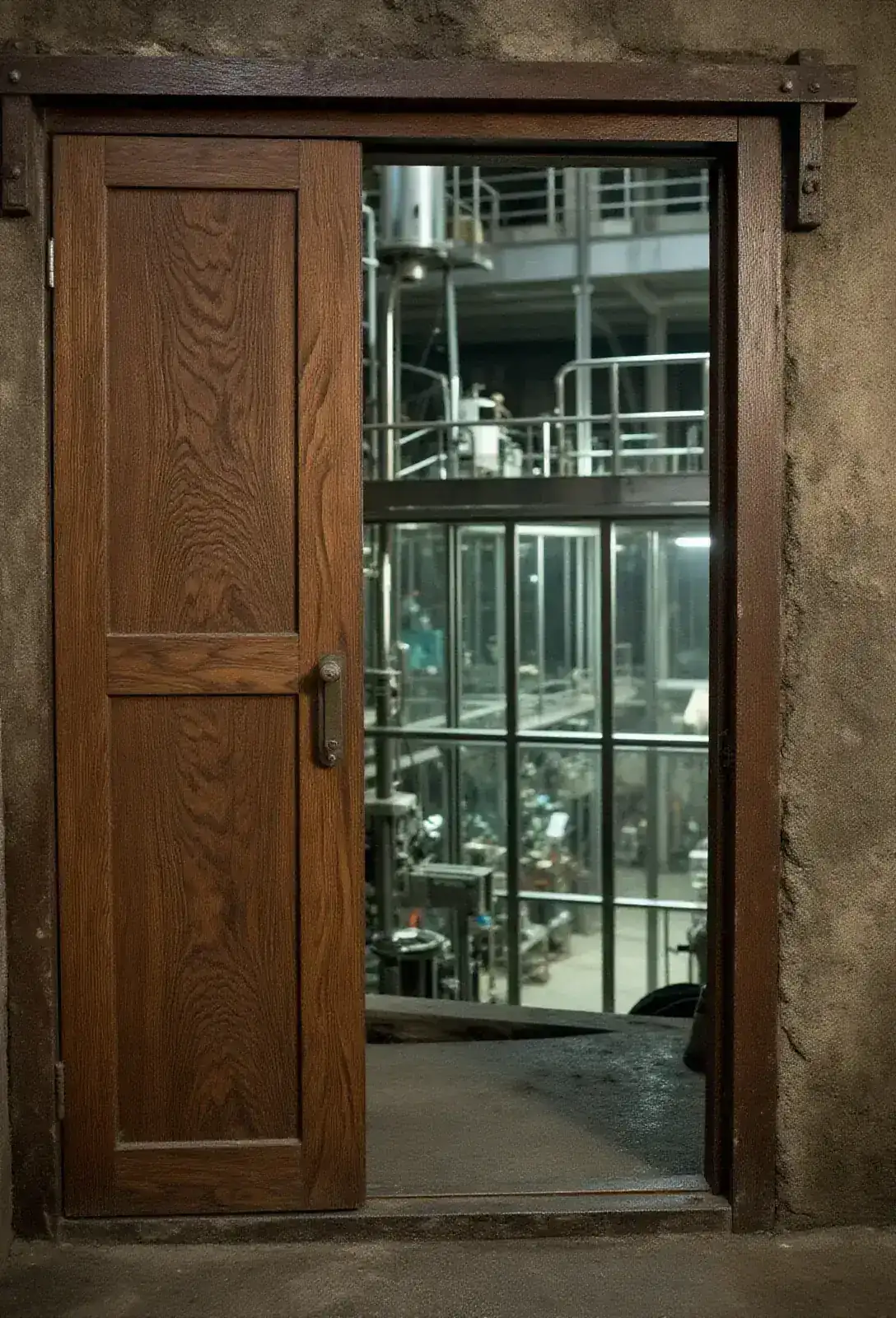
The door opened on a James Bond movie.
The cavern had been hollowed inside the mountain under the castle by a great deal of expensive cutting, and it had been outfitted with the kind of lab equipment that did not appear in catalogs. Glass partitions. Ventilation hoods. Centrifuges. Three rows of stainless gantries running into a central clean room. Metal stairs descended into the maze.
“The castle sits on an enormous cavern in the mountain,” Joyce said. “The original Baron kept his wine down here. We have expanded a bit.”
They started down.
“The corporation paid for all this?”
“We have several products that are doing very well at the moment. An insect-resistant rye grain, super-strains of hops and barley. And of course we were the first in Europe to market pre-sliced cheese.” Joyce smiled at the smile of a man who knew the joke he was making. “Dairy is very important here in Switzerland.”
They went down. The stairs went a long way down. The deeper they went, the cooler it got, and the cool was wrong for September even in the Alps. It was the cool of refrigerated rooms that did not want their air mixing with the air of mountains. A second cavern opened off the first. Nick caught a glimpse of a cold-storage tank the size of a railroad car with German lettering on the side. The lab had a department for raising things and a department for keeping things, and the keeping department was the bigger one.
A roar came up the stairs from a long way down, and the roar was not a cow. The roar bounced down the cavern and came back from three walls at once and came back wrong from the third. Nick stopped on the metal stairs.
“One of your cows,” he said.
Joyce smiled.
“Come and meet the boys.”
Behind him, somewhere in the dark above the gantries, a long muscular thing slid out of view across a steel mesh ceiling. Sherman Fosdick saw it. Sherman did not say anything. His glasses slipped half an inch and his hand came up to push them back, and the small movement of his hand was the only thing in the cavern that, for that second, was honest.