Rotor chop. Cheek on warm metal. Cruise rev, not transit.
Nick came back to the world in pieces. He was on a deck. He was airborne. They weren’t going far.
He kept his eyes shut. He let the rest of the body inventory itself. There was blood on his face, dried, with a fresh taste at the corner of the mouth. His hands were free. His ankles were free. The .50 was gone from his right hip and the cell was gone from his left. The knife in his boot, by the small bony pressure of it against his ankle, was where it had been.
He opened his eyes a slit.
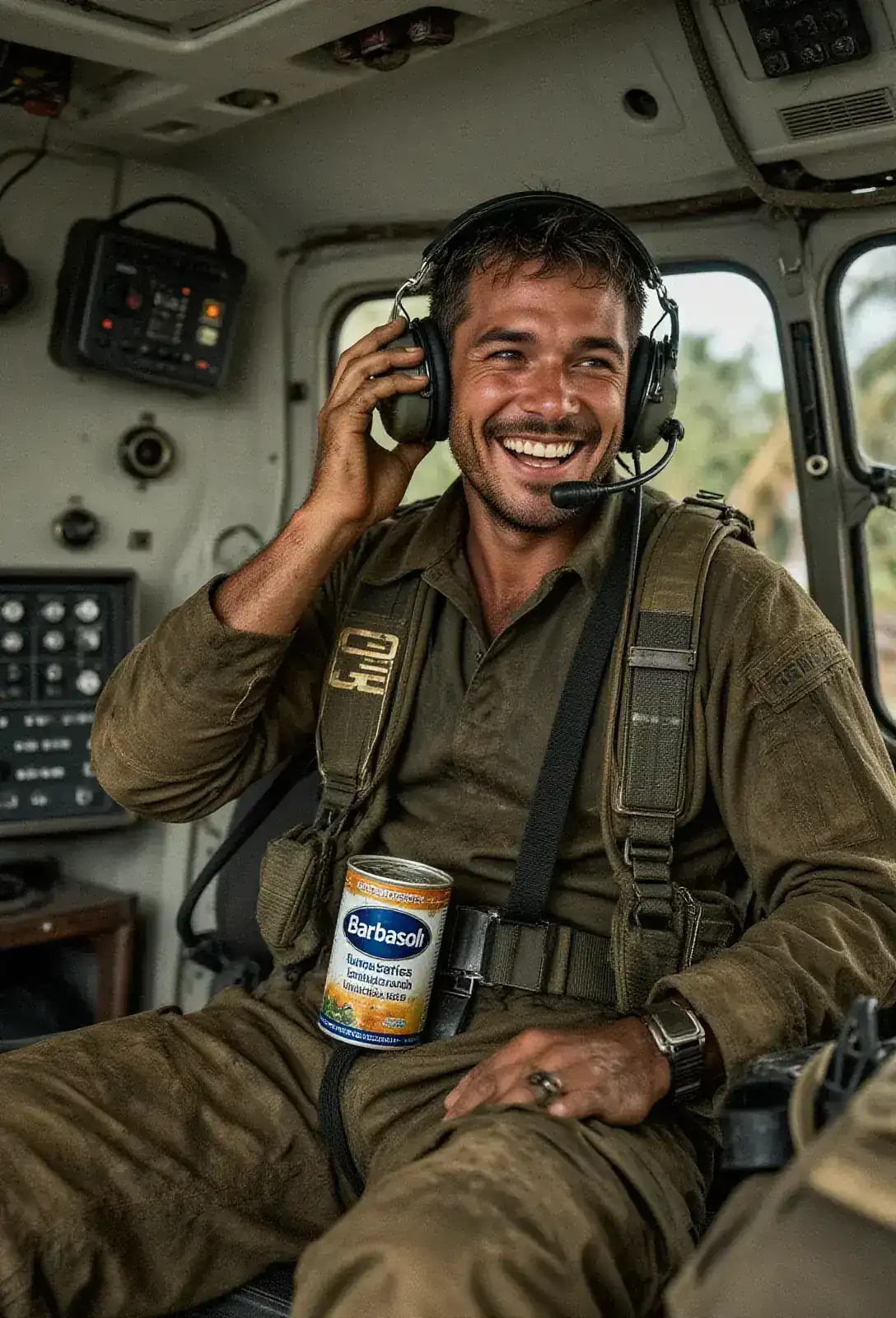
Nando, since the pilot had used the name twice in the comm, Nando, hombre, Nando, was on the bench across from him with the Barbasol can on his lap and his head turned forward, joking in fast Spanish into the comm. The can was within an arm’s reach. By the arm Nick had today, a long reach. The bay door was open. The world out the bay door was a thick blue stripe of sea topped by a thin yellow stripe of beach with bodies on it.
Tourists.
He could see, very low and clear, what would have been a postcard of a town, a town with palapas and a long curved wash of sand and a thousand people on it doing the small careful work of having a vacation. Towels in colors. A row of plastic chairs. Children at the surf line where the foam runs back. He estimated, by the angle of the sun and the white triangle of a hotel rising past the beach, that the chopper was at forty feet and dropping.
Forty feet. He had jumped from worse.
He gathered himself the way a man gathers himself when he has only one motion in him. He slowed his breathing. He counted. He kept his eyes off the can. Looking was the first thing a watcher saw.
He moved.
He came up off the deck in one motion and his hand was on the can and his hip was past Nando’s knee and the door frame was at his shoulder and he was out. There was a quarter second where he saw, very clearly, the beach below him at the angle of a man who has decided to fall, and that quarter second was the cleanest moment of the run.
Then he was in the air.
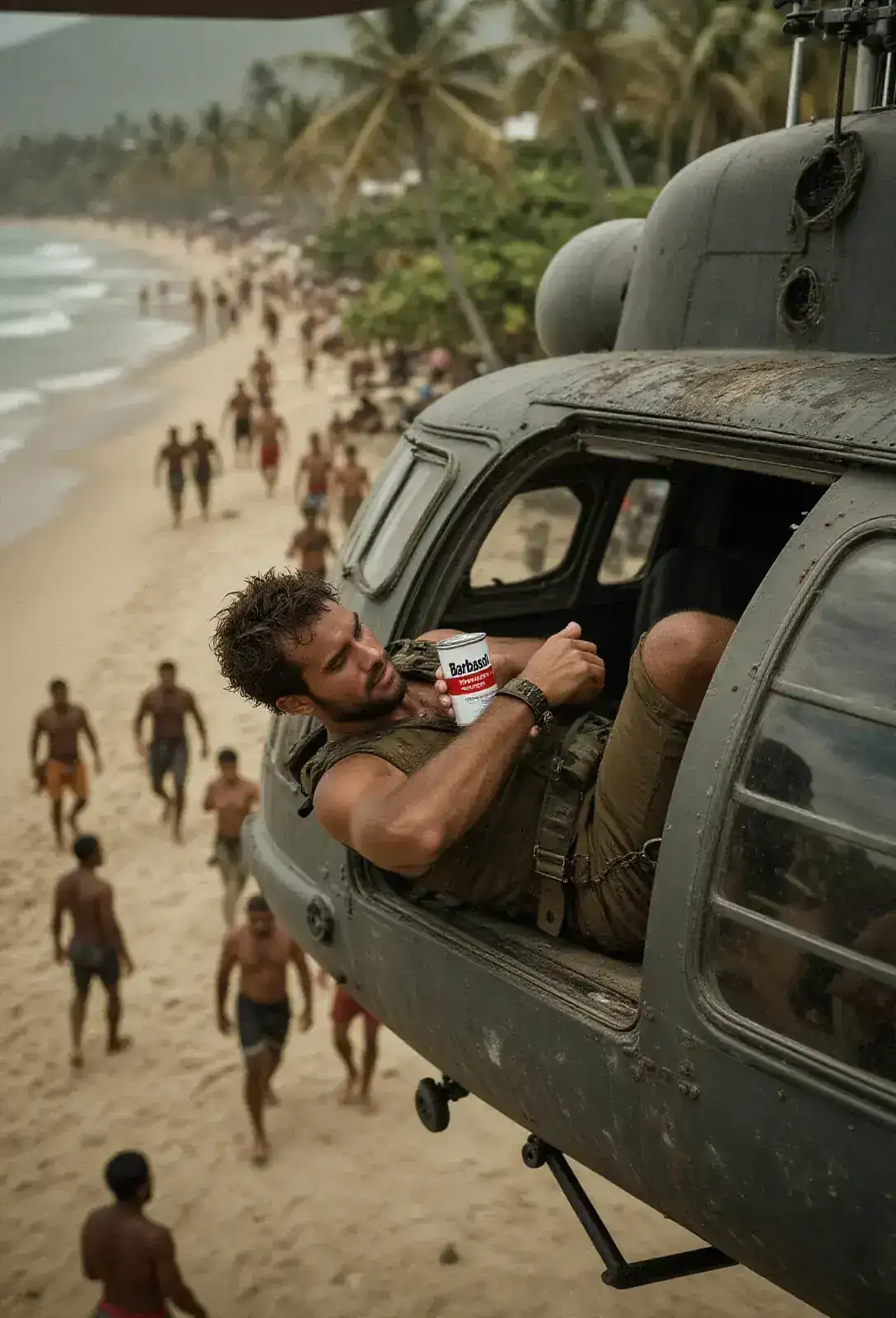
Forty feet is, as falls go, not negotiable. He went in feet first with his arms in close and the can crushed to his sternum. The water hit him like a board. His feet went in past his hips and his hips went in past the chest. He came up with his ears ringing and the salt cutting at his nose. The can was at his chest. The can was wet but the can was sealed. He swam.
The chopper banked above him and came around. The beach watched. A few of them clapped.
He came up running on the wet sand. There was applause. There were children pointing. A man with a tray of paletas had stopped pushing the cart, watching with the still attention of a man who knew he was about to be in someone’s home video. A boy of about six in red trunks held a sand pail with a tiny crab in it and lifted the pail up to show Nick as he ran past, the way a child shows a stranger a small wonder. Nick crossed the strip of sand at a dead run, the Barbasol can slick in his hand, and the chopper came down behind him with the rotors blasting sand and the people who had been clapping had begun to scream.
He saw a man up the beach he half recognized, and the half recognized was Overton, in his hummingbird-patch shirt looking out the wrong way down the surf. There was no time to stop. He shouted, on the sprint, as he passed:
“Ask for a cold one at Rodrigo’s.”
Overton turned. He saw Nick. He saw the chopper. He started moving.
The chopper hovered up above the palapas and the row of fried-everything stands at the back of the beach, turning this way and that the way a hummingbird turns when a hummingbird cannot decide which feeder it wants. Nick went through the palapas at speed, came out into a back alley that smelled of cooking oil and bleach, and put his hand on the back wall of a building and worked along it staying out of the line of the sky.
He found the back door of Rodrigo’s. He went in.
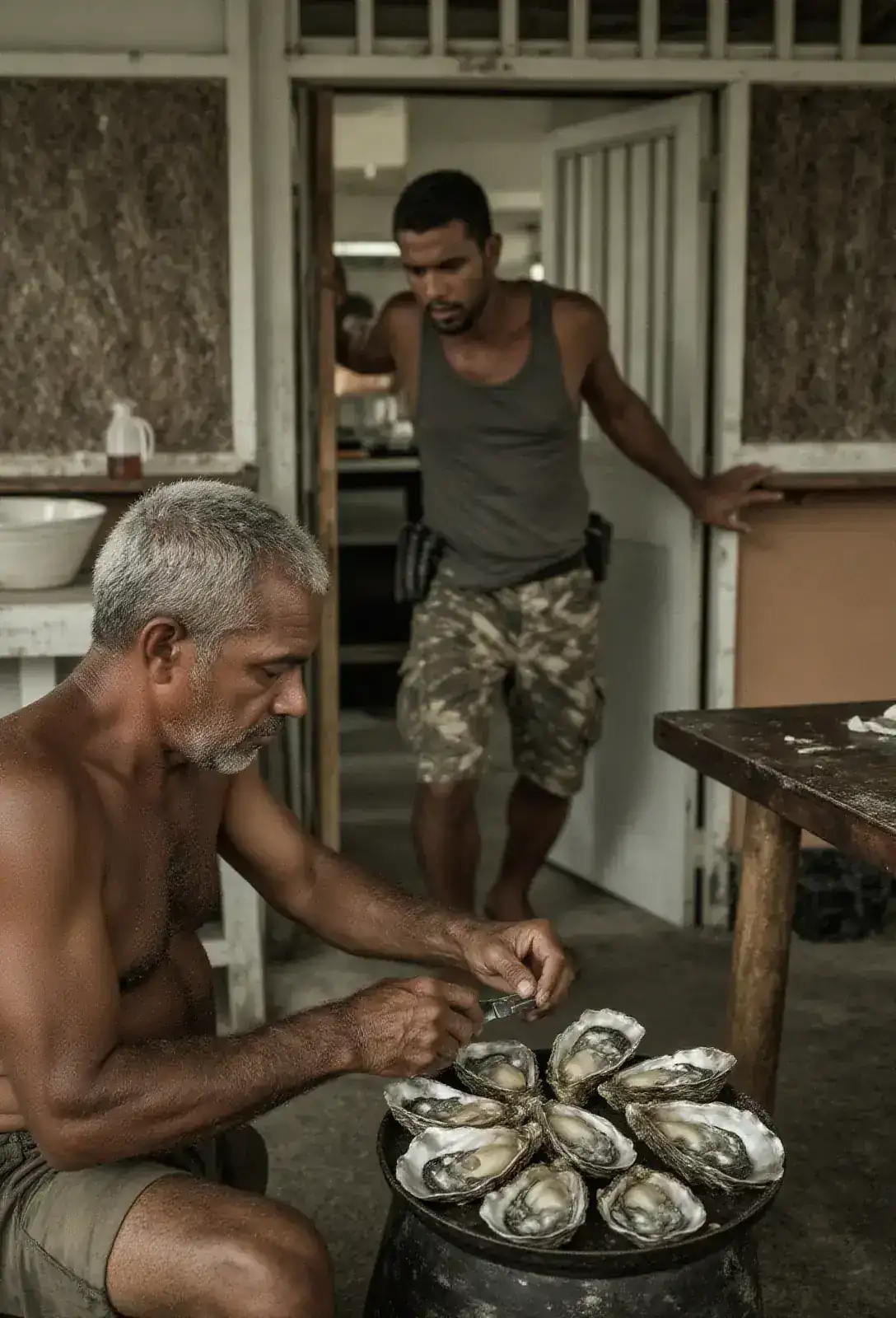
There was an old man at a small table with a heap of oysters in front of him, shucking. He had a thin paring knife and a wet folded cloth and the cloth was pink at the edges. He looked up at Nick and made the small acknowledgment one bartender’s friend makes another in the back of a kitchen, and went back to the oysters.
A Coca-Cola cooler buzzed in the corner of the kitchen with a chipped enamel front and a hinged lid. The cooler was older than Nick, older than Rodrigo’s, possibly older than the building. Someone had stenciled HIELO across the lid in black paint that had run before it dried. Nick crossed and lifted the lid. The cooler had thirty-odd long-necked bottles of beer in it on a bed of crushed ice, and there were a few small fishes in a wax paper at the bottom. He set the Barbasol can down among the bottles, label out, pushed it back two inches into the row. From above, lid open, the can was indistinguishable from the brown bottles around it. From below, looking up, the can would be the only white thing in the row, but no one was going to be looking up.
He turned to the old man. He spoke with the small deliberate care of a man who had not slept in twenty hours and did not trust his own Spanish.
“Voy a enviar a alguien para recuperarlo.”
The old man shrugged. He kept on shucking. The blade slid under a hinge and broke it with the precise small pop oysters make.
The chopper sound got louder over the roof. Nick went out the way he had come in.
He took the back streets at a limp. He passed a girl selling cut mango out of a small bowl with chili flakes on it and a paper straw. He thought about buying the mango. His pesos were soaking. Stopping got men killed in towns like this. The girl watched him go past.
He had hurt his right knee in the fall, and he had not noticed in the run because the body did not let him notice, and the knee was making up for the silence. He went two blocks and stopped in a doorway across from a small painted sign that said HOTEL DELPHÍN. The hotel was three stories, pink at the ground floor, the second story sky-blue, the third story a different sky-blue, paint that had clearly run out and been bought again at a different store. A vendor pushed a cart past, calling popsicles. Paletas, paletas, muy frescos, muy ricos. The vendor was not looking at him.
Nick took the small clean back-up cell out of an inner pocket. The cell had been wrapped in a Ziploc inside the inner pocket and the Ziploc was full of saltwater that had got in through the seam. The cell, by some grace, was dry. He keyed Overton on the second ring. He kept his voice low.
“Just do what we agreed on before. I’ll contact you when I’m in the clear.”
Overton’s voice came back at him, dry and patient, the voice of a man who had heard worse than this from a man on the run. “It’s very hot right now. Keep your head down.”
“I’ll do my best.”
He clicked the cell off and put it back in the inner pocket. He looked across at the Hotel Delphín. He looked back along the street. There were thugs in sunglasses cruising at a slow pace down the avenue, shoulders square in the perimeter walk that men of that profession use when a hunt is on. He weighed his options. The options were not many. The options were a hotel, a hotel, or the open street. The hotel had a roof.
He limped across.
The lobby of the Hotel Delphín had a ceiling fan that was not turning, a console TV showing an Argentine soap with the sound off, and a bowl of mints on the desk that had cemented themselves into a single fused mass. The smell was bleach over old smoke. A wedding photograph from another decade hung on the wall behind the desk. The bride had a wide gap-toothed smile and the groom had the haircut of a man who had recently won an argument.
The desk clerk was a kid reading a comic book. The clerk did not look up when the door chimed. Nick crossed to the desk and put his hand on the wood.
“Joven. ¿Ha estado alguien buscándome? ¿Esperándome en el cuarto?”
The kid put a finger in his comic book and looked up the way kids look up when an adult has interrupted them in the middle of a panel they were enjoying. He shook his head. “No, Mr. Harris. Nobody been lookin for you.”
Nick took his key from the cubbyhole. The cubbyhole had his name in pencil on a scrap of card. The pencil was the kind of pencil you sharpened with a knife. He went up the stairs. The stairs were tile and his good knee was carrying both his knees up them.
The corridor on the third floor was narrow and the ceiling fans were turning at the slow rate they turned in places that did not have any reason to make ceiling fans turn faster. The carpet had a print in it that had been a print of green leaves and was a print of green smudges. He limped to his door. He worked the key.
The door opened.
Nando was standing in the room with a different aerosol can in his hand, the nozzle pointed at Nick’s face. He had a shoulder rig on and a bandage along one cheek where someone had hit him, recently and well. He smiled the smile a professional smiles when he has caught up and the chase has not, on the whole, been satisfying.
“What’s that supposed to be,” Nick said.
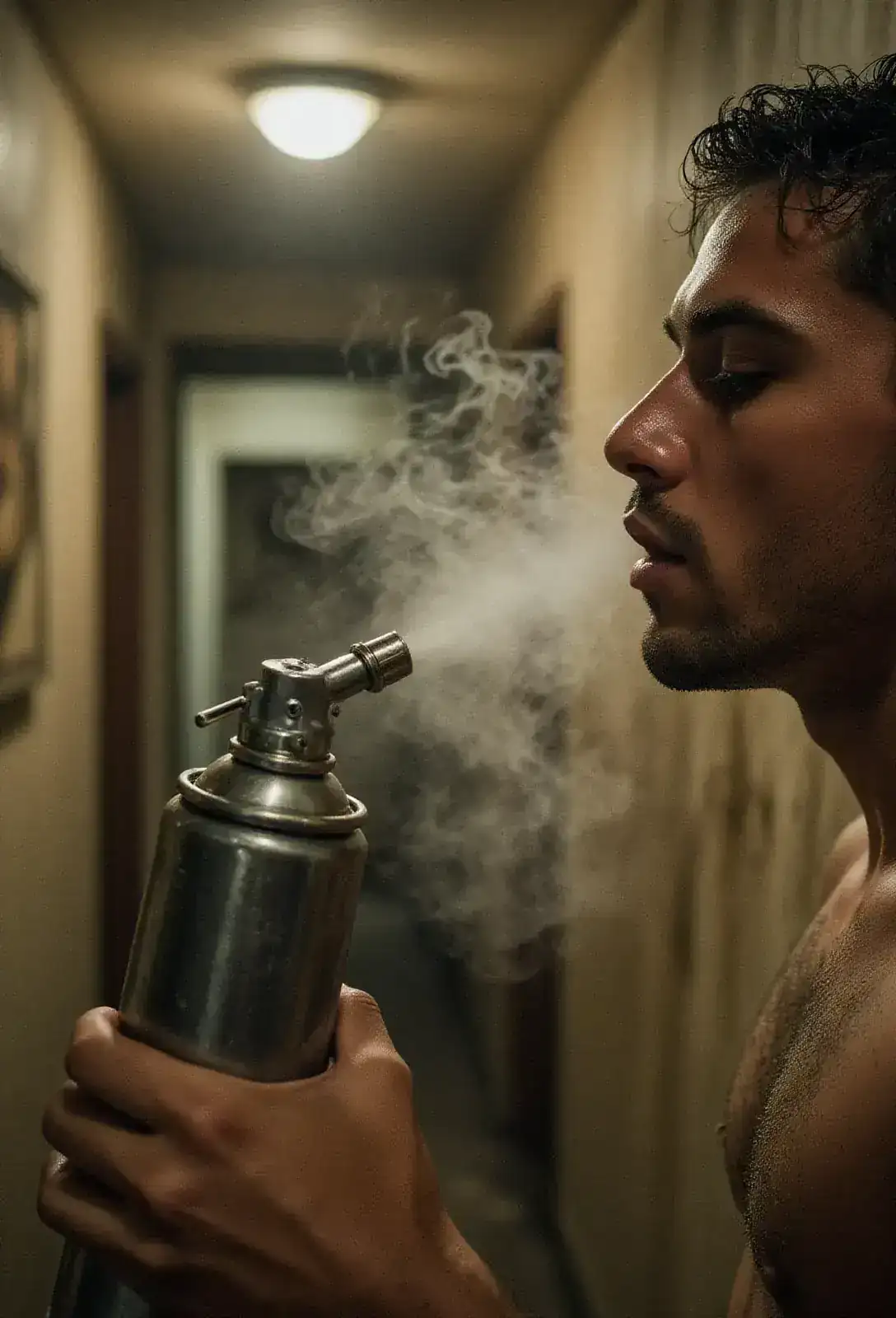
Nando hit the button.
The mist hit Nick in the eyes and the mouth and the back of the throat all in the same instant. It was sweet. It was, on the second instant, not sweet. He took half a step backwards into the doorframe and his hand went up to grab a wrist that had become two wrists and then four. The corridor began to slide. The leaves on the carpet detached and lifted. Nando, behind the doubled wrists, was patient. The face in front of him went out of focus and out of size. He felt his knees go before he felt the floor.
“What’s that,” he said again, and the words came out the wrong shape.
He went down.
The carpet came up at his cheek. The green-smudge print blurred and stayed blurred. The dark came down.
When the world came back it was yodeling. Slow alpine yodeling, two men trading a phrase, the kind of phrase men traded who had been trading it since boyhood. The recording, if it was a recording, was very loud. He was not in the hotel. Wherever they’d taken him, they had taken him a long way.
A bolt turned in a lock behind him. Old iron. The sound a door made in a castle.