The boys lived behind one-inch laminate glass and the laminate glass had been hit very many times.
Nick saw the spider patterns in it before he saw what had made them. There were three patterns at chest height and two at face height and one, the largest of them, at the height of a man’s hip, with a long horizontal scrape under it where a claw had drawn back. The glass had held. The glass was held in a frame of black I-beams welded into the cavern wall by men who knew what they were welding for.
He looked through the glass.
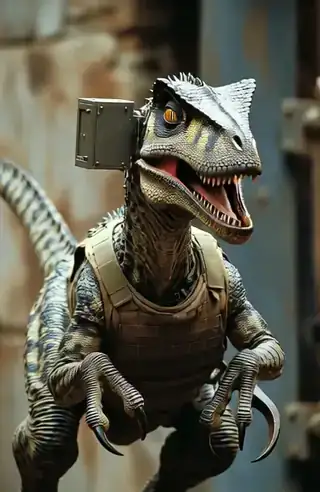
The thing on the other side of the glass was eight feet tall. It was running. It was running in a circle around its own enclosure with the focused, demented patience of a thing that had been doing this for hours and was going to do it for as long as the body would let it. The scales were a mottled black that shifted, when the light moved, into a deep dirty green. The forelimbs were longer than the forelimbs of any raptor Nick had seen pictures of, and the fingers on them were too long and too articulated. There was a regulator box bolted into the side of its head above the ear hole. Spray-paint on its flank, in fluorescent orange, said X-1.
It hit the wall on the third lap and bounced off and made a sound that did not belong to any animal.

“This is X-1,” Joyce said. “Our alpha male. Not in the best of moods at the moment.”
A woman was at a desk in the observation room, in a lab coat over a dark grey turtleneck and cargo pants, writing on a clipboard. She kept writing. She had ash-blonde hair pulled into a knot at the back of her head and her wrists, where the lab-coat sleeves rode up, had a faint silvery scar work that looked like the work of an animal smaller than the one in the enclosure.
“If you keep them in captivity,” she said to the clipboard, “you’ve got to accept a certain amount of neurotic behavior.”
“Training, not captivity, please,” Joyce said.
“Whatever.”
“Maya Lundberg. Our head of Behavioral Modification. Meet Mr. Harris.”
That got her to look up.
Her eyes were grey and intent and a little tired and assessed Nick from his boots up to the corner of his jaw and back to his boots in two long seconds. She nodded. “The trespasser.”
“We all followed your progress on the island,” Joyce said. “Sort of like an episode of Survivor.”
The X-1 hit the wall again. Maya did not flinch.
Nick stepped to the glass and looked down. The deinonychus, full forty paces away from him, came up out of its lap and locked eyes through the glass and skidded to a stop on the stone floor of its enclosure. The eyes were red. They were not red the way an animal’s eyes are red in a flashlight. They were red the way the inside of a cigar tip is red. Whatever was in the regulator box was not winning.
“So this is, what, like a mid-sized Tyrannosaurus?”
“Deinonychus,” Maya said. “Terrible claw, in Latin.”
“Deinonychus draxi.” Sherman Fosdick was at the doorway behind them, push-pinning a freshly torn print onto a corkboard with two fingers because he had a Diet Coke in the third. “It’s a sub-species. Wow. Look at that adrenaline.”
He had stepped to the panel of vital-function monitors and was reading the EEG with the loose excitement of a man who had been reading it for an hour and could not stop. Maya turned in her chair.
“Would you shut him down. He’s going to hurt himself.”
“X-1 is too cagey to hurt himself. No matter how much we pump him up.”
“Sherman.”
He went to the radio transmitter, punched the timer, and turned a dial. He kept narrating. He could not not narrate.
“Call out when the reticular formation goes blue.”
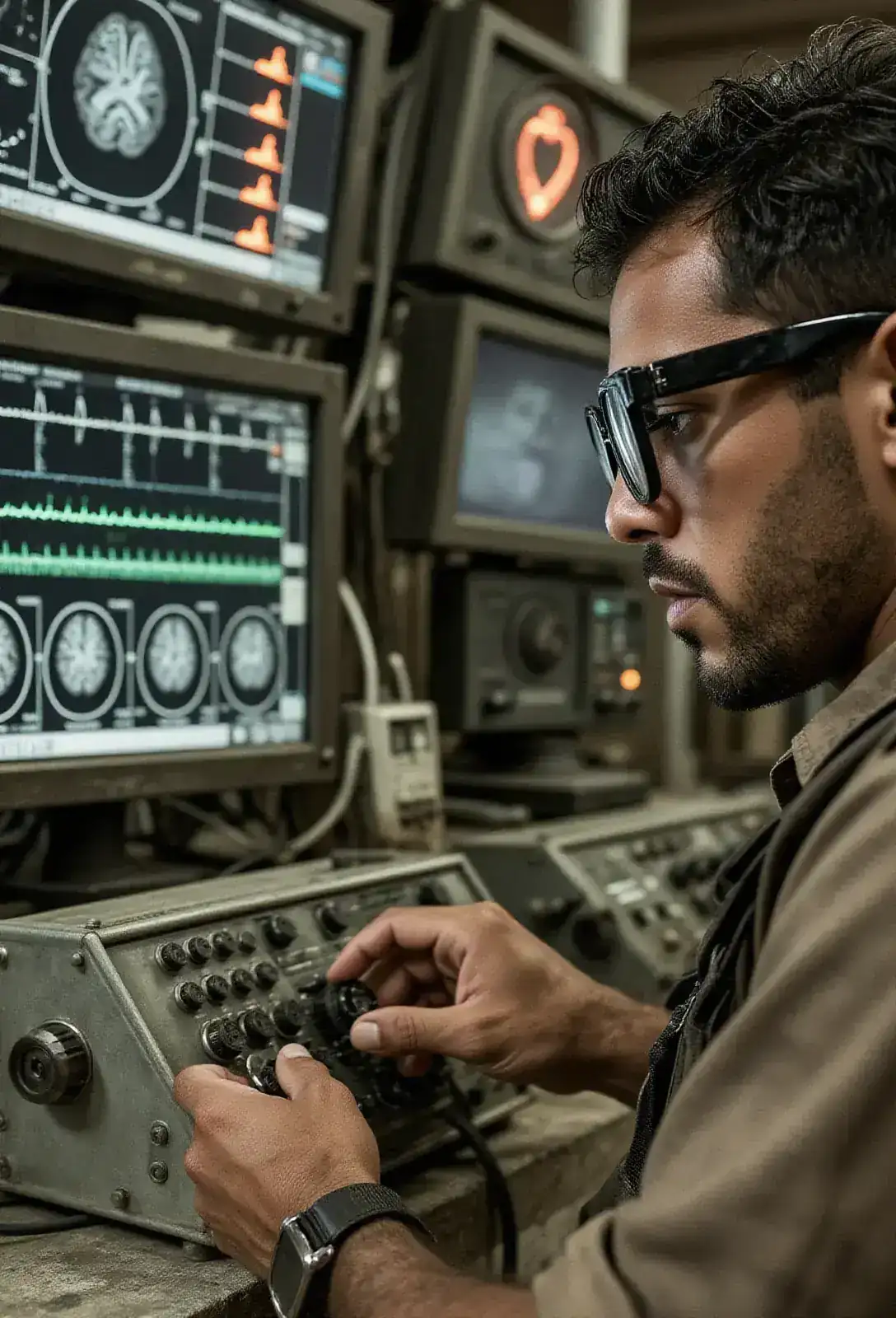
The brain-scan image on the upper monitor began to cool out of red into orange and orange into a steady working blue. In the enclosure, X-1 staggered. He staggered like a man who had been hit but was deciding not to fall. Then he was deciding to fall. He went down on his haunches with the heavy careful motion of a thing whose body was being rewritten under it, and his front limbs, those wrong, too-long front limbs, came down and propped him.
“Look at that,” Sherman said, almost in love with the dial. “And I’m only restricting acetylcholine.”
“Don’t make him fall over again,” Maya said. “His ribs.”
“Come on, baby. Nice soft landing.”
The deinonychus settled into a low crouch. The breath came out of him in slow heavy bellows. The eyes half-closed. He stared into a middle distance that was not in the room with them.
Nick turned to Joyce. He kept his voice low.
“What did you just do.”
“We’ve placed a few strategic implants,” Joyce said. “To let us control its hormones by radio signal.”
“Not hormones,” Sherman said. “Neuropeptides.”
Maya had not turned away from the glass. “Right now it’s experiencing something like acute chronic fatigue syndrome. Before you came in, the parts of its gray matter controlling rage and aggressive behavior were stimulated. We were running an arousal study.”
“It looked like a fit.”
“It was a fit,” she said. “We wrote it.”
Nick looked back through the glass. The deinonychus had fixed his head sideways and was watching Sherman through the window with one ruby eye. The eye, Nick noticed, was tracking. It was tracking the small movements of Sherman’s hand at the dial. It was learning.
“He’s faking it,” Nick said.
“What?”
“He’s not as far down as you think.”
Maya turned and looked at the heart-rate monitor and looked at the brain scan and looked at the deinonychus through the glass, and the small line at the corner of her mouth tightened a fraction. She did not, this time, contradict him.
Sherman did not notice. Sherman had moved on to a second dial.
Joyce smiled. “You remember the cockfights in Honduras? When a rooster gets mad, blood flows into its comb, responding to the adrenaline. But if the handler put the comb in his mouth and sucked blood into it. The rooster got mad before he even saw his opponent.”
“Fortunately for us,” Sherman said, “reptiles have a very compartmentalized brain. Just like chickens. We don’t get much spillover when we want to induce a specific emotion.”
“For what purpose?”
A silence.
Maya and Sherman looked at Joyce. The look was the look of two staff members waiting for the manager to decide which version of the company line to deliver. Joyce smiled the half-smile, the fencer’s smile, the smile that did not reach the eyes.
“Let’s leave that for tomorrow. You must be exhausted. You’ve travelled all the way from the Jurassic Era to the twenty-first century.”
Maya stood. She crossed the small space of the observation room. She put out her hand.
“Mr. Harris. I look forward to working with you.”
He took her hand.
She was strong in the wrist and the palm was dry, and there was, between her thumb and his, a small folded piece of paper that she pressed into his palm with the deliberate firmness of a woman who had practiced the move and knew the angle.
She let go.
Joyce had turned to look back into the enclosure. He gave a small nod, more to the window than to anyone.
“You kind of wonder what he’s thinking, don’t you?”
Nick brought the hand with the paper down to his side and closed it. He stepped to the glass. He looked in.
X-1 had recovered enough from the chemical down-shift to stand. He was on his feet at the center of his enclosure, weight balanced on the great curving sickle of the second toe of each foot, and his eyes had refocused. They had refocused on Nick. They were holding him with the stillness of an animal that had taken a measurement and would not need to take it again.
A colonel he had served under had once looked at him that way. So had a man he had killed. The look of a thing that had decided to remember a face.
“He’s wondering,” Nick said, “which one of us he should eat first.”
A small breath of a laugh from Maya. Joyce, from a step behind, allowed himself a wider one. The deinonychus did not move. He tracked Nick, by minute changes of head angle, as Joyce led Nick to the door.
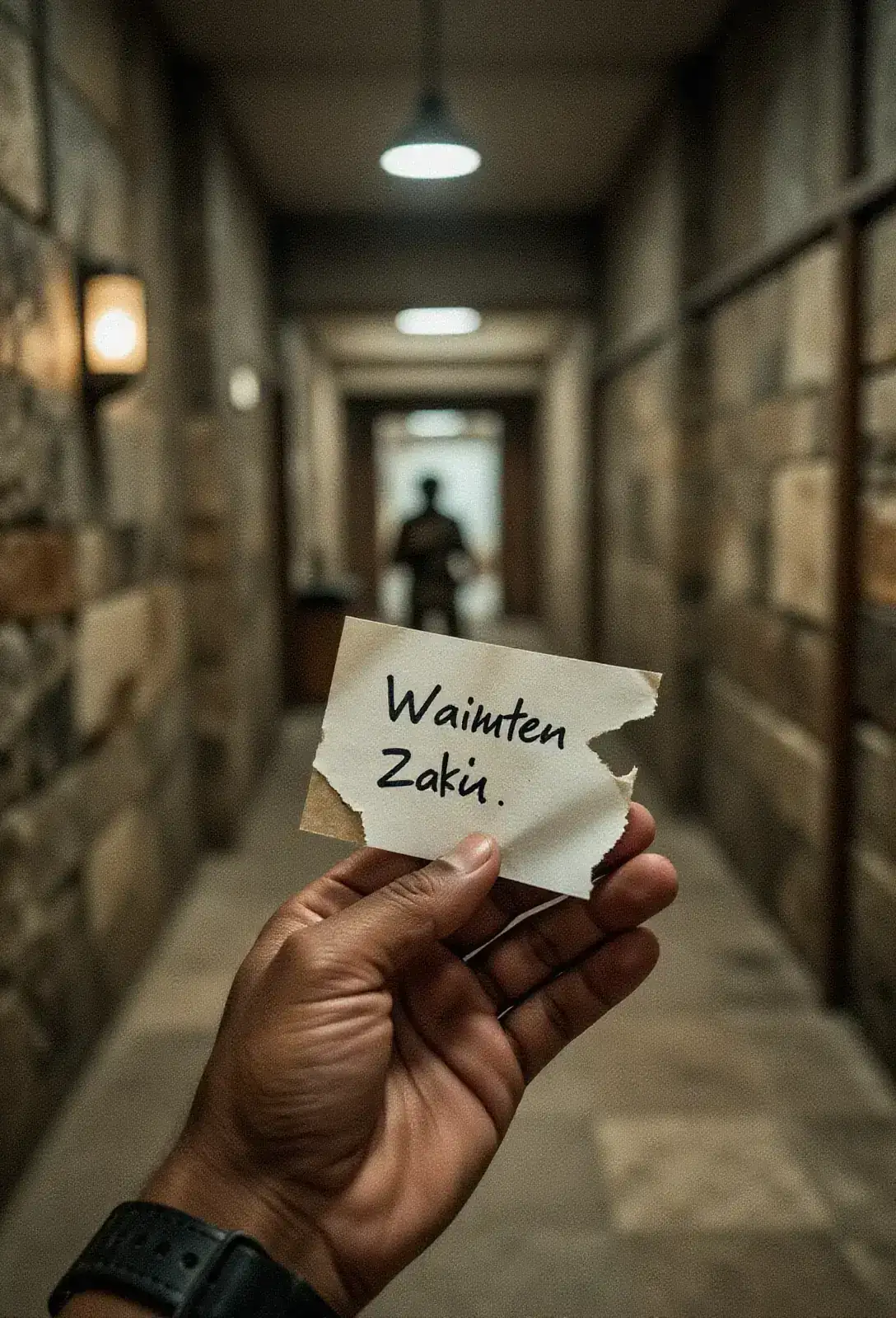
In the corridor, Nick opened his hand, palm up, and looked at the paper.
DO NOT GIVE THEM THE EMBRYOS.
The handwriting was small and even and slightly to the right. The pen had been pressed hard. The word EMBRYOS had been underlined twice.
He folded the paper into a quarter and slid it into the watch-pocket of his jeans.
They walked back through the cavern toward the stairs. Joyce was talking again. He was talking about the Baron and an upcoming dinner and the value of the wine cellar that had been lost when they had cut the third level for the genome lab. The cellar had run to four thousand bottles, Joyce said, some of them irreplaceable. They had moved what they could. They had had to leave some behind. There had been, in the early days of the construction, a small electrical fire involving a 1959 Burgundy that Joyce had taken personally.
Nick did not listen.
He was watching the cavern, the layout of the security points, the doors that locked from the outside, the doors that locked from both sides, the maintenance hatches in the ceiling, the airflow of the cold-storage tank room. He counted the men in lab coats he could see and the men in tactical gear in the shadows behind them, and he came up, by the time they reached the stairs, with a number that was high enough to make his shoulders go down half an inch.
Six tactical. Ten lab. Two managers. Three computer techs in glassed offices, including one who had a cup of coffee at his elbow and a holstered sidearm Nick was pretty sure was a Sig Sauer.
He thought about the note in his pocket and what it would cost him. He thought about the can in the bottom of an old man’s cooler in a town six hundred miles south, in a row of beer bottles that had not yet been opened. He thought about Hammond, sucked dry by lawyers, plotting his last good play with a pencil on an order pad in a fake aviary.
He decided two things.
He was going to play along.
He was going to need a friend.
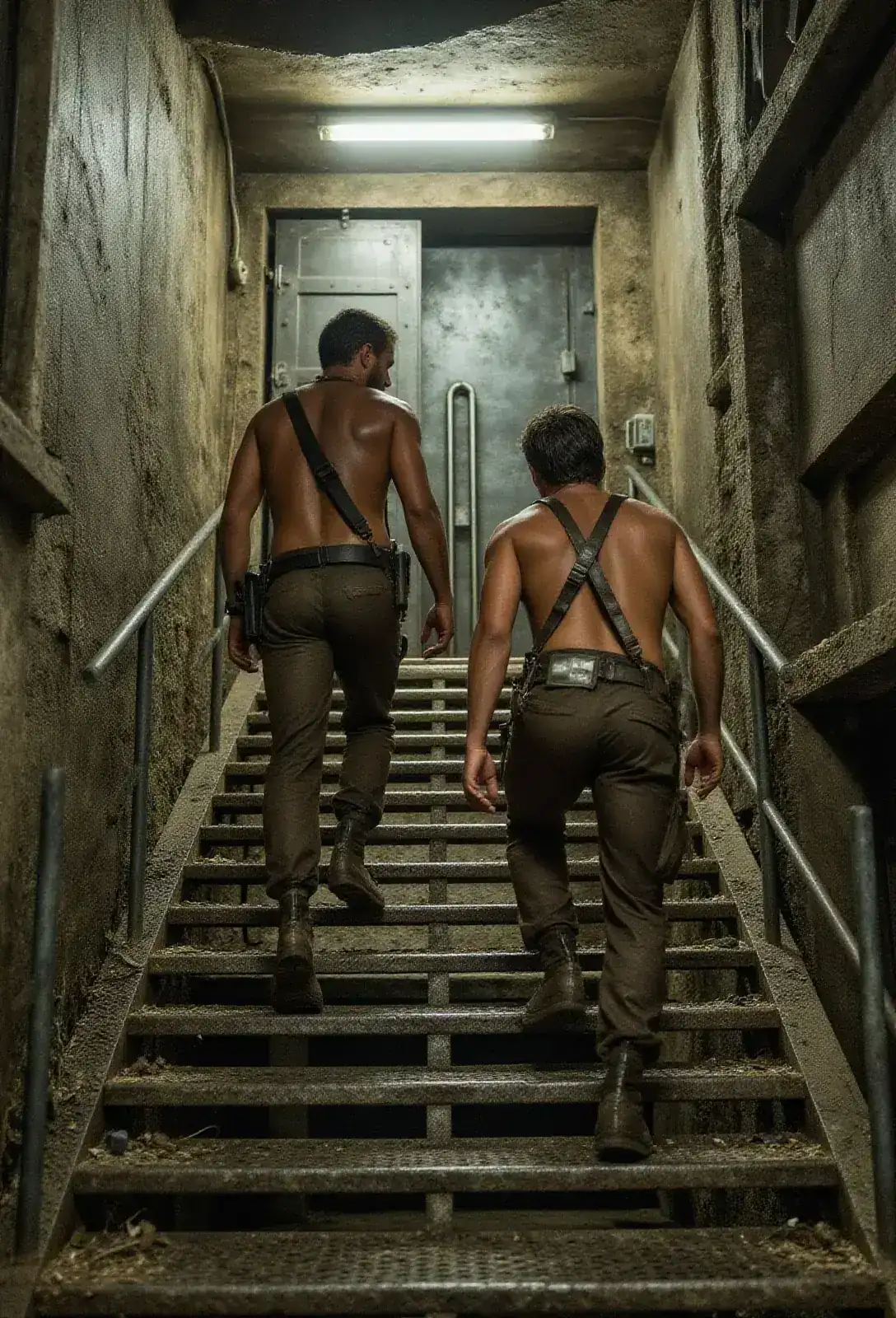
At the top of the stairs Joyce stopped at the steel door and held it open for him.
“Dinner is at eight,” he said. “The Baron does insist.”
Behind them, somewhere down past two layers of insulation and a steel door, X-1 made a single low call that was not audible in the corridor and was, all the same, audible to Nick. He had heard the call somewhere before. He could not place it. He thought about it on the way up the stairs, and he thought about it as Joyce led him through a panelled hall, and he had it by the time they reached his bedroom door.
It was the call of a man counting his men before a fight.
The butler was waiting at the door with a clean pressed shirt over his arm and a small silver tray of cheeses, and Joyce wished him a good evening and went away down the corridor with his hands behind his back, whistling something operatic. Nick took the shirt. He sat on the edge of the bed. He took the note out of the watch-pocket and unfolded it once and read it again. The pen had gone almost through the paper.
DO NOT GIVE THEM THE EMBRYOS.
He folded it back along the same crease. Whoever Maya Lundberg was, she had just bet her life on a stranger. Now he had to decide what kind of stranger to be.