The dirt was warm because something warm had been sleeping on it, and was not sleeping on it any more.

Nick saw the eggshells before he saw the rest. Big ones, off-white, the size of cantaloupes, in pieces along the floor. He counted them anyway. He counted because he was trained to count, and he could not stop, and the count, when he had it, was thirty-seven. Some had not hatched yet. The unhatched ones were leathery and warm under the flashlight beam and one of them was, very faintly, moving from inside.
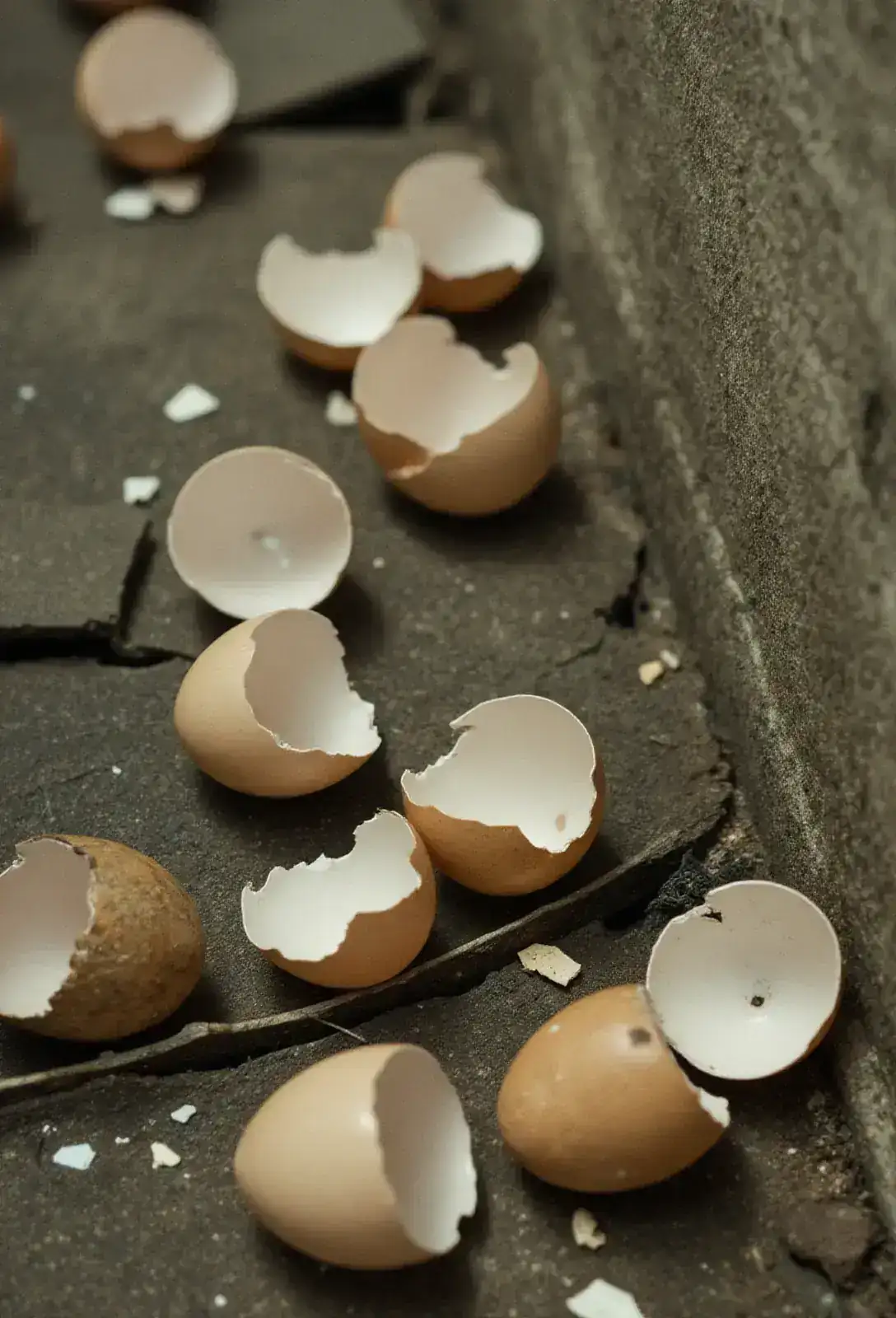
“Terrific,” he said. “It’s the nursery.”
A roar came down the tunnel behind him.
The map was wrong. The thing behind him wasn’t. Nick took the left fork and ran.
Pipes overhead clanked. A second clank answered the first. A thing in silhouette dropped from the pipes behind him and lay flat to the cement and came on, low, fast, the way no animal that hunted men was supposed to come. The flashlight beam, ahead of him, picked up a single cone of yellow daylight at the end of the tunnel where a maintenance ladder rose into the open.
Three Spitters stood between him and the ladder.
He had never seen a Spitter outside of Hammond’s brief description and a single grainy photo on the contract briefing. The neck-frill was a shock. It came up around the head like an umbrella opening, and the throat under the umbrella was wet and had something black moving in it. The body was not a body that wanted to be touched. The Spitter at the front hissed. The frill went up another two inches.
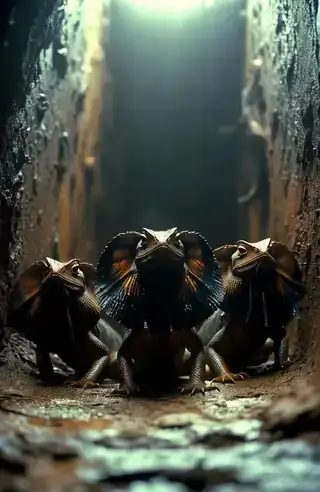
Nick whirled. Behind him, four more Spitters had come up from the floor he had not been watching, and behind them, by the sound of it, the digger was finally clearing the cover. He had a moment, and he used the moment.
POP. POP. POP. POP.
The .50 in his hand made the noise it made. The Spitters at the front backed up an inch and held their ground. They did not run. He clenched the pistol in his teeth, jumped, and got both hands on the overhead pipes. The pipes were filthy and the filth was a real grease that did the favor of giving him grip. He swung forward hand-over-hand, knees pulled to his chest, and the Spitters under him jumped up at his heels and the teeth missed him by inches the first time, less the second.
One of the Spitters went up the exit ladder ahead of him. It got to the top, turned, and was looking down with its frill up when Nick fired twice from where he hung, pistol in the right, the left holding all his weight. The Spitter went off the ladder past him and hit the floor with a sound that was wetter than it was loud.
He dropped. He hooked the top of the ladder with one foot. He went up the rungs in three movements.
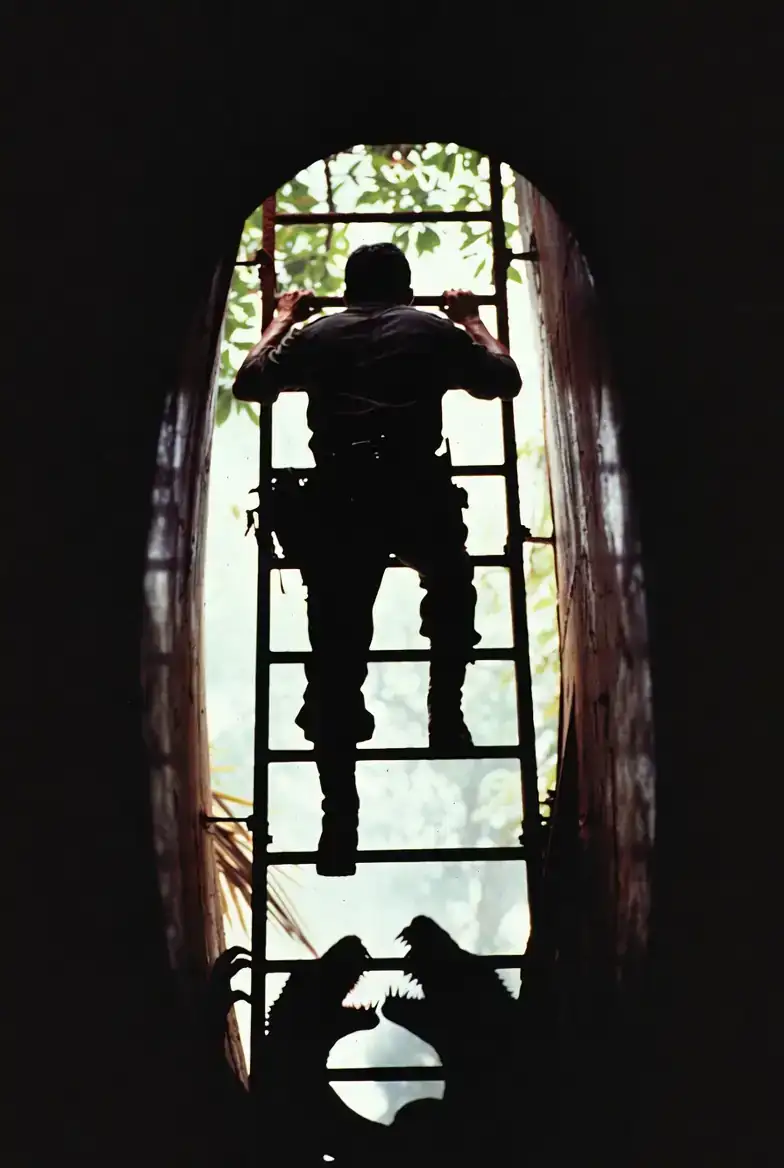
He came out into the back fence yard of the old park, panting, the sky bigger and bluer than seemed fair. The back fence was twelve feet of chain-link with a strand of barbed wire across the top, mostly intact. There was a low animal hole at the base where some short-legged thing had dug under. He took the pack off his back and pushed it through ahead of him. He squirmed under, and the steel of the bottom edge of the fence caught his vest and tore at his shoulder, and he came through.
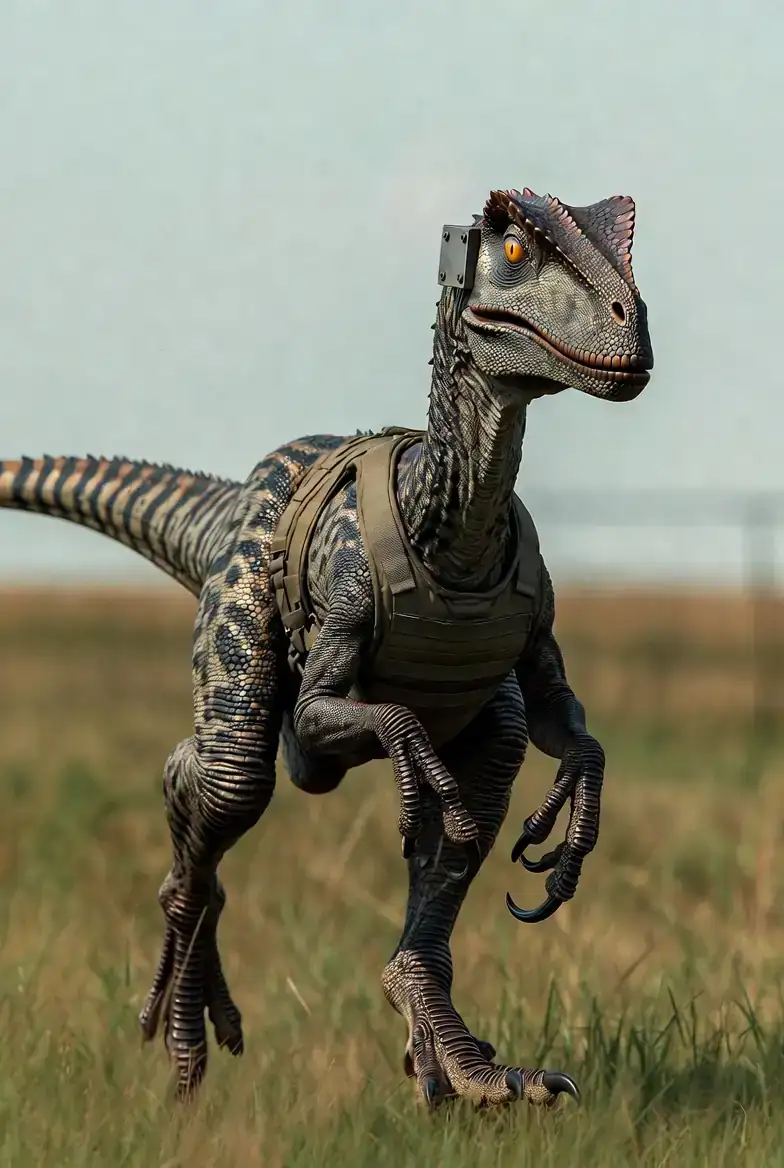
A digger came up the ladder behind him and out of the hatch. It got halfway out and a second beast yanked it back into the hole by the tail and there was a brief savage fight at the lip of the hatch, all teeth and dewclaw. Black scale slid against black scale. Something underground made a sound like a man’s belt being torn off a buckle. Then the digger came out again, on its own this time. It hit the fence headfirst, looking for him.
He grabbed the pack on his side. The Barbasol can was visible in the webbing pocket. The digger started digging at the base of the fence with a focus of purpose that meant the fence was going to lose this conversation in under a minute.
He started running parallel to the chain-link. He slapped the fence with his open hand.
“Come on, you stupid lizard. Come and get me. Come on, knucklehead.” His own voice was rough at the back of the throat. He was running on adrenaline and saltwater and he could feel both of them metering out.
The digger broke off and ran the fence with him, head low, eyes fixed. Nick looked ahead for a break before it found one first.
“That’s it, Einstein. Follow the nice man. Thattaboy.”
He stopped.
Twenty yards down, a section of fence had fallen. Two posts had given. The chain-link lay in the grass in a shape that was no longer a fence.
The digger saw it too.
They looked at each other across the wire.
“See you on the beach.”
He turned and sprinted back the way he had come. The digger took a step after him and then thought better of it and turned and made for the gap. Nick reached the hole he had come through and put his arm through and grabbed the pack and the Barbasol can on the run, and he pulled the can free and dropped the pack into the grass and ran for the trees.
The plane was where Hammond’s people had said the plane would be.
He came out of the palms onto a strip of white sand and saw, two hundred yards down the curve, a small pontoon plane idling at the surf line and a man in a tie-dyed Deadhead T-shirt standing in knee-deep water with his hand on a wing strut and his head down looking at his watch. Nick ran. He ran and the man with the watch looked up.
“Start it up,” Nick yelled. “Start it up.”
“No problem, dude.”
The pilot was named Darwin in the briefing note, and no one had ever been more visibly Darwin than this man. He climbed up onto the pontoon and into the cockpit. The engine coughed. The prop spun. It picked up revs.
A roar came out of the trees behind Nick and the digger came through the trees and into the sand.
Nick pulled up. The digger was between him and the plane.
“Taxi out,” he yelled. “I’ll swim to you.”
He went sideways. He went into the surf flat-out, knees high, the can in his fist held up out of the water. The digger looked at him and looked at the plane. The plane was big and noisy. The man was small and going into water the digger did not yet know how to feel about. The digger picked the plane.
“Lift anchor and we’re airborne,” Darwin yelled, and then he turned and saw the digger coming for him at thirty yards, and he made a sound that was not language.
The plane hit the throttle. The line on the tail had gone slack at high tide, and it pulled out of a half-buried driftwood stump like the stump had never been holding it, the whole root coming up in a shower of wet bark, dragging behind the plane on the water like a body skiing on its back. The plane lifted. The root skipped out behind it on the surface. The digger thrashed in the surf, bellowing, thigh-deep, watching the plane go.
Nick swam. He was a strong swimmer when he had to be, and he had to be. He did the long crawl out into deep water. The plane was banking. The plane was coming back. The digger was wading out of the surf and watching, betrayed, an animal whose first plan had failed.
“Easy, buddy,” Nick called up at the sky. “Easy. No sweat.” His left arm was burning at the shoulder where the fence had taken a piece of the vest. The salt found the cut and sang.
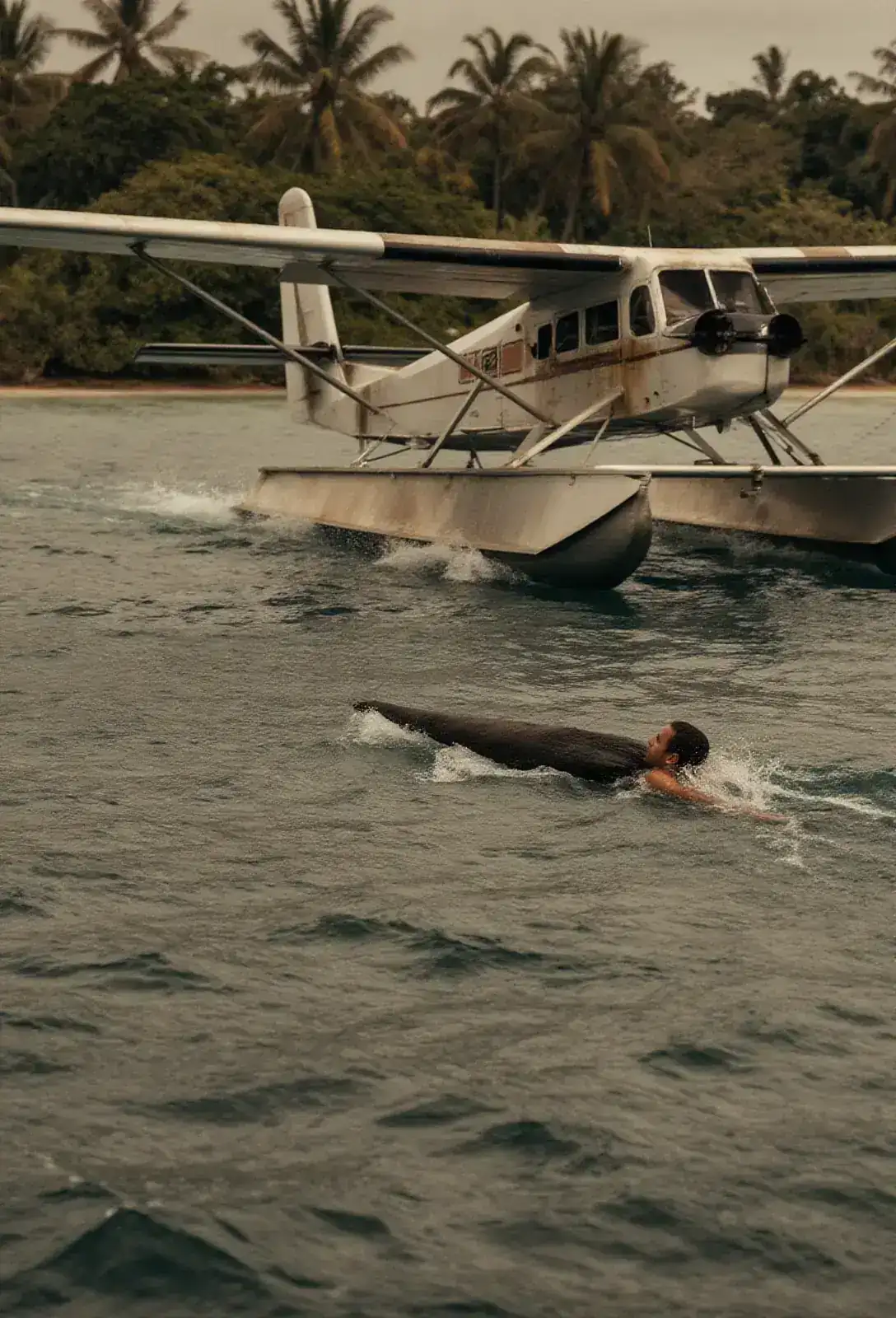
The driftwood root skipped along the surface at the end of its line.
The water beside it changed.
The change was a slow grey hump that became a wedge that became, in less than a second, a head the size of a small car. The jaws opened. They were wider than the cabin of the plane. The Kronosaurus came up out of the water with the driftwood root in its teeth and the line on the root pulled the entire tail section off the plane in one clean tear, like a man pulling the back off a paper book.
Darwin yanked back on the joystick. There was nothing for the joystick to do.
The plane rolled dead and came at him nose-first. He took a breath. He went under.
He went deeper. He felt the shadow of the plane pass over him and the muffled crash of it hitting water somewhere past his head, and he stayed under as long as the lungs would let him.
He came up.
The plane was in the water fifty yards off, sideways, chunks of wing tearing free. It rolled belly-up. The pontoons kept it on the surface. After a long moment Darwin came up coughing from the wreckage and crawled onto a pontoon and sat on it gasping.
“Hey, man,” Darwin called, when he saw Nick swimming over. “What happened?”
“I just saw your tail section come off.”
“It never did that before.” Darwin shook the water out of his ear. “You got a phone?”
“Yeah. A wet one.”
Darwin’s eyes shifted past him. “Hey. Those security dudes don’t have, like, a — a submarine, do they?”
Nick turned in the water.
A long shape was moving fast just under the surface, straight at the wreck. Darwin was up on his toes on the pontoon, backing away from the water that was about to be where he was. He opened his mouth to say something and the head came up and took him.
Nick did not see the rest. He had heard the snap and he was swimming the other way at the time. The fluke slapped the surface twice as the kronosaur dove with its meal, and after the slap the water flattened and the world went very quiet.
He swam parallel to the shore, looking for the back of the kronosaur and listening for what came next. He could not go back to shore. The digger was on the shore. He swam.
He heard the chop of a helicopter before he saw it, a low rising chuff out across the water, and then the gunship was there, low over the surf, a rescue ladder feeding out the side door. He swam at it.
The ladder swung wide on the first pass. He missed it. The kronosaur came up behind him a long way back and rose its head clear and was eating the surface to get to him. The chopper banked and hovered. He grabbed the ladder. He pulled up two rungs.
“Take it up,” he shouted. “Take it up.”
The Kronosaurus’s jaws closed on the air the bottom rung had been in.
Strong arms hauled him into the bay. He lay on the floor on his back with his chest going. A man leaned over him in a Grendel Corporation Security Ranger uniform and smiled the wrong kind of smile.
“I hope you haven’t forgotten our can, Mr. Harris.”
Nick raised his head and tapped his ear like he could not hear over the chop.
“Sorry. The helicopter noi—”
The fist came in flush. The dark took him. Somewhere under him, the Barbasol can rolled across steel.