The Jefe emptied his magazine into a tree.
He emptied it the way men empty rifles when men are surprised at the wrong distance, which is fast and high. The rounds went a foot above where the second raptor was coming up out of the ground beside him. The second raptor came out of the ground the way a man comes out of a bath, vertical and at speed, and the rounds went away into the canopy, and a parrot somewhere a quarter mile off began to scream like it was being killed.
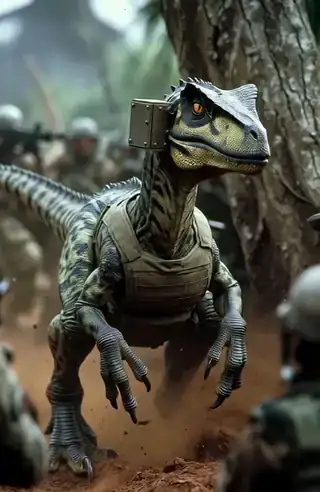
Then the holes opened.
There were five of them. Six. The men had been standing in a circle on what they had taken to be old root holes, and the holes were not old root holes. The holes were the front porches of a colony of Excavaraptor, eight feet of black-scaled muscle on bow legs with a digging claw at the end of each forearm bigger than any claw a thing the size of a man had a right to. The faces were narrow. The eyes were the color of a stoplight. They came up clean, no dirt on them, like they had built the tunnels with the dirt going somewhere a man could not see.

A digger took the second-in-command in the neck and shoulder and shook him the way a dog shakes a slipper. Bone gave at the seam where the collarbone meets the chest. The Jefe was on the ground with a hind foot the size of a brick on his sternum, looking up at a body which had no business being above him. He fired again. The rifle did not click empty so much as the rifle stopped having any meaning. The Jefe had three sons in San José. He thought about each of them, very fast.
Nick was running before the second magazine had emptied.
He went past the man who had been the second-in-command and past the digger holding the man, and the digger lifted its head, and there was a wet line down its chin that was not its own. Something behind Nick made a sound that he had heard before only in dreams about machinery. He went into the brush at a flat-out sprint with the shotgun across his chest. Close trees. Big things crashed in close trees.
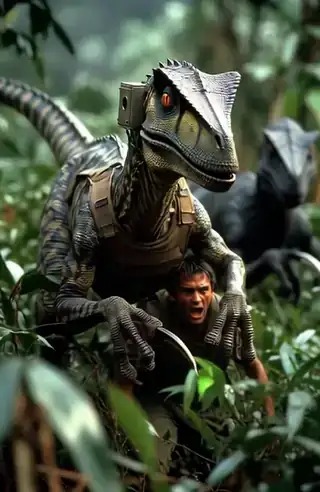
Two diggers ran with him. One on each side. One was bigger and was crashing through brush the way they crashed. The other was smaller and was using the path the bigger one made, the way little brothers do. The smaller one was going to get to him first.
Behind, the colony was finishing its work. He did not hear screams any more. He heard, twice, a single short call that was not a roar, and after the second call a quiet, and the quiet was not the quiet of nothing happening. The quiet was the quiet of a thing being eaten. Somewhere east, a parrot kept screaming. The parrot was loyal to its routine.
He hit a prickler vine at hip height and the vine went into the meat of his thigh in three places and held. He twisted and felt the tear and twisted again and the vine snapped and he had the shotgun up and the muzzle a foot from a face that filled the muzzle frame.
BLAM. BLAM.
The face went into something that was not a face. The big body fell in a way that was not a way a thing the size of a man falls. The other digger came around the dead one and stopped, and looked at the dead one, and made a noise that was not a roar — it was more like a question — and then it was coming on again.
He ran.
He ran past lamp posts and past the rusted base of a chain-link fence and over a service vehicle’s wheel half-buried in the loam, and the breath in his chest was getting expensive. He came into a clearing. The clearing had an old service truck in it with a faded park logo on the door and the words STAFF SERVICES under it. He put his back against the grill and listened. He pumped the shotgun. He had three shells. Two in the tube. One on the lift. He counted them again. Counting them was the only thing left.
A small face with a long nose came up at his shoulder.
Compsognathus. Through the shattered windshield of the service truck. Then another. Then several. They were the size of small dogs. The eyes were yellow and the teeth, when you saw the teeth, were the wrong number of teeth for any face that small. One squeaked. The rest squeaked back.
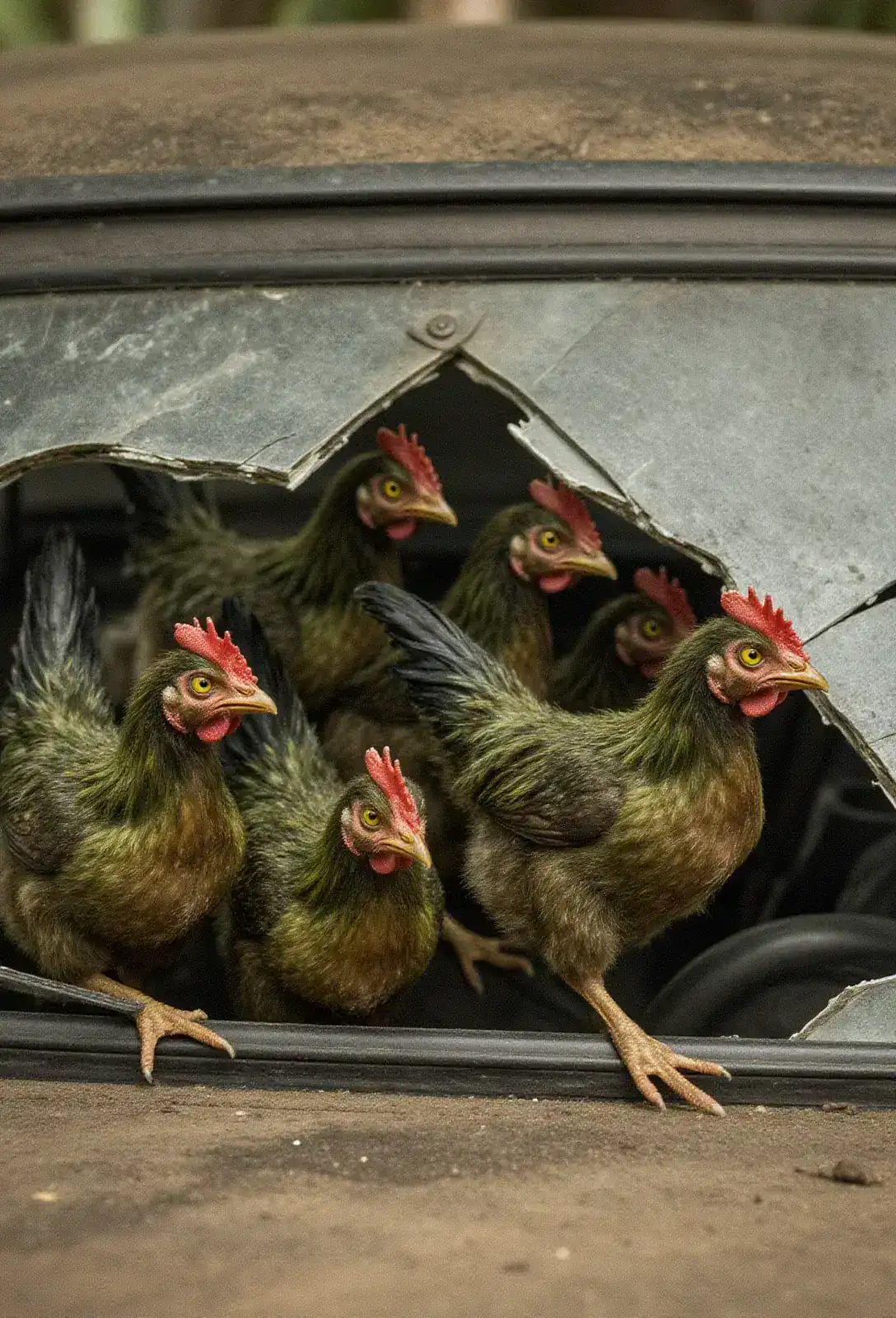
He whirled and fired. He had three shells. He used one. The blast cleared the windshield, and a dozen of the things that had not been in the windshield came out of nowhere, off the hood, off the roof, out from under the running board, and they were on him before the muzzle was down. They did not bite hard. The bite was the bite of something the size of a Jack Russell terrier. There were a great many of them.
He spun. He swatted. They came off in the air. One had a piece of his sleeve in its mouth and ran with it. He saw the building.
He sprinted. He went headlong at the broken window and crossed his arms over his face and went through it. Glass took a strip off his elbow. He rolled. The .50 was up before the first compy made the sill.
POP. POP. POP. POP.
The fourth one came down off the sill with no head. The rest of them had a small panel meeting on the windowsill and decided not to come in.
He let the breath go all the way out before he took another. The shotgun was on the ground out the window. He thought about it. He thought about how he was going to get it back. He decided, the way you decide these things, that the shotgun had been a separate man’s shotgun and was no longer his.
The room had the smell rooms get when no one has cleaned them in fifteen years and a great many small mammals have. Bunk beds along three walls. A boombox on a shelf. A coffeemaker in the corner with the carafe in it. Footlockers under the bunks with combination padlocks rusted to the hasps so completely that the lock was the locker. On the wall above the boombox a poster of a Tyrannosaurus rex was peeling at the upper corners, and someone had drawn a knife and fork in its little forelimbs and written, in a balloon above the head: PASS THE TOURISTS, PLEASE.
Nick laughed once. He laughed because his lungs had to do something with the air they were holding.
He pulled the laminated map off the lanyard. He squinted at it. STAFF QUARTERS ONE TWO AND THREE in a small green block, with a dotted line that ran out of the block southwest along a service spine and ended at a building marked POWER STATION. The power station was, by the scale on the map, two hundred yards from the beach.
“Utility tunnel.”
He spoke it out loud the way men speak directions in empty rooms. The room did not answer.
He went to the corner where there was a hatch in the floor. He set the .50 on the floor next to it. He grabbed the ring and yanked.
Nothing came out of the hatch.
Down below, a rusted iron ladder went into a cement floor. He un-velcro’d the small heavy flashlight from his belt and shone it down. The cement floor caught the light and gave it back. The rungs of the ladder were black with rust. Two of the rungs were missing. The black square of the floor down there was the shape of an eye that had not opened in a long time.
He looked back at the window. Three compys had come back to the sill. They looked at him with the kind of patient interest a thing has when it is going to wait you out. He whipped the .50 around. They jumped.
He looked back at the hatch.
“No way, José.”
He saw it then.
A second hatch in the ceiling, over one of the bunk beds, with a deadbolt eyehook latched to the rafter. He crossed the room and climbed onto the top bunk and made a face when his hand came up coated in cobweb. He swiped the cobweb on his pants. He reached up. The hook had rusted to the latch and the latch had rusted to the eye, and the whole assembly was a single brown lump.
He took the butt of the .50 and gave it a hard rap.
The hatch fell open.
Then the upper half of a dead man fell through it.
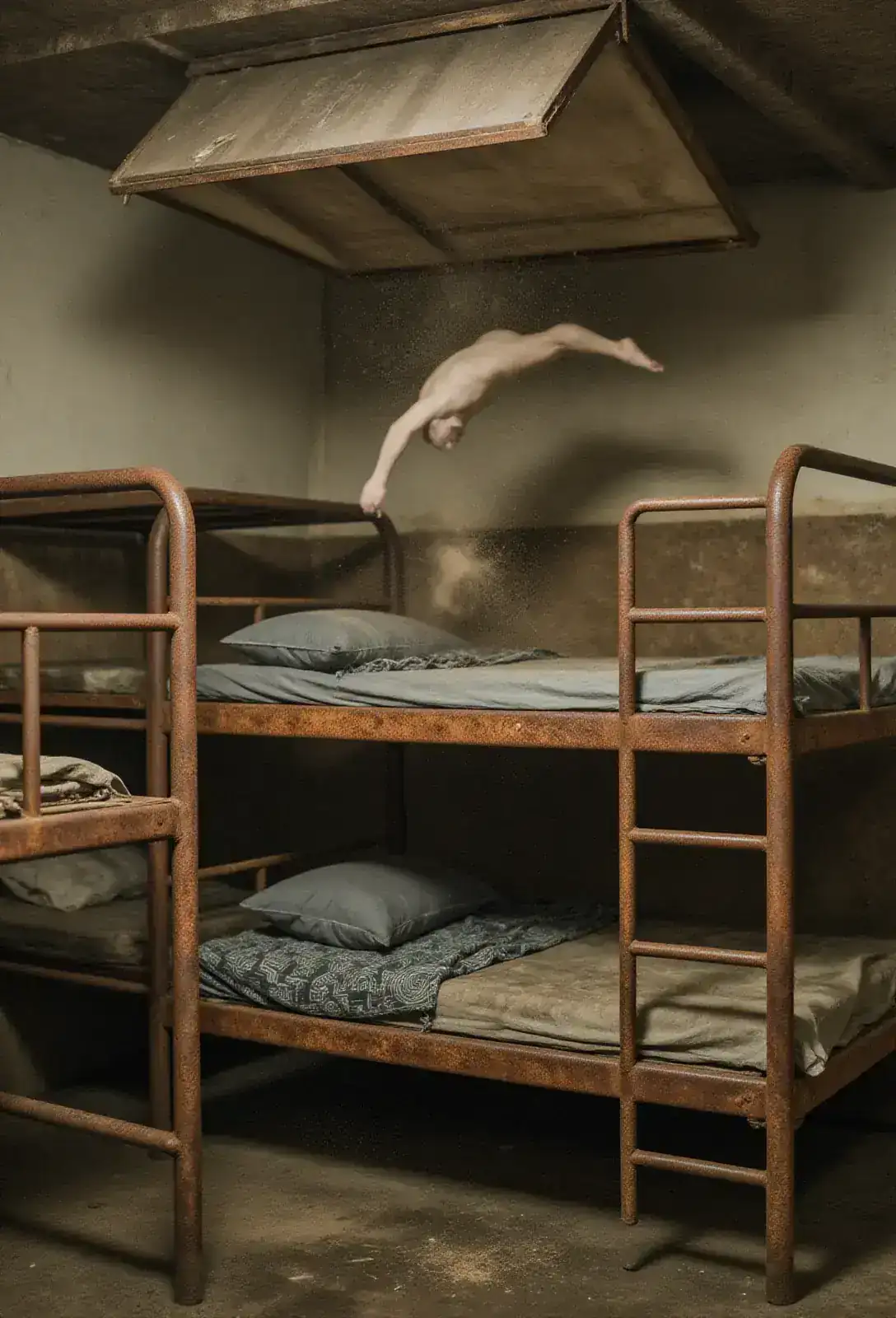
Nick shouted in surprise. He went off the bed backward and onto the floor with the pistol up and the muzzle tracking. The body was a man in the camouflage of the rangers, gnawed in a way that a man can be gnawed and still be recognizable, and it lay in the bunk above him as if it had been resting there for a week. From the smell, it had.
He breathed. He brought the pistol down. He brought the heart rate down. The room did the thing rooms do when you have stopped moving in them, which is shrink.
The front door of the barracks blew inward in two pieces.
The digger came through the front door and across the floor and into the standing lockers in the corner with the grace of a refrigerator falling through a roof. The coffeemaker went out of the world. The lockers went down on top of it. The boombox slid two feet on the cement and stopped. There were maybe four feet between the locker pile and where Nick was standing.
He did the only thing.
He pulled the bunk bed down on top of himself.
The frame came down at an angle. He went under it. The mattress was a tube of foam and old springs and small black mushrooms and was, in this moment, the only thing in the room that was on his side. The digger came up out of the lockers. The digger lunged. A sickle leg went straight down through the mattress and through the springs and stopped a thumb’s width from his throat. He could see, from where he was, the underside of the digger’s foot and the way the dewclaw hooked in. There was a small pink scar on the pad. A gunshot had gone through it, once, and healed.
He scrambled out from under the frame on the side away from the foot. The digger was twisting, trying to free the leg. He was at the floor hatch before he had decided to be. He went down through the hatch, foot before hand, and the rusted rungs gave way in two places, and he was falling more than climbing, hitting the cement on a shoulder and on his back.
CRANG. The cover above him moved and three claws came through the metal in three white parallel slashes.
He pulled the cover shut from below by the inner handle. He clicked the flashlight on. He started down the tunnel at a trot.
Above him, a bigger and angrier sound began to work on the cover. The cover bowed. A claw came through the metal and bent it back. A second claw worked into the bend and pulled. Three stripes of yellow daylight fell down the ladder and lit the rust-flakes on the cement and lit Nick at the bottom. He flicked the flashlight on and ran.
The tunnel was high enough to walk in. Pipes ran along the ceiling, fat black pipes carrying nothing any more, with hand-stencilled labels that had bled. The walls were sweating. The cement floor was cracked in the kind of long zigzag that meant a slab pour gone wrong fifteen years ago, and somewhere along the cracks small dark things skittered out of his light and back in. The air smelled of standing water and something else, an animal smell, sharp and a little sweet. The smell got stronger as he ran.
He went a hundred yards. He went two hundred. The pipes overhead clanked once on their hangers, and the clank was the kind of clank that meant something heavier than air had moved up there. He looked up. The flashlight found nothing. He looked back down at the floor. The cement had ended. He was running now on dirt.
The dirt was warm.