Ramírez crossed himself when Nick fell backwards over the gunwale. That was Ramírez’s last contribution to the operation, that and the fishing boat and the small dignified silence of a man who had been paid not to ask.

The water off Isla Nublar was the temperature of breath. Nick swam under the surface for as long as his lungs would let him, two minutes, three, kicking on his back with the supply raft tugging at his belt like a small dog on a leash. The line did not chafe yet. It would. He had been a SEAL since ‘92. Equipment failed. Men failed. You worked the order.
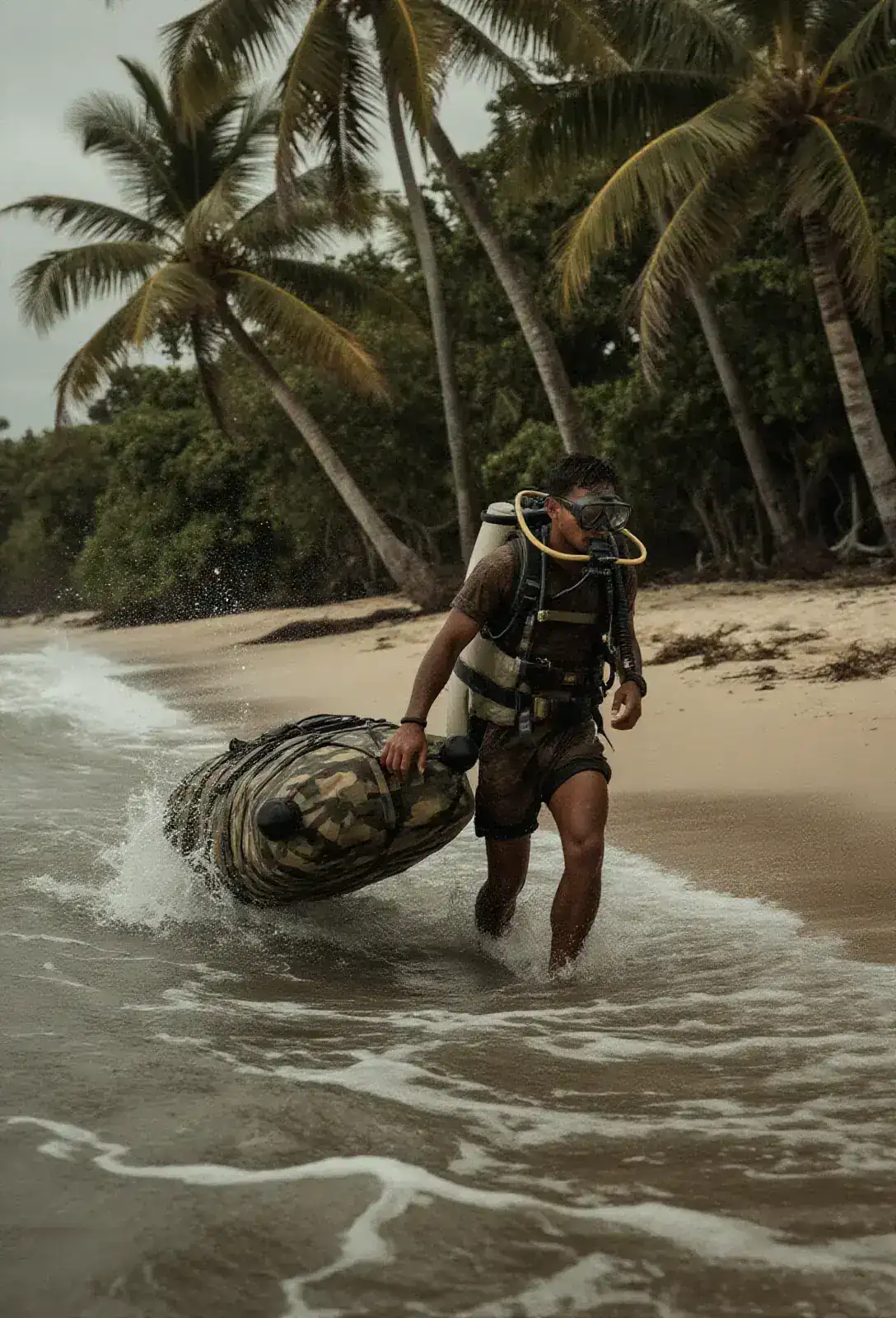
He came up in the surf and crossed the strip of sand at a low crouch and made the palm line in seven seconds, raft in tow. The crabs scattered. Coconuts had fallen and cracked along the seam where the husk meets the meat, and the meat had gone the color of old tobacco.
In the shade of the palms he stripped the wet suit and laid it open like a skin. He pulled out, in the order he liked, boots, pack, GPS, the laminated map on a lanyard, the combat shotgun, the small pack rifle with the silencer, the .50 in one holster and the cell in the other. Boots before pack. Pack before GPS. He laid the rifle parallel to the shotgun. He clicked the cell on and watched the bars. Three bars. Hammond’s people had paid for three bars. The cell had a satellite chip the size of a fingernail. The chip was the only thing in the kit that had cost more than the rifle. He set the homer in the sand at the treeline and left it unarmed. The button on the homer was red. The button stared up at him out of the sand the way a button does when a man has been told what it does and what it does is not, in the strict sense, a button thing.
He stood. He walked into the jungle.
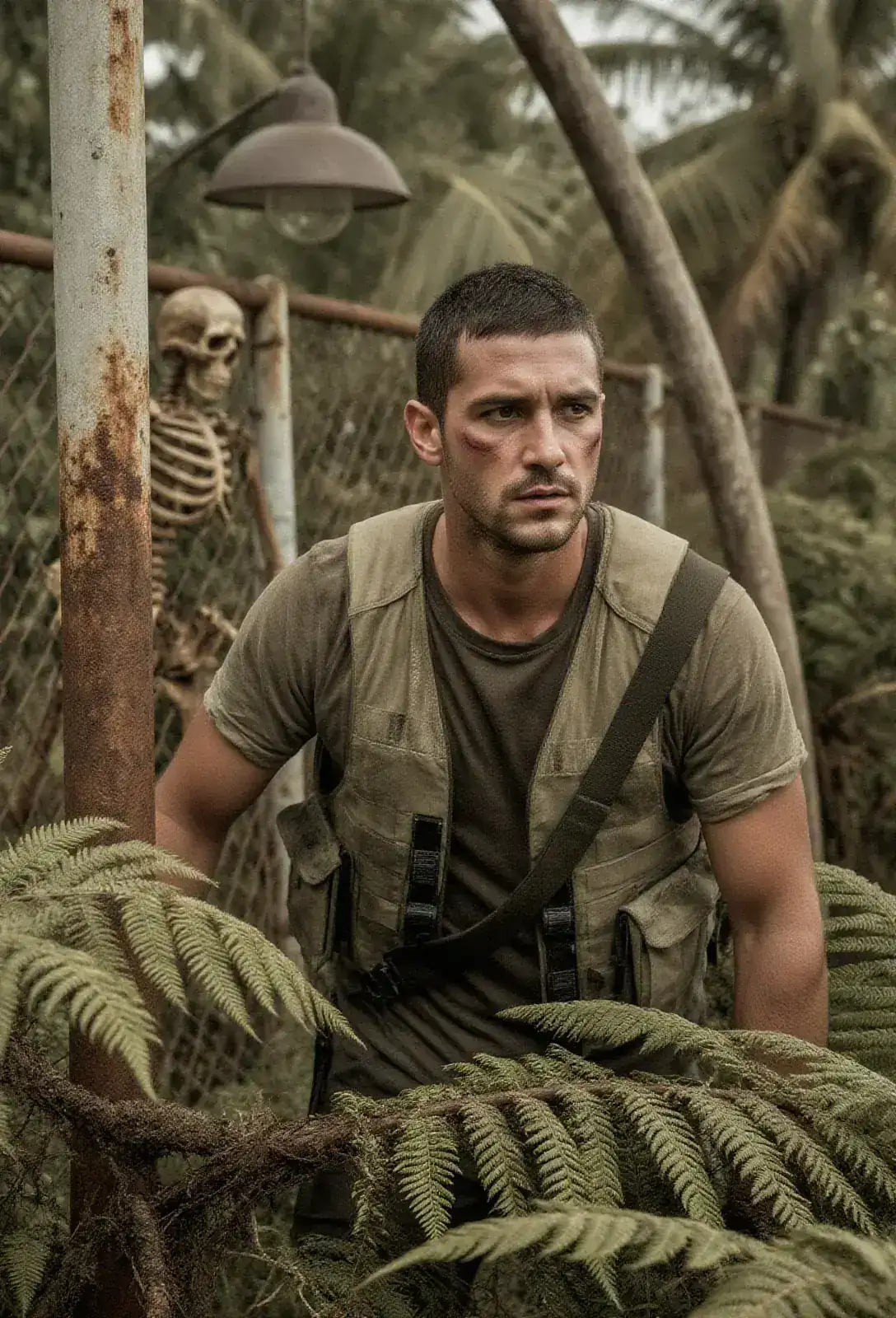
The path had been a tourist track once. There was a board sunk in the ground where a sign had been, and farther on a row of those long curved lamp posts that the parks of the eighties had loved, and the lamp posts had gone over at every angle the wind had asked them to. Iron bones. The fences were torn back along the line of growth, palm fronds threaded through where there had been chain link. He moved well. He had always moved well in this kind of country. The sound of the jungle was the sound of every jungle on a calm day, the cicadas going up and coming down, the click of something small moving through dry leaves, a parrot or two arguing in the canopy. Vacation noise. Nothing you couldn’t hear on vacation.
He stopped at a switchback on the path and listened. He checked the GPS. He moved on.
He did not see the surveillance camera on the lamp post above him. He had checked the lamp posts at the first three switchbacks and the cameras on those had been blown out, lensless, the housings full of mud and the wires hanging out like roots. The camera on the fourth post had been replaced. The replacement had been done by men who knew the man who would come looking would have checked the first three. The lens swiveled half an inch and held him in its frame. Then it swiveled to follow him.
A few hundred yards up the path Nick vaulted a hole at the base of a gnarled tree. It was an old root hole. Ten feet to the side of the path. He had seen many holes like it, on this island and in places he was not supposed to talk about. He hopped over it without looking.
He was not in the frame when, a long minute later, a four-fingered black-scaled hand came out of the hole and gripped the dirt at the lip and held there. The claws were the wrong shape for any reptile that had ever lived on the planet before this island. The hand stayed in the open about as long as a man can stop without breathing. Then it slid back.
The vehicle was where Hammond had said it would be.
It had been a 4-wheel-drive of some sort and was now a rust-perforated cage shot through with vines. The wheels were sunk past the rim. A torn flap of canvas hung from the driver’s-side cage where a roof had given up. Nick pushed the canvas aside and looked at what was behind the wheel.
Dennis Nedry, what was left of him, had not dropped a few pounds. He had dropped most of himself. The skull was, as skulls are, in fairly good shape, and the small bones of the hand were curled around the steering wheel as if he were in the act of trying to leave. A tiny anolis lizard slid out through one eye socket and disappeared down a stripped wire harness. The teeth in the skull had old fillings in them. Nedry had had bad insurance, or no insurance, or the kind of insurance that meant the cheap silver-mercury work that made the X-rays look like pictures of constellations.
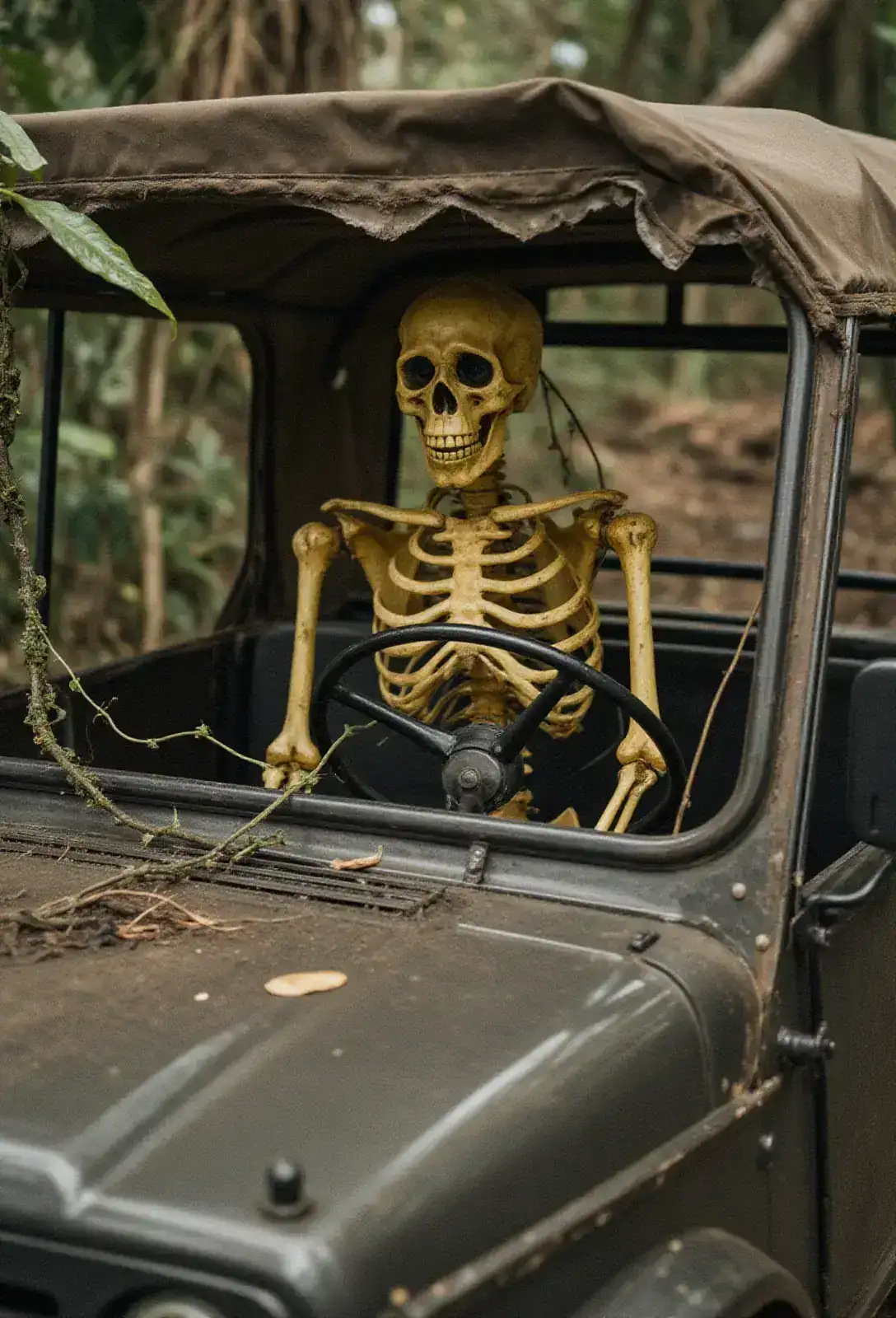
“Looks like you’ve dropped a few pounds,” Nick said, because the line was the kind of line a man says to himself in a place like that, to keep the place from saying things back.
He searched the interior in the order he searched any vehicle. Glove compartment. Footwell. Under the seat. The seat foam was full of small black mushrooms. There was a flashlight that did not work. There was a heap of candy wrappers, six or seven, the wrappers the brand-color you remembered from the eighties, faded into something paler. Snickers. Two Three Musketeers. A Butterfinger. Nedry had not died hungry. Nedry had died well-fed and afraid.
No can.
He stepped back from the vehicle and squared his shoulders against the jungle and unzipped the pack. The metal detector came out in five pieces and assembled the way metal detectors assemble, which is to say slower than you remember. Off in the trees something gave a long screaming call and stopped, and Nick stopped with it, listening, the screwdriver between his teeth. The call did not come again.
He set up a grid the way he had been trained to set up a grid, with wooden stakes and a length of mason’s line, and he worked the grid the way the manual said. Sweat soaked through the front of his T-shirt and through the back of it and the bottom edge of the vest darkened. He worked through the grid, square by square, and got nothing. He worked the second grid. He got nothing. He cursed Hammond, mildly, in the way you cursed a man who was paying you. The third grid took him to the edge of a stream that ran out of the high trees, the water clear over a bed of small white stones, and he was about to break for water when he caught himself and let the detector arm reach over the line of the grid into the stream itself, on a whim, the way you check a pocket once more.
The detector crackled.
It crackled again. He held the disc over the spot and the crackle steadied into the long high-throated tone of a buried something. In any of the parking lots of his youth that tone had been a nickel under a quarter inch of asphalt. On this island it was forty species of nightmare in a shaving-cream can. The needle on the dial pinned. The headphones in his ears went hot.
It crackled in the way a detector crackles when it has found something larger than a tin lid. Nick dropped the handle and went into the stream on his knees and dug at the mud bar in the middle of the streambed with his hands. The mud was cold the way water at altitude is cold, and the cold of the mud made his fingers ache before he had been digging twenty seconds. He felt something flat. He pulled.
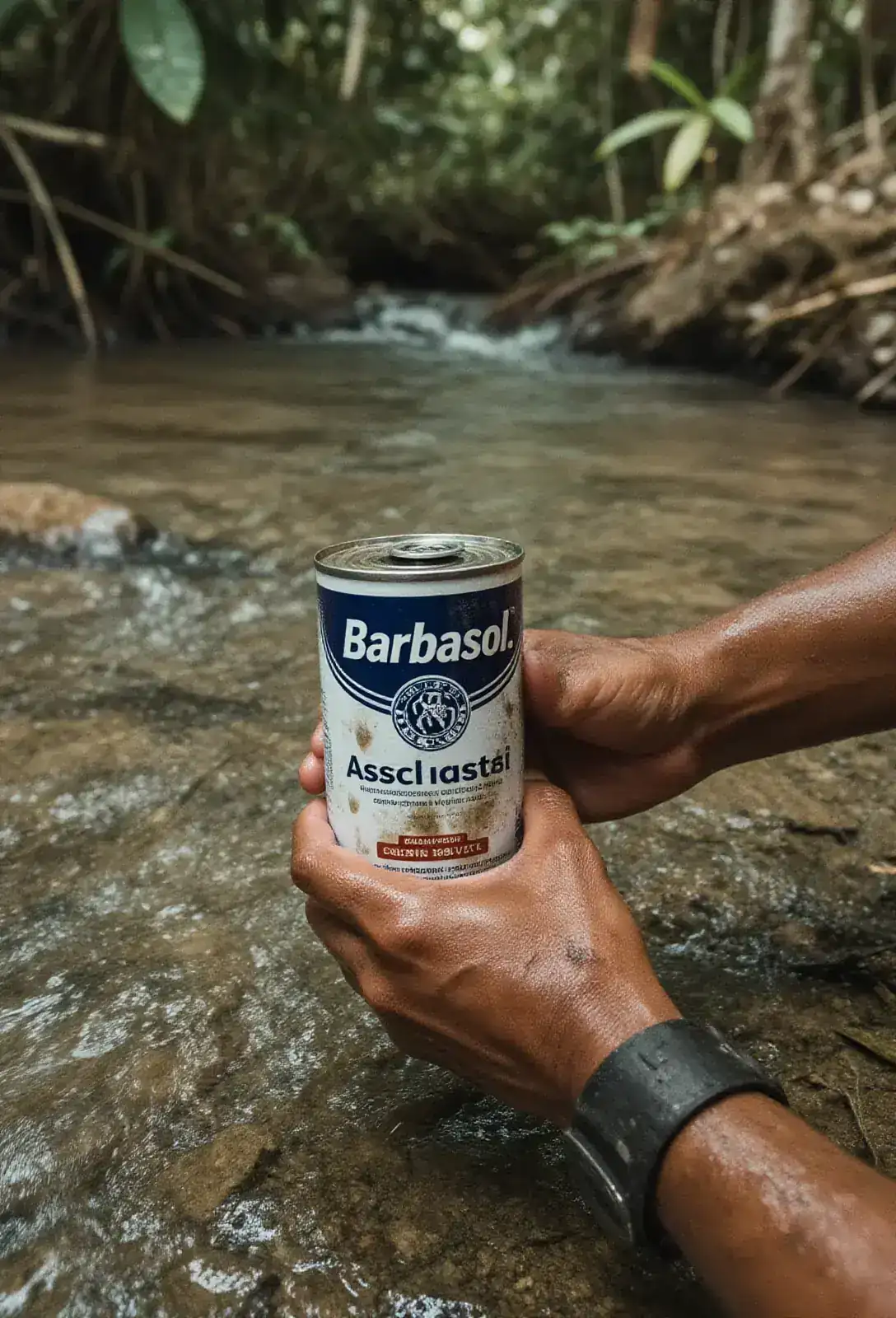
A muck-covered cylinder came out of the water. He washed it in the stream. The label was pitted but the brand showed, in red and white and that very particular blue. Barbasol. The valve was sealed shut with old plastic of a kind they had not been making for fifteen years. He turned the can in his hand. There was a small hairline ring on the bottom of it, the color of solder, where the false bottom had been welded in.
He pulled the cell out of the holster.
“Yo. Objective secured. Proceed with extraction. I’ll fire up the homer.”
He pulled the remote from his vest and pushed the red button.
A long way back, on the strip of beach behind the palms, a small device began to blink and to beep so softly that the sound did not carry past three feet. The light was visible, the beep was not. That had been the design.
He held the can in his palm a beat longer than he meant to. It was lighter than he had expected. There were forty species in his hand, on the gist of a Hammond claim, and he had been around enough Hammond claims, by the standards of his industry, to know that forty was the kind of figure men gave to financiers. Whatever was in the can was smaller and stranger than forty. He weighed it. The valve had a small crust of mineral on the rim. The whole thing smelled, faintly, the way a coin smells.
He put the can in the cargo pocket on his thigh. He buttoned the flap. He looked back at Nedry in the truck and gave the skeleton a small two-finger salute, the way a man salutes a fellow employee he has not liked but recognizes as having done his part. He thought, irrelevantly, about a woman named Karen he had been engaged to in 1999 and what she would say about him crouching in a stream on this island holding a fifteen-year-old can of nothing. Karen had had opinions on his career. Karen had been right about most of them.
He stood. He took a bearing on the homer. He shouldered the pack and started back the way he had come, moving cautiously through the thick jungle, around the big root-holes in the path, ears open for anything that did not match the cicadas. The path under his boots had been built for foot traffic and had not seen any in a long time. Roots had come up through it. A fern had grown straight up out of one of the lamp posts where the bulb housing had given. The jungle had got the place back, mostly.
A rustle behind him.
A snap to the side.
He brought the shotgun up and crouched.
“¡Bájelo!”
The voice came out of the trees and was answered by other voices, and out from the green, all around him, came a squad of six men in camouflage with short-barreled rifles. The man who had spoken first stepped out and held his rifle low and steady at Nick’s chest. Jefe. You could tell the man in charge of any squad by the way the rifle stayed level when he talked. The man behind him, a younger man with a thinner face, translated.
“Don’t be afraid. We only want the can. Your escopeta, please. On the ground.”
Nick took a long breath. He looked, very slowly, at the men around him.
He saw something.
“Is very good we find you before the dinosaurs do,” the younger one said.
“I was told there aren’t any left on the island,” Nick said.
The younger man smiled. “Oh, there’s a few.” He shrugged. “They only come out at night.”
“Like the one standing behind you?”
The younger man laughed. It was a clean honest laugh, the kind a man laughs at a joke he was not expecting from someone he is about to disarm. The Jefe did not laugh. The Jefe was a better man, and the Jefe was beginning, faintly, to read Nick’s face.
He was laughing when the head came over his shoulder.
The head was the size of a ham. The eyes were red the way embers are red, and the snout was narrow, and the teeth were long and curved back. There was a black scaled neck behind the head and there was a body behind the neck, but Nick did not see the body yet. The head came down on the younger man’s neck and shoulder and the laughter ended in a sound that was not a sound a young man ought to make.
The Jefe lifted his rifle and emptied it at the trees.