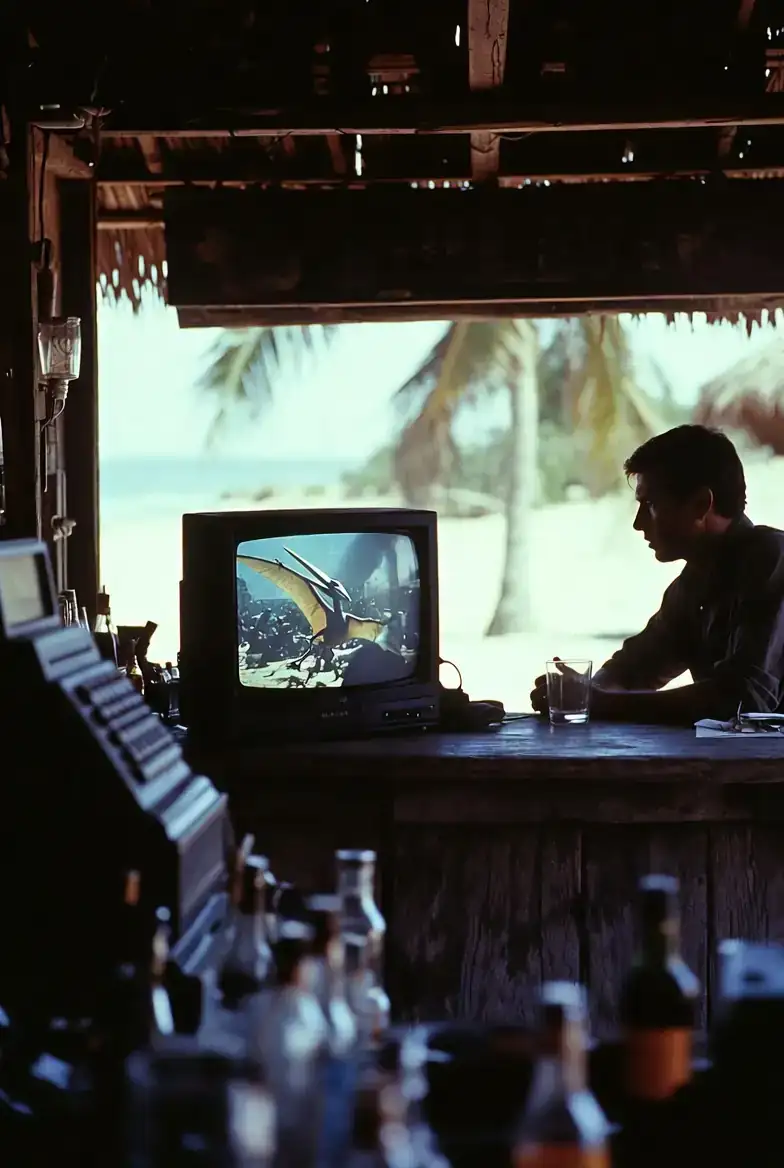
The Speiler man on the television had a Swiss accent he was trying to flatten into something a Midwestern audience would forgive, and Nick Harris sat at the bar with his thumb pressed to his glass and listened to him try.
“Our eradication of the genetically engineered creatures at the former Jurassic Park is nearly complete.” Speiler had a tie the same color as a corporate folder. “We believe that these current depredations can be attributed to animals that escaped the island before we at Grendel took possession of it.”
Nick pushed the glass aside. “Right, buddy.”
The bartender was a kid in a cut-off Hooters T-shirt who had not been alive when the original park went down. He looked at the news the way kids looked at the news, which is to say at the chyron, not the man. The chyron said GRENDEL CORP. and below that, in smaller letters, Statement on Continental Migration. That was a lawyer’s word. Migration. Nick had been around enough lawyers to know what the word meant. It meant the company was going to win.
He paid in cash and left a dollar on the bar.
Outside, the boardwalk was hot and the boards were loose where the dock met the parking. There were teenagers on a bench eating ice cream out of cardboard, and a woman walking a fat black dog, and an old man selling shells from a folding table the way old men did at every beach Nick had ever been to. The air had that flat tin smell of low tide. He squinted against the sun and started walking nowhere in particular, which was the kind of walking he did since the contracts dried up.
A shadow crossed him. He looked up.
Two pelicans, three pelicans, the shapes wrong only in the half-second before the brain caught them and decided they were fine. He let his shoulders drop. Two years of looking up. Two years of being wrong about what was up there. He kept walking.
“Nick.”
He turned. The man coming up the boardwalk had a quasi-military uniform with a hummingbird patch on the breast pocket, and a gait that was slightly off in both legs. The face was not slightly off. The face was Captain Jeb Overton from the worst week of 2003.
“It’s you, right?”
Nick smiled the way you smile at a man you used to be in a hole with.
“Captain.”
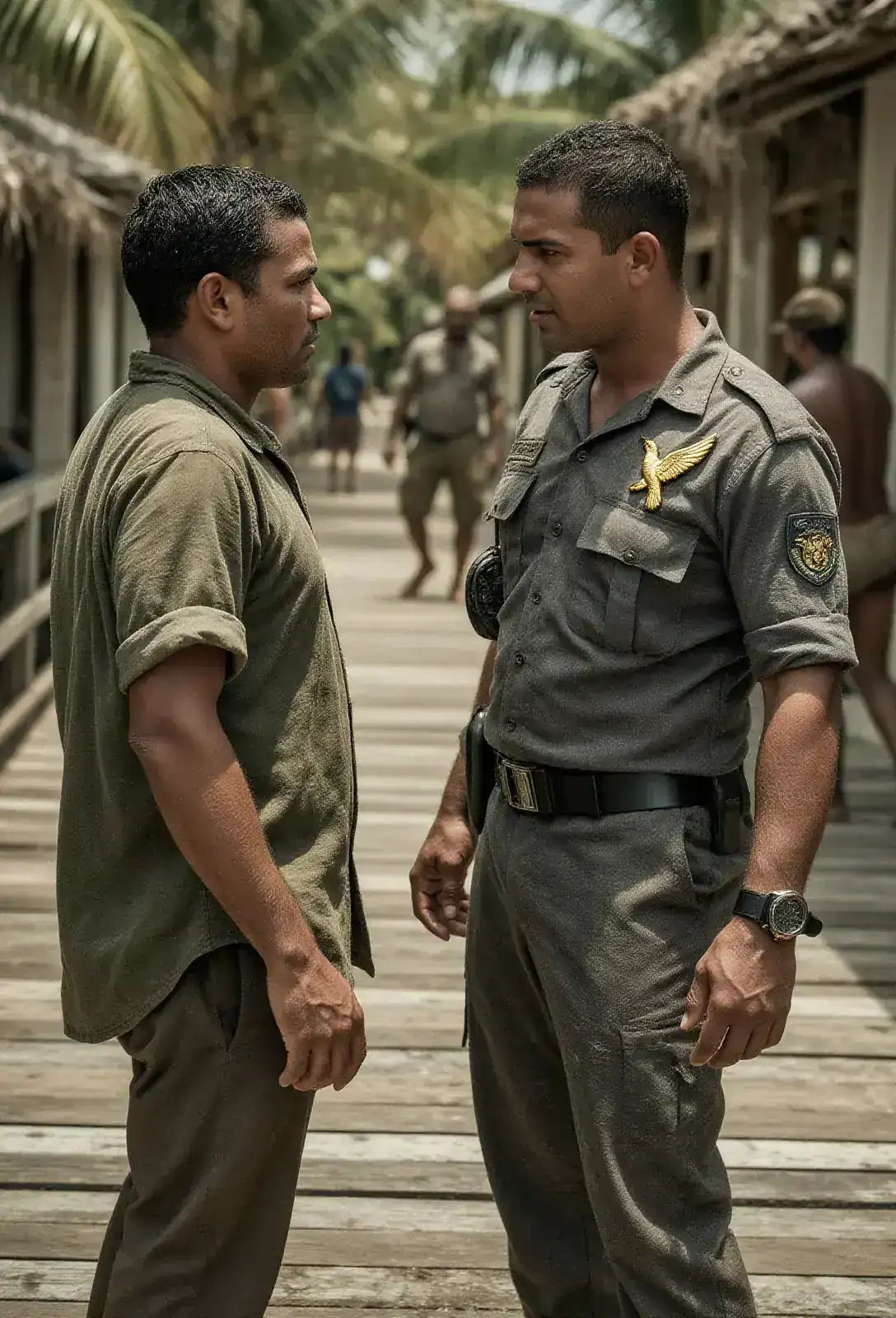
“I look more like Captain Crunch in this outfit.” Overton tugged the front of the jacket, smiled, dropped the smile. “Haven’t seen you since.”
He didn’t finish. The place they had last seen each other was on a runway outside Quito and was not a place either of them was going to bring up in a beach town with kids on bikes going past.
“Yeah,” Nick said.
“Heard from any of the guys?”
“Haven’t been in the loop.”
“Wilkens drove off a cliff,” Overton said. “DeStefano. Peacetime is rough on a lot of guys.”
“How about you?”
Overton hitched his pants up an inch. Below the cuff there was a blue-grey gleam where a calf should have been, and below that another, and the boots beneath them were not boots a man had worked into. They were boots straight out of a box.
“I’m the bionic security guard.” He let the cuff fall. “State of the art. I run lock-up at the aviary.”
He tapped the hummingbird patch.
“Giant zoo for birds.”
“You always were for the birds.”
“Yeah.” Overton looked at him a long second. “You still consulting?”
“Haven’t had a contract in three years.”
“If there was one. Good money, a little travel.”
Nick looked out over the beach. People with pink shoulders. A girl on a paddleboard who had not yet figured out the paddle. The Atlantic where it goes flat in the late summer.
“You’ve been looking for me.”
“More or less.”
A boy ran past with a kite shaped like a shark, and his father ran after him shouting his name in a way that was more love than worry. Nick watched the kite tug into the wind and pull back. Whatever was coming, the kite did not need to know.
“Who’s it for?”
Overton scratched his ear. “Well. He’s kind of strange.”
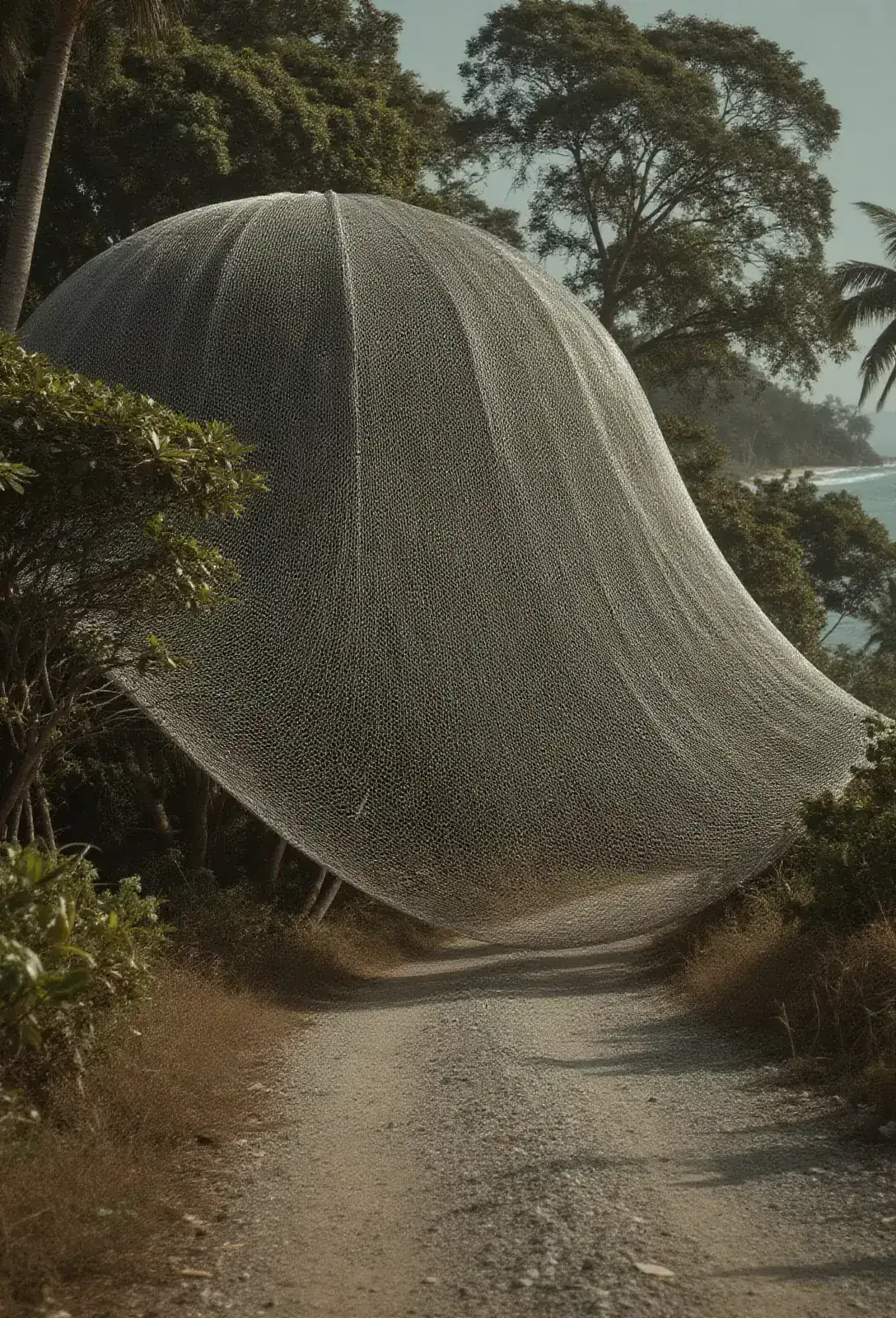
The aviary was not in any tour book. It was up the coast, an hour north on a county road that ended at a gate. The gate had a uniform on it and the uniform did not check Overton’s badge because the uniform was Overton’s. Inside the gate, past a tall hedge and a parking lot wet with the morning’s hose-down, the netted dome rose out of the trees like the shoulder of something half-buried. Nick had seen domes in deserts. This was the first he had seen wet.
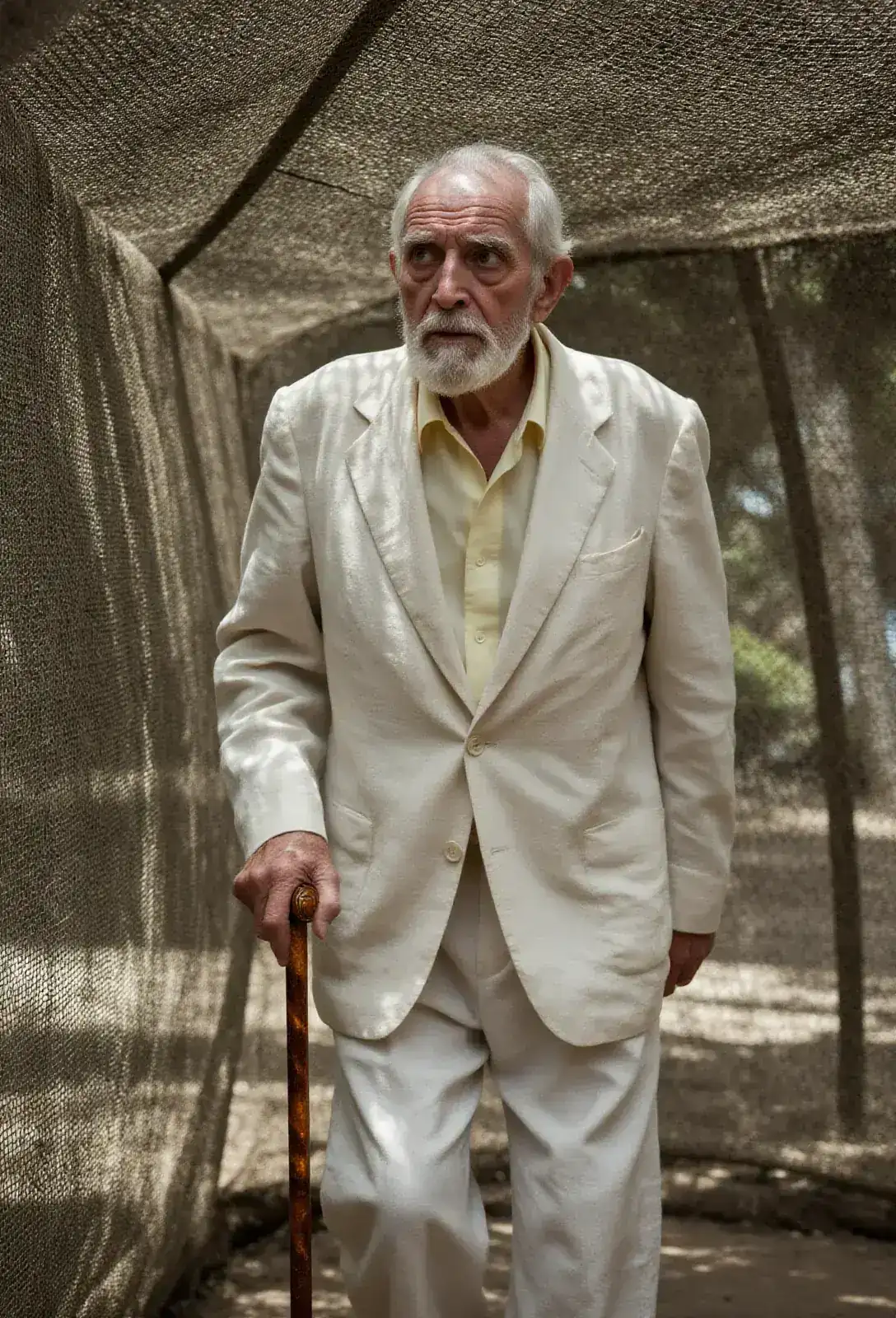
They went in through a service door. There was an old man on the path, leaning hard on an amber-topped cane, in a cream linen suit gone soft at the elbows. Behind him, fifteen feet back, walked a sturdy nurse in white shoes who pretended not to be paying attention to anyone.
An emu stood in the long grass off the path. It had the long grass in its peripheral vision and it had Nick in its peripheral vision and it was not pleased with either. It dropped its head and made a sound like a beer keg falling down a flight of stairs.
“They can get rather territorial in captivity,” John Hammond said.
Nick looked at him. The eyes were clouded but they were on him. The hand on the cane was knuckled and freckled. The voice had a frailness to it that broke off twice at the edges of words, like a man whose engine kept missing on the same cylinder.
“Of course,” Hammond said, “it doesn’t put me in the best of moods, either.”
“You’re not in captivity.”
Hammond glanced over his shoulder at the nurse, then back. “You just can’t see the chains. My late heir managed to get me declared. Incompetent. My minders are bribed to spy upon me, for. My enemies.”
“You have enemies?”
“Did you know,” Hammond said, “that I am the most-sued person in the history of the world. It’s in the Guinness Book. Prominent law schools devote entire semesters. To my malfeasances. Regulatory statutes bear my name.” A small thin smile. “Not the legacy I had in mind when I started out. But a legacy nonetheless.”
They walked. The gravel made the sound gravel makes. Roseate spoonbills picked through a shallow pond off the path, pink against the green, looking embarrassed to be themselves. Hammond’s cane tapped out the rhythm of an old man’s walking. The nurse stayed her fifteen feet.
“We look back at our lives, Mr. Harris. We try to tally up the things we are proud of against the regrets. Do you have regrets.”
“More than a few.”
“At the moment, my greatest regret. Other than having spawned the careers of thousands of tort lawyers.” He paused; he had to pause to draw a breath he could use. “Is having put an evil into the world that may become permanent. An evil that must be eliminated before it spirals out of control.”
“Your dinosaurs.”
Hammond smiled, and the smile did not have charm in it any more, only the muscle memory of charm. “Yes. My dinosaurs. How much do you know about them?”
“Most of them have been wiped out. A couple species are making a nuisance of themselves.”
“Whenever a new organism, especially a predator with no natural enemies, is introduced into an ecosystem, the result is disastrous.”
“Pest control isn’t in my line.”
“I am not proposing you run about with a butterfly net, Mr. Harris.” Hammond stopped. The cane planted in the gravel. He liked the next part; he had practiced it. “The most effective weapon against any species is its own behavior. Particularly its reproductive behavior. Take a population of any wild animal, and introduce a number of highly aggressive but reproductively neutered individuals within it. A ‘Judas strain,’ so to speak.”
“Cuts down on the birth rate.”
“Who better to locate our errant creatures. Than their identical kin.”
“Why not give them diseases too.”
“Viruses mutate faster than lawsuits.” A papery laugh. “I am afraid. Too much risk they would begin to affect other species. But a large influx of young, aggressive, sterile but sexually attractive females.”
“Sounds like a college boy’s dream.”
“And the only solution, I believe. To our present crisis.”
“Sounds good to me.”
“But not to the United Nations.” Hammond sighed. “They’ve laughed off my proposals. Outlawed the creation of any new dinosaurs, sterile or not. And prohibited the world-wide mining, sale or possession of amber.”
“No little mosquitoes trapped in tree sap.”
“Means no basic genetic material to work with.”
A snack bar stood at a bend in the path, hand-built, more rustic than the dome around it deserved. Hammond made his way to the counter and looked up at the menu the way he looked at everything, like a man parsing a foreign language he had once spoken.
“But even if you had these genes,” Nick said, “you couldn’t.”
“Among the people on the board of this aviary.” A little dry cough; the cane shifted. “Funded through a trust I set up before my legal difficulties began. Are some of the finest genetic scientists in the world. People who would be happy to risk implementing my plan. If a source. Of the vital DNA. Could be located.”
“Something tells me you’ve found one.”
“I didn’t find it. I left it behind.”
He told the story in the same hesitating way, with the same drops in the same places. A former employee. Nedry. A man so unhealthy that an aerosol can in his hand had occasioned no remark. A storm. A road slick. A creature with frills around its neck that no one alive had ever properly described until Nedry described it.
“And he never made it back.”
“We were forced to abandon the island. Before his exact fate. Or that of the material he had stolen. Could be determined.”
Nick watched a hummingbird hover at a fountain in the path’s middle. The hummingbird was real. The hummingbird was, as far as Nick could tell, the only real thing on this whole property.
“But the people who took over the island.”
“Grendel International. If they had found it, they would not be constantly pressuring me to reveal its whereabouts. I have good reason to believe. They might be the people. Who engaged Nedry in his betrayal.”
“Why would they want dinosaur genes?”
“I shudder,” Hammond said, “to think.”
Hammond pulled an order pad from the counter and wrote a number on it with a pencil whose lead kept skipping. He turned the pad to Nick. There were a lot of zeros. He folded the pad over before the nurse, who had drifted closer, could see.
“Major Overton tells me you are an expert in covert operations.”
“I was Navy SEAL. I’ve been involved in missions, in and out of uniform.”
“We know the sector Nedry was in when he disappeared. The stolen material seems to have been hidden in an aerosol can. Of some sort.”
“Deodorant.”
“Given the state of Nedry’s personal hygiene.” Hammond smiled the practiced smile. “I doubt it. We can provide you with a map.”
“There aren’t any dinosaurs left on the island?”
“Grendel International claim to have restored equilibrium. They maintain a small security force there, to discourage trespassers.”
“So I go there. I steal this can.”
“Reclaim.”
“I bring it back to you.”
“Captain Overton will be your contact.”
Nick looked at the number on the folded pad. Then at the old man. Then up at the netting where, very high, two black silhouettes that were not pelicans were drifting in slow unhurried circles outside the dome.
“I’ve done worse for less.”
“Excellent.” Hammond’s eyes lit, just a flicker. “Would you care for a sundae?”
The order pad went into his coat pocket. The pencil went back into the wire holder. Behind the counter, a girl in a green polo with the aviary’s logo on it began scooping vanilla into a paper boat, and the act of it, the small bell-shaped scoop turning over in her wrist, was the most ordinary thing Nick had seen in a week. He watched her work. She did not look up. Jeb Overton stood ten feet off in his cheap uniform, watching the path. The number on the pad was already settling out of Nick’s mind. He had known he would take it before Hammond wrote it.
He took the sundae. The plastic spoon was the wrong shape for the cup. Far above the netting the two silhouettes drifted on, very slow, very patient. Whatever they were, they were waiting on him.