The Baron broke porcelain in the courtyard at dusk, and Nick walked into his line of fire.
Three vases had been set up on a wooden stand at the far wall of the inner courtyard, fifty paces off, vases that, by the small painted scene of a bird-and-flowers along the side of one of them, were not the kind of vases a man broke for sport. They had been broken for sport. Two had been broken into pieces in the gravel. The Baron had the crossbow at his shoulder. Kroner, two paces back, was working a windlass to recock the action. Joyce was at the loggia with his hands behind his back, watching. Zeiss was at Nick’s shoulder, armed.
Smash. The third vase exploded six feet from where Nick had stepped through the inner door. He felt the porcelain fragments hit his chest like wet hail.
“Nice shot.”
“I am an expert,” the Baron said, “with several archaic weapons.”
“Very useful, if you run into some archaic enemies.”
“And what about you, Mr. Harris. Are you a friend or an enemy.”
“An employee.” Nick nodded back at Zeiss. “He says you wanted to see me.”
The Baron lowered the crossbow. He gestured at the wooden stand.
“Would you mind placing another vase on the stand for me.”
A row of additional vases sat on the gravel beside the stand. Nick walked across the courtyard to the row. He picked up the topmost vase. The vase was warm where it had been in the late sun, and the painted scene on its side was a hunting scene with three small figures and a stag. The brushwork was fine.
“These look expensive.”
“Priceless. But I am tired of them.”
He took the vase to the stand. He turned to set it on the wooden top.
Smash.
The shot came as he was setting the vase on the wood. The bolt took the vase out of his hand and broke it inside his fingers. The shards of it cut him across the palm in three places and the wood of the stand splintered behind it. He looked at his hand. It was a small shallow set of cuts. Blood beaded along three lines. He turned, slowly, to face the Baron.

“As I am tired,” the Baron said, “of waiting for you to return our property.”
“We don’t really have a deal,” Nick said. “Do we.”
“Your payment —”
“My payment isn’t much good unless I’m free to spend it.”
The Baron raised the recocked crossbow and pointed it at Nick’s head.
“You wish to leave us.”
Nick walked across the courtyard. He walked at the Baron, slow, easy. Joyce, on the loggia, pulled half a step forward and stopped. He had the look of a man whose principal was about to do something inadvisable, the look of a chief of staff wishing to be a chief of staff for one more day.
“We need him,” Joyce muttered, half-loud.
The Baron held the crossbow steady on Nick’s forehead.
Nick stopped a few feet away. He kept his hands at his sides. He kept the volume of his voice level.
“You’re keeping Maya here. She wants to go.”
“Miss Lundberg,” the Baron said, the small smile flickering, “is not one of our more enthusiastic employees, no, but it would not be prudent to —”
“You let her leave,” Nick said. “No strings. No repercussions. And I tell you where I left the aerosol can.”
The crossbow was a foot from his face. The bolt at the head was a forged steel quad-flange head, six inches long. The Baron was, for the small frozen second of a man balancing a shot, holding the trigger.
“If she talks about what we are doing here,” Joyce said, behind him.
“After the demonstration,” Nick said, “you’ll be begging for publicity. The whole point of a strike force like this one is to intimidate the people who don’t have one.”
He kept his eyes on the Baron, and only on the Baron.
“And if we let her go then,” Joyce said. “You’ll stay with the program.”
“Like you said. It’s what I was meant to do.”
The smile at the Baron’s mouth, the twenty-three-Baron smile, came back fully. The Baron shifted the aim of the crossbow ever so slightly past Nick’s right ear, and fired.
A vase to Nick’s right exploded.
The string snapped back. The bolt buried itself in the wooden stand. The porcelain came down in pieces.
“We have an agreement,” the Baron said.
He handed the crossbow to Kroner.
“Now.” He clasped his hands behind his back. “Where are the embryos?”
Nick swallowed. The cuts on his hand were closing themselves, by the slow process of clotting. He worked his jaw.
He gave the Baron the address.
The address was an address in a town in the country where Nick had pulled the can out of the mud six weeks ago. The address was the address of an old man’s bar with a freezer in the kitchen, and the freezer in the kitchen had, in it, a Barbasol can. Nick gave the address and the cross-streets and the name of the bar. He gave the name of the old man.
The Baron nodded. He turned his head.
“Joyce.”
“Sir.”
“Send our team. Tonight. By morning, the can is in this courtyard.”
“Sir.”
The Baron looked at Nick a long second.
“You are doing a wise thing, Mr. Harris.”
Nick said nothing.
“Wisdom,” the Baron said, “as my forebear noted, is often the better part of valor. Particularly when one has run out of valor.” He smiled, briefly. “Good evening.”
The Baron walked across the courtyard and into the loggia. Joyce, with a small bow toward Nick that was less a bow than a tilt of the head, followed. Kroner gathered the broken porcelain into a dustbin, careful of the painted shards. Zeiss melted away into the shadow of the inner gate.
Nick stood in the courtyard alone with the wooden stand and the broken vases and the small cuts on his hand.
He looked up.
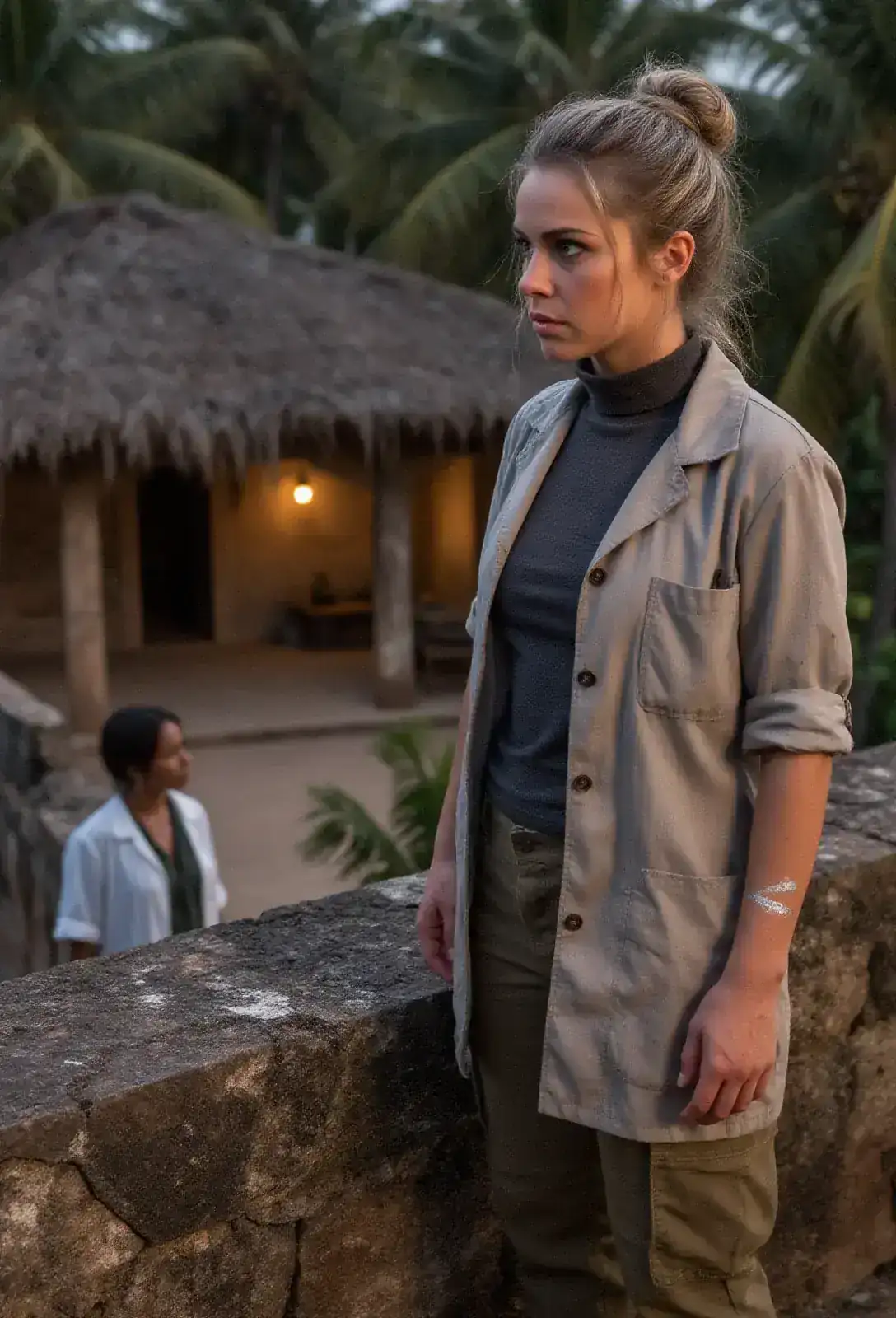
Far above, on the parapet, Maya stood at the merlon with her arms folded against the cold. She had been there the whole time. She had heard the deal. She did not, at this distance, react. She was good at not reacting. She had, this evening, watched a man play out a hand for her freedom.
She gave him, instead of a reaction, the smallest nod.
He went inside.
In the dungeon below the great hall the ankylosaurus was still, methodically, smashing his tail into the dungeon wall. A low pile of stone and mortar rubble had grown at his feet. Nick stood on the railed platform above the pit with his hands on the rail and watched.
“I know how he feels,” he said.
Maya joined him. They watched together for a moment. She had come down through the corridor without knocking. She stood close.
“They’re talking to each other,” she said.
“Who.”
“Achilles. The others. They have been calling all afternoon. From the isolation cages.”
He nodded.
“I told them where the embryos were.”
She turned her head.
“Nick. No. Why would you —”
“As soon as this demonstration is over, no matter how it goes, you are free to walk.”
“And you trust them?”
“No. But I’ll work for them.”
“How can you say that.”
“Mercenaries have existed all through history,” he said. “Like weapons. The only question is who’s using them and what for.”
She looked at him a long moment. She glanced up at the corner of the platform.
A wide-lens security camera looked down at them from the ceiling of the dungeon entry, its red LED a small steady dot in the half-dark.
She leaned in. She kissed him on the mouth, slow and full, and as she broke off the kiss she put her lips against his ear and her words were a whisper.
“Who do you think had that little girl kidnapped?”
He held very still.
He saw it.
Joyce in the loggia. The chair in Tangier. The violet cuff. The Colonel’s patches. World market, the Baron had said. Grendel had supplied the kidnappers for the demo. The two earlier dead employees. Isabel.
His stomach dropped the way Maya’s had dropped in the cage.
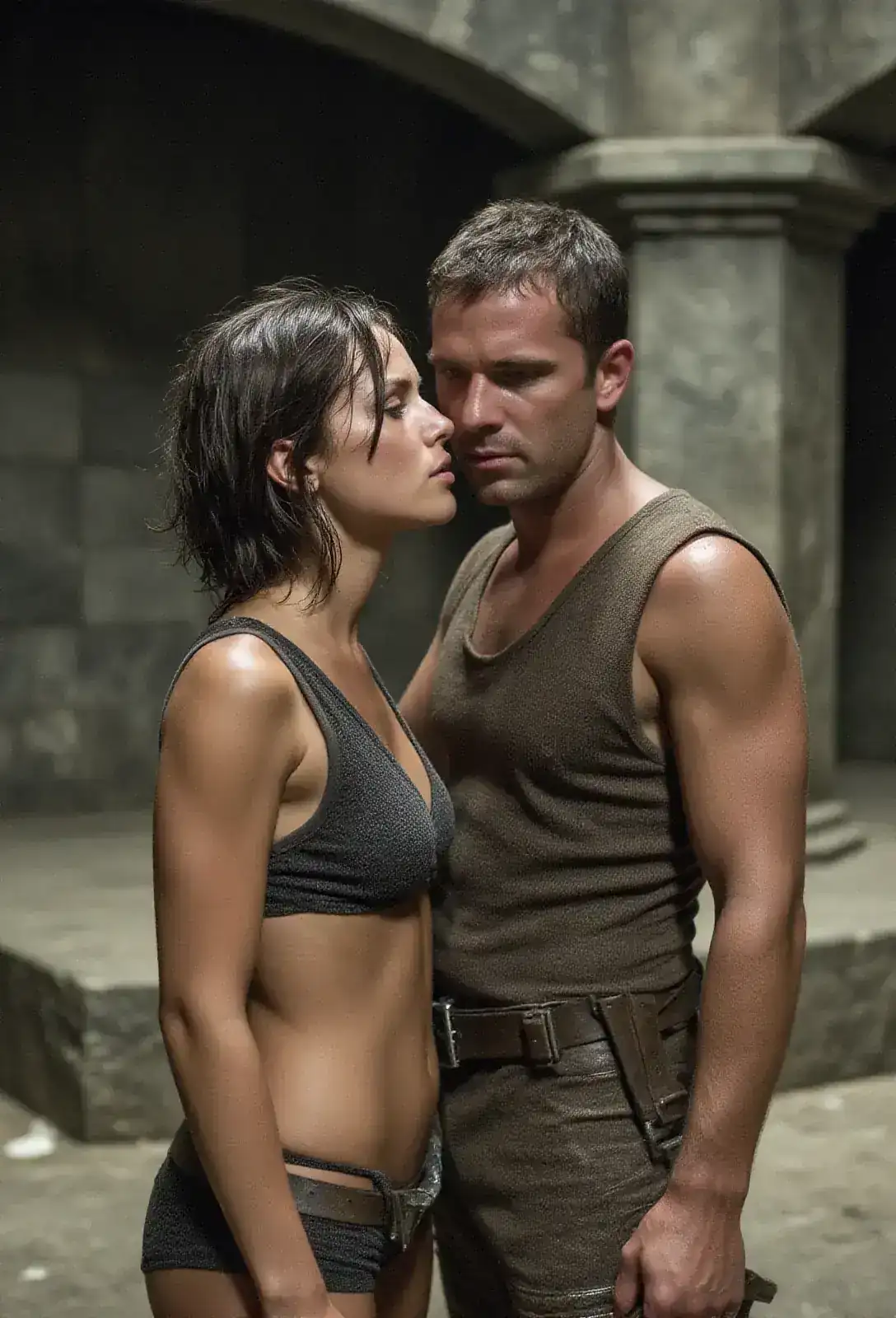
In the security room two floors above, a guard watched the camera feed and wrote, in his log, Lundberg-Harris contact, dungeon platform, evening. He had no audio on the feed. The whisper went unrecorded.
He saw only the kiss.
Down in the dungeon, the ankylosaurus pounded the wall.
Nick held Maya’s eyes a long second. Then he straightened. He stepped back. He looked, deliberately, at the camera.
He nodded at it.
Then he walked Maya out of the dungeon and up the corridor toward the cavern stairs, and he kept his pace slow and his face composed, and he did the small careful work of a man who had just been told the truth of his employer and had decided, in the quiet between one breath and the next, what he was going to do about it.
The fake had to be ready before morning.
He had, at most, eight hours.
He would use them.
In Maya’s lab, with the door closed and the cameras she had taught Sherman to disable for inventory checks disabled for an inventory check, they made the fake.
The fake required a Barbasol can, an aerosol of the kind they had at the maintenance cupboard, and the contents. They had a clean Barbasol can in a drawer, the second one Sherman had bought from a roadside service station outside Geneva four months ago, never opened. They had the aerosol from the maintenance cupboard. They needed contents. They needed contents that would not, on a quick visual inspection, be noticed as wrong, and that would, on a slower DNA inspection at the Grendel sequencing lab inside the next eight hours, not survive scrutiny.
“Frog,” Maya said.
“Frog?”
“The genome library has bullfrog and tree-frog samples. Hammond used frog DNA to fill out the dinosaur sequences in the original park. Sherman has the frog samples in the freezer next to the dinosaur samples. If somebody opens it and runs a sequencer they’ll get a hit on something amphibian, conclude it’s contamination from the original Park sequence, and try a different sample. They’ll burn through the eight tubes thinking they have a contamination problem before they figure out it’s a fake.”
“That buys us how long.”
“Six hours after they take possession of it. Maybe ten.”
“Ten.”
“Ten.”
He worked. She worked beside him. They made eight small ampoules of frog DNA in cell-suspension solution and labeled them with the same hand-stencil black marker the original ampoules had been labeled with, and they put the eight ampoules in the false bottom of the new Barbasol can. They sealed the false bottom. They aged the can with a wet rag and a smear of mud they had mixed from a potted dracaena on the windowsill and the spit-finger of a hand. They aged the label. They scratched the valve with a small file.
When they were done, the can looked like a can that had been buried in mud on a tropical island for fifteen years. The can was, by every visual measure, the can.
Nick weighed it in his palm. It was, on the gram, two grams lighter than the real can. He noted this. He filed it.
“That gives me something to do tomorrow,” Maya said.
“What.”
“Get the real one to Hammond’s man.”
“Overton has it.”
“Then get the real one to Hammond by way of Overton. Where is Overton.”
“Last I knew, watching Rodrigo’s bar in Mexico.”
“Then he is, by morning, watching Grendel’s tough guys take a fake out of Rodrigo’s freezer instead of the real one. We need to swap before they get there.”
“They are already on a plane.”
She looked at the clock. Six hours.
“Then we have six hours.”
He looked at her. He had not, in all the months at the castle, kissed her. Tonight he had been kissed by her, on a dungeon platform, in front of a security camera. He had been kissed for the cover of a whisper.
He kissed her without an audience this time. Slowly.
She broke the kiss.
“Six hours,” she said.
The clock above the door clicked through eleven into twelve. The fake can sat on the bench between them, two grams light, weighing exactly as much as their lives.