Champagne in the great hall, the Baron at the head, and Nick in the middle seat with his arm around the back of a chair he was not sure he wanted to be sitting in.
“Tonight, my friends, we have made history.”
The Baron lifted his glass. Joyce lifted his.
“To our victorious reptiles.”
Glasses. Drinks.
The Baron was as flushed as Nick had seen him. The video they had been watching on the great-hall screen, end-to-end footage from the three shoulder cameras synced for a final-cut highlight reel that had been edited, in the eight hours since the convoy had returned, into a piece of corporate marketing of the kind no corporate marketing department on the planet had ever made before.
“The video was thrilling,” the Baron said. “I felt I was in the room with them.”
“Be thankful,” Joyce said, “that you were not.”
“I think we are quite ready,” the Baron said, “to show our capabilities to the world market.”
Nick set the champagne flute down, half full. His arm did not, exactly, want it any more.
“Market.”
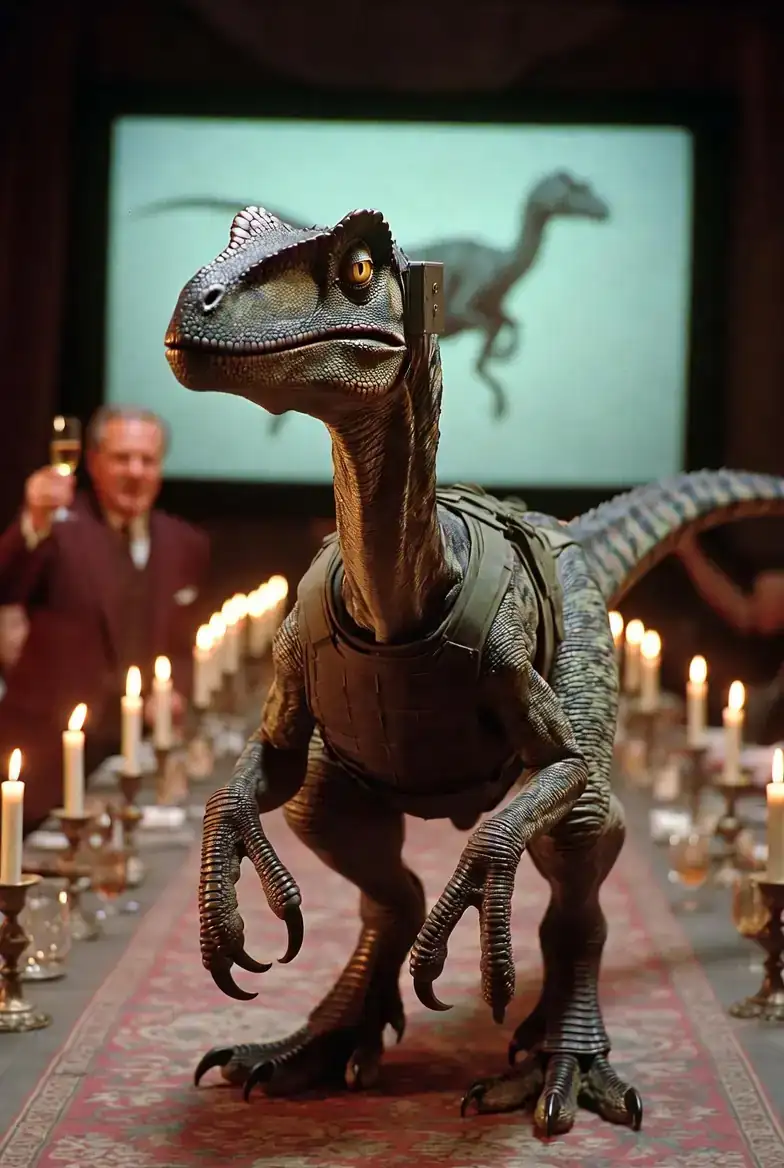
“There’s another mission we’ve been planning, Nick.” Joyce had drifted around to the side of the table. “On a larger scale.”
“And this time,” the Baron said, “several interested parties will be on hand to watch. Including a representative from your country’s Special Forces, Mr. Harris.”
“We want you on board, Nick.”
He looked at Joyce. He looked at the Baron. He looked, last, at Maya at the foot of the table, who was holding her glass without drinking and who was, by the line at the corner of her mouth, somewhere darker than the rest of the room.
“Do I have a choice.”
“I watched you out there,” Joyce said. He smiled the half-smile. “You were in your element.”
Maya looked up.
“It’s in your blood,” Joyce said.
The smile stayed.
The next morning Joyce had Nick in the strategy room before breakfast.
The strategy room had been redressed. The Tangier model was gone. In its place a topographical mock-up of an extensive jungle compound, the kind of model an intelligence service builds for a target it does not, in the official record, have. Checkpoints. Guardhouses. Barracks. Drug-processing buildings. A lavish hacienda-style central residence. A motor pool. A river behind it. A jungle wall around it.
“Pepe Aguilar,” Joyce said, “controls a large percentage of the heroin and cocaine moving out of Latin America. He has a private army, his own fleet of cargo planes, and here, at Cuchibamba, a state-of-the-art processing plant.”
“So bomb it off the map.”
“Aguilar also keeps several dozen prisoners in the compound. Kidnapped members of prominent families. Politicians from all the major and minor parties. And, most importantly, the President’s favorite niece. He’s way back in the jungle here. To make a surprise attack with the number of ground troops you’d need —”
“It wouldn’t be much of a surprise.”
“It is the perfect scenario for our very unique services. Penetrate their defenses and eliminate Pepe Aguilar.”
“Without hurting the hostages.”
“Naturally.”
“This isn’t a special-ops mission. It’s an invasion.”
Joyce nodded. “I suspect we’ll need the whole team this time.”
“All five.”
“All five. Plus.”
“Plus what.”
Joyce gestured toward the door of the strategy room.
“Come and meet the boys.”
Down in the cavern lab, in a wing Nick had not been in, two pairs of yellow eyes met him at the bars.
The Spitters.
They were the size of a large dog each, slender, with a dry mottled skin the color of chocolate-and-mustard and a frilled mantle that lay at the moment flat against the back of the neck. They were on the wrong end of a sniff. Their throats worked. The closer of the two had a small bolt-on regulator at the base of the skull, a thinner unit than the deinonychus carried, with a single LED that blinked yellow.
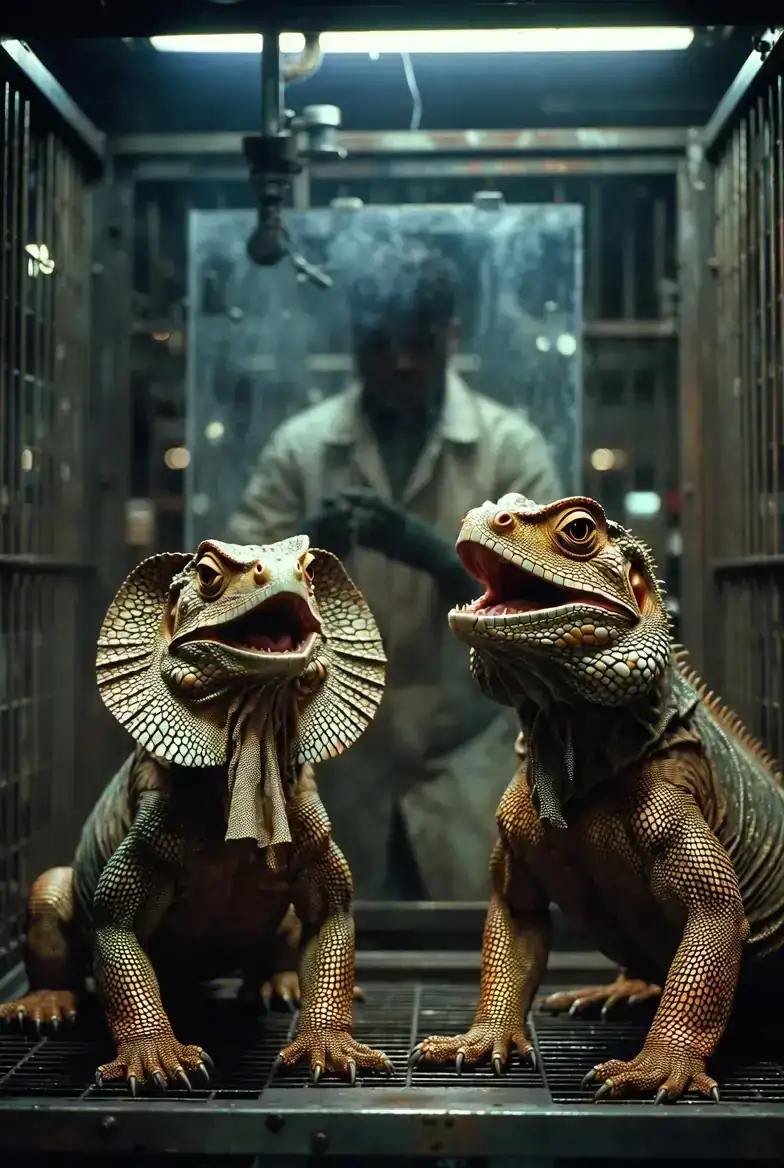
“These things were on the island,” Nick said.
“They seem to thrive underground,” Sherman said, who had appeared at the bars with a clipboard. “Hard to track them all down.”
“Were they bio-engineered.”
“Not to the extent the deinonychus are. But they’re relatively controllable. Chlamydosaurus sputori. Chlamydosaurus meaning frilled lizard, and sputori meaning —”
He flipped the plexiglas faceplate down on his safety helmet and took three steps toward the enclosure.
The Spitter at the front of the cage raised its frill in a sudden ratcheting motion that was, for a thing the size of a beagle, immediately wrong. The throat hawked. There was, briefly, the sound of a man clearing a deep wet cough.
CHHHHHHHHOK.
The plexiglas of Sherman’s faceplate took the splat full-on. A black mass the size of a man’s palm slid down the plastic in one slow oily slug and came to a stop, pulsing, at the chin guard.
“You get the idea,” Sherman said, behind the faceplate, calmly. “We’ve trained these spitters with the idea that there might be some tight spaces we need access to.”
Nick studied the Spitters a long moment.
“From now on they’re Casper and Pollux.”
Sherman wiped his faceplate clean with a rag.
“Which is which.”
“You’ll figure it out.”
The valley training facility had been redressed too.
In the previous two weeks, while Nick had been deployed to Tangier and back, the engineers had erected a half-scale facsimile of the relevant structures of the Cuchibamba compound on the valley floor. Two checkpoints. A guard tower. A barracks. A hacienda mock-up. The kind of thing the United States military built for itself in Nevada, for problems they were not yet permitted to admit they were going to solve.
Nick walked the mock-up at dawn with Maya behind him, her clipboard against her chest. Sherman trailed half a step behind her with two technicians. Joyce was at the guard tower checkpoint with binoculars. Zeiss was at the tower with another mercenary.
“This is a marketing demonstration,” Maya said, low.
“This is a marketing demonstration.”
“He doesn’t actually care if it works.”
“He cares,” Nick said, “that it looks like it works.”
She walked. He walked.
“And the buyers,” she said.
“Are coming. Several of them. By the look of the table-model briefing, including some governments that, on the record, don’t buy this kind of thing.”
“And the niece.”
“Is the headline,” Nick said. “She is the part of the brochure they will all read first.”
Maya stopped walking. She turned and looked at him in the wash of pale alpine light.
“Nick. You know I have been thinking about what Joyce said about who put Aguilar in business. Aguilar moves fifty percent of the cocaine out of South America. That is somebody’s market share. That is somebody’s distribution. The North African Liberation Front.” She blinked. “We have not yet talked, you and I, about who put Isabel Chartiers in that warehouse.”
He was about to answer. He did not, in the end, answer at the time, because the radio at his hip clicked and Sherman, behind them, was telling them that the buyers’ jet had cleared Geneva customs and would be in the canton inside the hour.
He nodded once at Maya.
He walked on.
That evening they ran the first full-team mock assault.
Casper and Pollux came out of the chute first, single file, with their flak vests on and their shoulder-mounted cameras live and Sherman muttering at the bio-meter readouts. The vests had been re-padded at the shoulder. The cameras had been swapped to the lighter mount Sherman had specced after the Tangier raid had banged the heavier one against a fire escape. Behind them came the five raptors, also in vests, also with cameras, and the formation, on the bank of monitors in the Humvee, was a thing to see — five bipedal predators in light body armor and two frilled trackers on the ground, moving in a wedge through scrub pine, the wedge tightening and loosening on its own.
“Send them out,” Nick said into the radio.
“You’d think the big ones,” Sherman said, “would just eat the little ones.”
“We threw a chlamydosaurus in with the big boys early on,” Sherman said. “They’ve got glands full of that toxin they expectorate.”
“The deinonychus were sick for days,” Maya said.
“I bet the spitter wasn’t too thrilled about it either,” Nick said.
In the woods, Casper stopped. The frill went up. He was inches from a tripwire two feet off the ground. The deinonychus stepped over the wire, careful, single-file. The Spitters dug under it, fast, sending the dirt up behind them.
The wedge reformed on the other side.
Joyce, on the tower, watched through the binoculars. He had a faint smile on him.
“Gentlemen,” he said into a radio that was not Nick’s, in a tone that was not the tone of a man addressing trainers. “I have something to show you.”
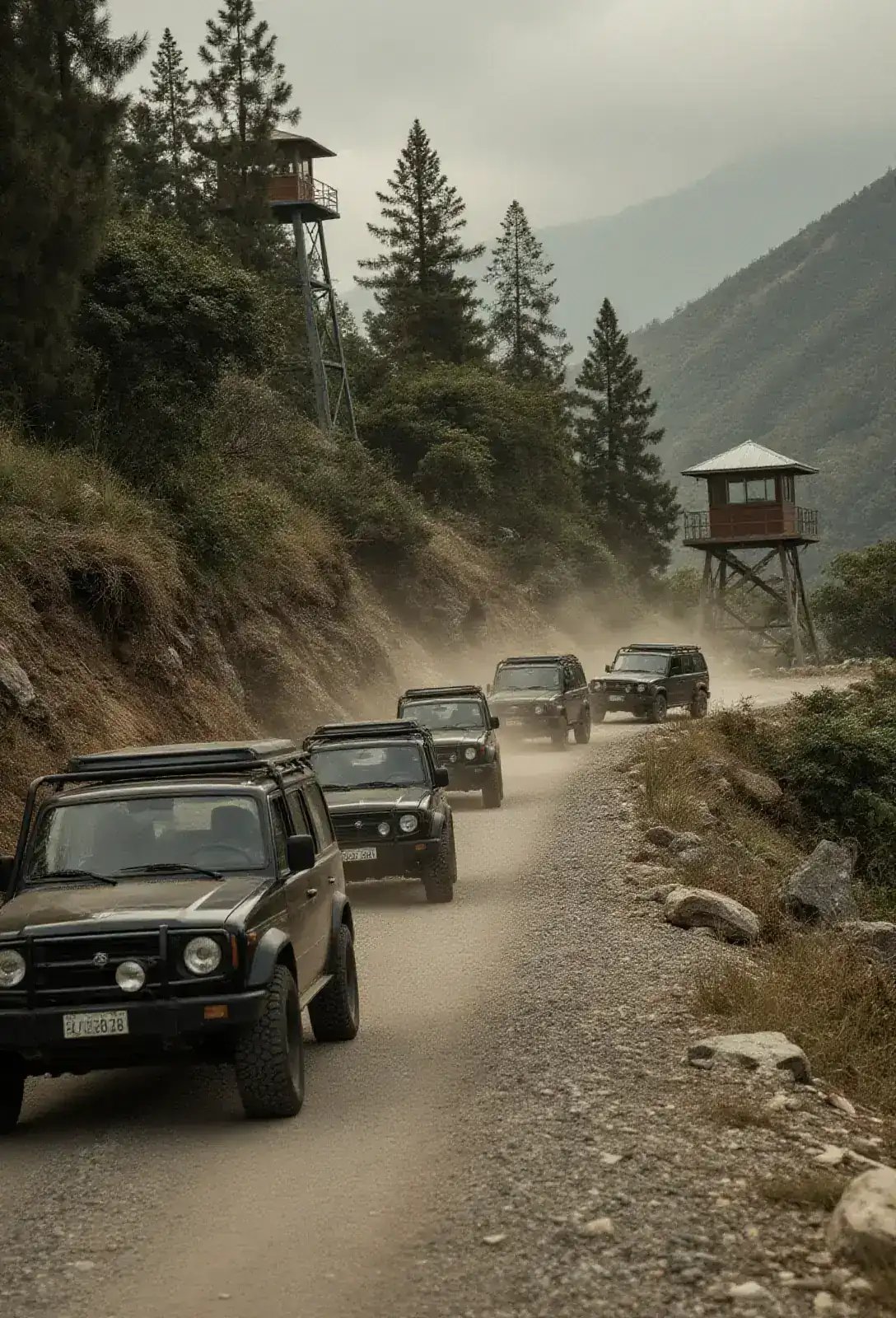
Up the road from the canton, a private convoy of black SUVs had come into the valley.
The buyers were here.
In the Humvee’s monitor, Spartacus paused at the edge of the practice village. He turned his head slightly. He looked, for a held second, into the camera that was on Hector’s shoulder.
He was, Maya saw, taking a count. He was reading the team. He was checking which of the four was where he had left them. The reading lasted three seconds and ended with a single small grunt that Sherman’s meter showed and the buyers did not hear.
She held the silence.
Beside her, Nick read it, and read her reading it, and they exchanged the small look two people exchange when a thing has been confirmed that neither of them has been, in front of witnesses, willing to confirm.
Spartacus was getting ready. So were they.
The buyers came up out of the SUVs slowly. They came up the way men come up out of vehicles when the men know that a great deal of money is in their pockets and that the day is being structured around them. Six men, three women. Five different cuts of suit. Three of the men had tactical advisors in the second SUV, men in plain dark gear with shoulder rigs and Bluetooth pieces in their ears, men whose job was to look at the guard tower and the practice village and the Humvee and write numbers in a notebook nobody else would see.
Nick recognized one of the advisors.
The recognition was small and unwelcome. The man had been a master sergeant in 2003 in a place neither of them had been admitted to be in, and by his haircut and the way he held his shoulder he was on somebody else’s payroll. He looked at Nick once across the valley. The look was the flat acknowledgment of two men who would not, in the next forty-eight hours, speak.
Joyce did the introductions. He made small bows. He was, in this mode, masterful. The Baron’s German was, when he switched languages, of the imperious-correct kind that bored some of the buyers and frightened others. Nick watched the buyers’ faces during the German and learned more about who would buy and who would not, in those forty seconds, than from any of the briefing slides.
The Russian observer was, by the cut of his jacket, somebody whose paychecks did not need to be deposited in any country he could name. The Russian observer kept a hand in the pocket of his coat the entire time.
There was a Saudi, an Israeli, a Pakistani, a Nigerian, two unaffiliated South Africans, and a Colonel in unmarked U.S. Special Forces khaki whose face Nick did not know but whose patches were the patches a man wore when he was on assignment from a unit that did not, on the public record, exist. The Colonel did not introduce himself. The Colonel shook Nick’s hand and held the hand half a second longer than a handshake, and his palm was dry, and his eyes had the weary patience of a man who had been to too many demonstrations of too many ways to kill people in too many countries.
“Mr. Harris,” he said, in a Texas Hill Country voice that had been worked on by years of professional rooms.
“Sir.”
“Quite a piece of work you’ve put together here.”
“I just train them.”
“Hell,” the Colonel said, “I’d settle for that.”
He moved on.
That night Nick stood at the slit window with his palms flat on the cold stone and worked the next move.
A deal with the Baron in the courtyard tomorrow. A location for the can. Not the real location. Something to bleed Joyce another two days.
And Maya. He was going to get her off this mountain.
He sat on the edge of the bed. He worked a crick out of his neck. He thought, for no reason, about a taco truck in a Pensacola parking lot in 1996.
Down in the cavern lab, somewhere through twenty feet of stone, Spartacus was awake.